


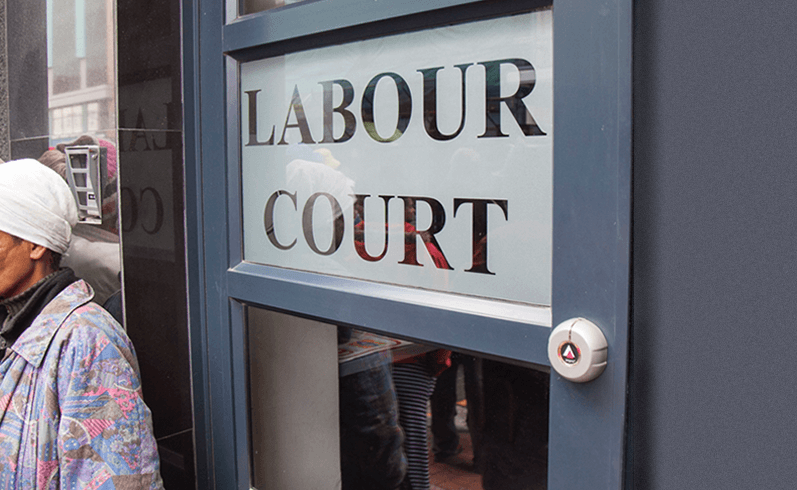
- Enoch Mgijima Local Municipality failed to overturn a ruling refusing its application for exemption from a 5.4% salary increase for municipal employees.
- The municipality blamed its financial difficulties on historical maladministration and allegedly inflated employee grading.
- The Labour Court set aside part of the panellist’s ruling that dictated how the municipality should structure its budget.
A municipality cannot rely on its own history of maladministration and poor financial management to escape its obligations to employees, the Labour Court in Gqeberha has found.
Acting Judge PN Kroon dismissed an application by Enoch Mgijima Local Municipality to review a bargaining council ruling that refused to exempt it from paying negotiated salary increases to its employees.
Municipality blamed financial crisis on historical mismanagement
The municipality approached the Labour Court seeking to overturn a ruling by a panellist of the South African Local Government Bargaining Council, which refused its application for a partial exemption from the three-year Salary and Wage Collective Agreement.
The agreement, concluded on 15 September 2021 for the period from 1 July 2021 to 30 June 2024, provided for a 5.4% across-the-board salary increase for municipal employees in its third year. Having complied with the agreement during the first two years, the municipality sought an exemption from clauses 6.6 and 6.7 for the final year, arguing that it could no longer afford the increases.
The municipality attributed its financial difficulties to historical maladministration, poor governance and allegedly inflated employee salary levels inherited following the merger of three municipalities.
It told the court that employees from the former Tsolwane and Inkwanca municipalities had, through industrial action in 2016, secured pay levels matching those of the former Lukhanji municipality. Further industrial action in 2018 and 2019 allegedly resulted in employees receiving salaries at even higher municipal grading levels.
The municipality said the resulting payroll burden had contributed to its financial distress, which included creditor liabilities approaching R1 billion and an Eskom debt of approximately R1.1 billion. It also argued that a new municipal administration should not be held responsible for decisions taken by its predecessors.
Employees should not pay for poor governance
Judge Kroon rejected the argument that a change in municipal leadership justified exempting the municipality. He found that an organ of state remained accountable for its actions regardless of changes in political leadership or administration.
The judge said it would be unfair for employees to bear the consequences of the municipality’s historical mismanagement. “The stark fact is that the Municipality itself is responsible for the perilous financial situation it finds itself in,” Judge Kroon said.
He added that the municipality was effectively seeking to transfer the consequences of its poor governance onto employees by withholding remuneration increases they were entitled to under the collective agreement.
The judge also questioned why the municipality had not taken earlier steps to challenge what it described as incorrect employee grading. Although the municipality maintained that the grading arrangements were unlawful, it acknowledged that the issue fell outside the bargaining council panellist’s powers.
Judge Kroon said the municipality could not rely on an allegedly unlawful administrative decision while it remained in force and had not been set aside by a competent court. He further emphasised that the appropriate way to address maladministration was through constitutional interventions, turnaround strategies and debt relief measures, rather than penalising employees.
Financial difficulties did not justify exemption
The municipality also argued that refusing the exemption could threaten jobs and worsen its financial position. However, Judge Kroon found that potential retrenchments had to be addressed through the processes provided for in the Labour Relations Act, including consultations under Section 189.
He said a municipality could not use an exemption application to bypass those procedures. The judge also considered the importance of collective bargaining, fairness to employees and the financial circumstances of the municipality.
He found that the bargaining council panellist had properly considered the relevant factors before refusing the exemption. The municipality had not demonstrated that the panellist committed a reviewable error or exercised her discretion improperly.
Panellist exceeded powers in budget directive
Although dismissing the municipality’s main challenge, Judge Kroon found that the panellist had exceeded her powers by ordering the municipal council to review and adjust its budget to prioritise employee salary increases.
The original ruling had directed the municipality to adjust its budget and obtain approval for those changes. Judge Kroon found that the directive unlawfully interfered with the constitutional powers of the municipal council, which is responsible for approving the municipal budget.
He explained that a panellist’s powers under the collective agreement were limited to granting or refusing an exemption and did not extend to dictating how a municipality should structure its budget.
The judge also found that the budget directive had been issued without being properly raised with the parties during the proceedings, denying the municipality an opportunity to address the issue. He said a decision-maker could not grant relief that had not been sought or properly canvassed.
Review application dismissed
In a judgment handed down on 30 October 2026, Judge Kroon dismissed the municipality’s review application, except for the challenge to the budget directive. The court ordered that paragraph 78 of the bargaining council ruling, which required the municipality to review and adjust its budget, be deleted.
The remainder of the ruling, including the refusal to grant an exemption and the directive to pay the negotiated increases, remained intact. There was no order as to costs.
Get your news on the go. Click here to follow the Conviction WhatsApp channel.
