


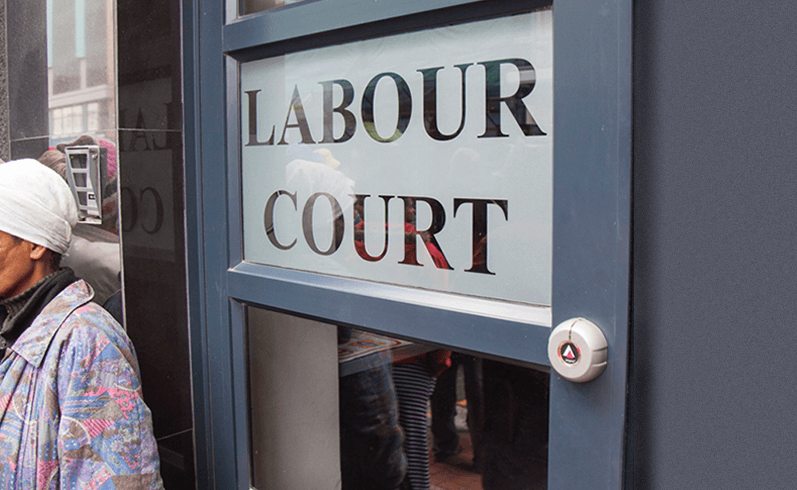
- The Labour Court says honesty in job interviews is required by law, not just good manners. Lying can get you fired, even if there is no financial loss.
- Fezile Hlangana lost his job after claiming he had no past disciplinary action, when in fact he had. The arbitrator and the judge both agreed that it was fair to fire him.
- The court said review hearings do not redo the whole case. They only check if the decision was reasonable, and here it was.
Fezile Hlangana went for a promotion to Head of Communications in the City of Cape Town. This department deals with land use and building plans for about 900,000 properties. The interview was done over Skype, and Hlangana got the job, starting in June 2022.
A few months later, in March 2023, Hlangana was charged with two things. First, he was accused of lying when he answered “no” to the question whether he had ever been convicted of any departmental or disciplinary action or was currently facing any. He knew he had been sanctioned before, including two findings of plagiarism. Second, he was charged with misrepresentation for not disclosing this record.
The director of the department started looking into his past after being unsatisfied with his performance. She said that if she had known about his disciplinary record, he would not have been in the running for the job. She also explained that four people in the department had been dismissed the previous year for dishonesty, and she did not want to take the risk with him.
Details of the case and the arguments
The whole case came down to whether Hlangana had tried to hide his past or if he just misunderstood the question. His defence was that the question had two parts and that when he answered “no,” he was only thinking about whether he was currently facing charges. He said he did not mean to mislead anyone.
A lot of the cross-examination focused on this point. The HR manager who had asked the question in the interview was pressed to admit that Hlangana was not lying about his current status. At one point, Hlangana’s representative said they wanted to call a language expert to explain the two-part nature of the question, but the arbitrator did not allow it, saying the issue was simple enough for everyone to understand.
Later, it was said that Hlangana only became aware of the first part of the question after seeing it in writing when he was charged. Hlangana also argued that his past misconduct was now “null and void” and did not need to be mentioned. He claimed the panel should have asked for more details if they wanted to know about previous disciplinary hearings and that he would have answered truthfully. He suggested it was up to the employer to get the full answer.
At the internal hearing, he had even blamed poor Skype connectivity for not hearing the first part of the question, but later admitted the whole question had been asked and said it was just the second part that stuck with him.
What the arbitrator decided
The arbitrator did not accept Hlangana’s defence, saying it “did not have a ring of truth about it.” He described Hlangana as a professional in communications who should have understood the question. The arbitrator said he should have given “a clear unconditional yes or conditional no.” He said the question was “phrased in plain language, even if it comprised two elements,” and that the answer “could have materially influenced the outcome of the interview.”
The arbitrator found it “more probable that he decided not to tell the whole truth about his disciplinary record.” He also pointed out that the City had a zero-tolerance policy for dishonesty and that any remorse from Hlangana “came too late.”
The arbitrator wrote, “employees needed to be bona fide and honest in their dealings with the employer, and that trust and confidence were fundamental to the employment relationship.” He called the debate over the two-part question “an artificial semantic issue” and said the question was “not unclear.” In the end, the arbitrator concluded, Hlangana “had simply not been truthful when he answered the question.”
The Labour Court review
Hlangana argued in the Labour Court that the arbitrator should have allowed a language expert and that being fired was too harsh. Judge R Lagrange disagreed, saying the issues were not “abstruse grammatical constructions or elaborate use of language.” The judge said these were simple matters that the arbitrator and the lawyers could handle on their own.
Judge Lagrange said the important question was whether the employer had made out a case that warranted dismissal for dishonesty, and that any other motives were not relevant. He found that Hlangana would not have been considered for the job if the interview panel had known about his full record. Even though there was no financial loss or reputational damage, the judge said the dishonesty was not minor. “The applicant obtained appointment to a job he would not have been considered for, had his record been known to the interview panel.”
The judge pointed out that Hlangana never really took responsibility for his answer and that “dishonesty involves deliberate deception.” He called the idea that the panel should have probed further “extraordinary,” saying it is not the employer’s job to extract the full answer.
Judge Lagrange summed up the case by saying, “the main difficulty the applicant has is to demonstrate that the arbitrator’s decision lay outside the bounds of what a reasonable commissioner might conclude.” He added, “it is just possible another arbitrator might have seen the magnitude of the applicant’s dishonesty in a less serious light, but that does not mean the arbitrator’s finding that it was serious enough to warrant dismissal is reviewable.”
The judge concluded, “I am satisfied the arbitration award is not one that a reasonable arbitrator could arrive at and the review application must fail.” The application was dismissed, and there was no order for costs.
Get your news on the go. Click here to follow the Conviction WhatsApp channel.


