


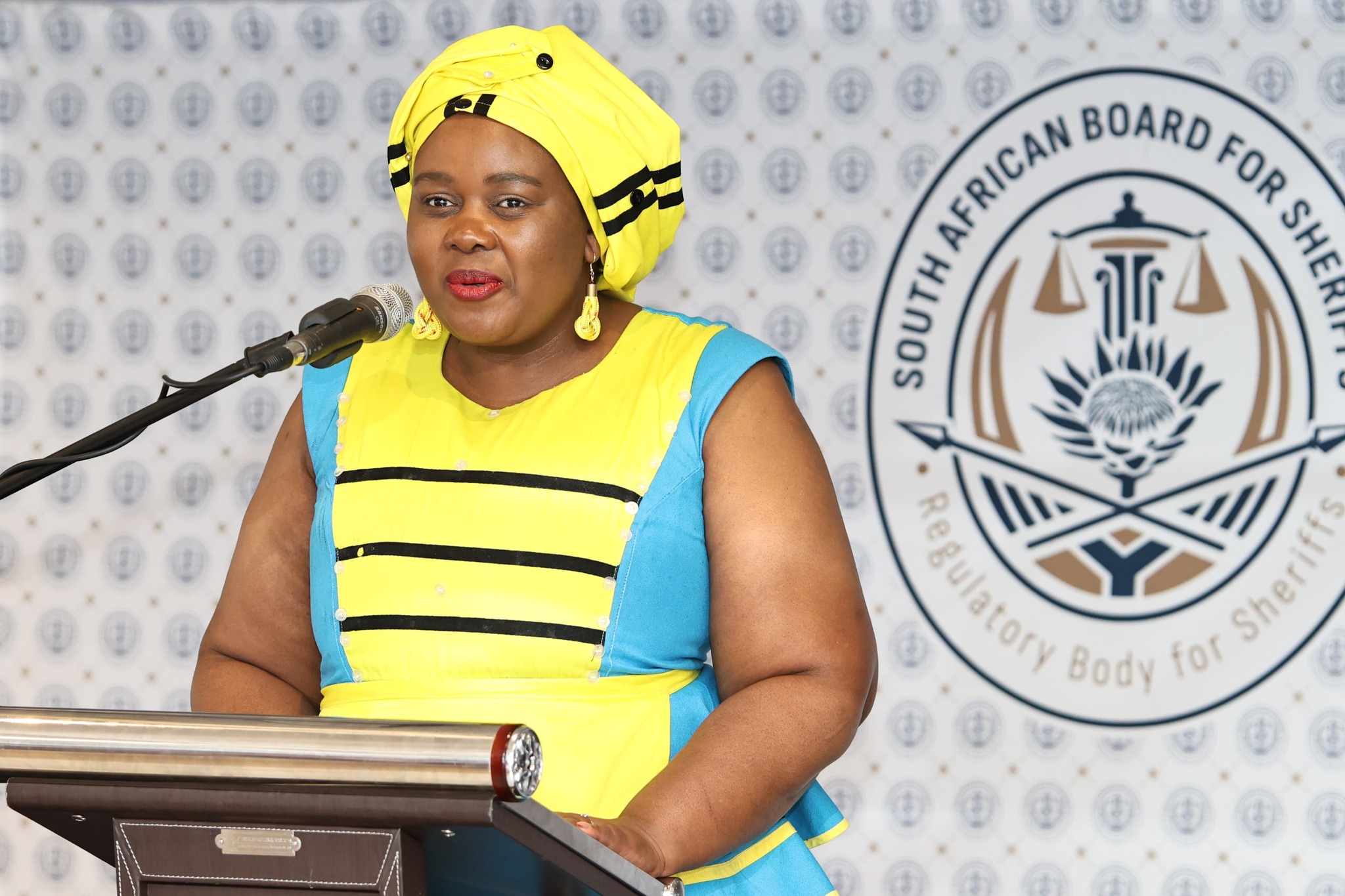
- Minister Kubayi champions women sheriffs as agents of justice reform, invoking South Africa’s legacy of resistance.
- Gender parity gains are noted but incomplete, with calls for deeper transformation in the legal system.
- A revised sheriff code of conduct is launched, reinforcing accountability and protection for vulnerable communities.
Minister of Justice and Constitutional Development, Mmamoloko Kubayi, delivered a compelling address at the South African Board of Sheriffs (SABFS) annual Women’s Day celebration on 29 August 2025, honouring women in the sheriff profession and calling for continued gender transformation in the justice system.
Reflecting on the struggle for women’s equality, Kubayi reminded attendees that power does not yield without effort. “It is only those who believe that it is not written in the stars that they are underlings, who take up arms and engage in a struggle for change,” she said, invoking the words of Nelson Mandela.
Drawing inspiration from the 1956 Women’s March, she highlighted how pioneers like Lilian Ngoyi mobilised women to demand change despite apartheid-era oppression, proclaiming, “You strike a woman, you strike a rock.”
The minister emphasised that almost 70 years later, women in South Africa still face structural disadvantages. Gender-based violence remains prevalent, women disproportionately experience poverty, and female unemployment continues to outpace male unemployment. In the economic sphere, self-employed women are largely concentrated in the informal sector while men dominate the formal sector.
Women sheriffs as agents of dignity and protection
For sheriffs, Kubayi stressed the importance of going beyond routine duties. “Every interaction you have with the public is an opportunity to uphold dignity, to protect the vulnerable, and to reinforce the rights guaranteed by our Constitution,” she said. Sheriffs must be sensitive to the realities of women, many of whom are survivors of violence, inequality, and poverty.
The minister noted progress in gender transformation within the judiciary and the sheriff profession. In 1994, only two female judges served across South Africa’s superior courts. Today, women occupy 121 of 252 positions in the Superior Courts, including leadership roles in six of the fifteen Superior Courts, the Constitutional Court, and the Supreme Court of Appeal. In the magistracy, women make up 54% of all magistrates.
In the sheriff profession, prior to 1994, women accounted for only 4.7% of the 465 registered sheriffs nationwide. Today, the profession includes 306 registered sheriffs, 75 of whom are female, and 836 deputy sheriffs, with 185 women represented. While progress is evident, Kubayi underscored the need for continued intentional recruitment, mentorship, and empowerment.
She urged women sheriffs to conduct themselves with integrity, demonstrate competence, and establish networks to ensure collective success. “You must not allow men to define how you should conduct yourselves as women in the profession. You don’t have to be masculine to succeed,” she said.
A new code, a renewed commitment to justice
The minister also highlighted the new code of conduct for sheriffs, emphasizing timely service of court processes, responsible handling of trust money, avoidance of conflicts of interest, and respect for public language preferences. These measures, she noted, protect the integrity of the profession and the broader justice system.
In conclusion, Kubayi invoked the words of Mama Winnie Mandela, reminding attendees of their moral responsibility to effect meaningful change for women who have long been marginalised. “Will you be able to live with that type of conscience?” she asked, challenging women in the profession to act decisively in advancing equality and justice.
Conviction.co.za
Get your news on the go. Click here to follow the Conviction WhatsApp channel.


