





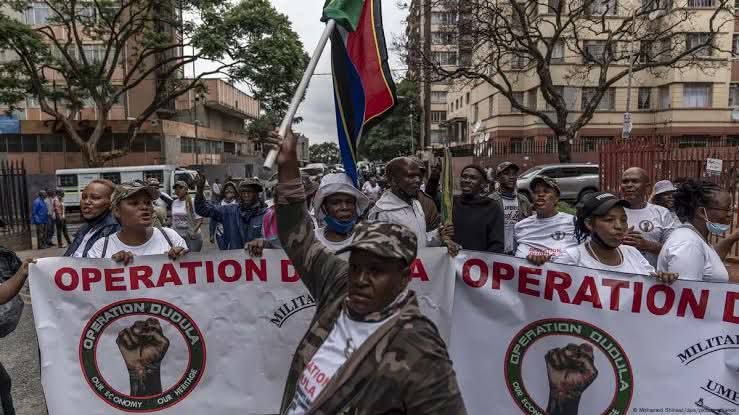
- The High Court affirms constitutional rights for all persons, including foreign nationals, living in South Africa.
- Operation Dudula was interdicted for coordinated hate speech, harassment, and intimidation against foreign nationals.
- The government is ordered to take concrete action against xenophobia, including implementing the National Action Plan and revising police procedures.
For years, foreign nationals in South Africa have lived in fear. Operation Dudula, a self-proclaimed civic movement, led a campaign of intimidation, eviction, and hate speech that swept through informal settlements, inner-city buildings, and trading stalls. Its members demanded identification from civilians, forced people from their homes, and incited violence both in public and online.
They wore military-style uniforms, staged raids without warrants, and acted without consequences. The state watched. The police stood by. The silence became complicity.
On 4 November 2025, the Johannesburg High Court broke that silence. In a ruling delivered by Judge LR Adams, the court declared the actions of Operation Dudula unlawful and unconstitutional. The ruling affirms that everyone in South Africa has the right to dignity, privacy, and legal protection, regardless of citizenship status.
“The fact that an individual is a non-citizen or undocumented does not mean that her or his basic human rights can be violated without consequences,” Judge Adams wrote. “That flies in the face of the founding provisions and values of our Constitution.”
The courage to confront
Four grassroots organisations brought the case; Kopanang Africa Against Xenophobia, the South African Informal Traders Forum, the Inner City Federation, and Abahlali baseMjondolo Movement SA. These groups are deeply rooted in the communities most affected by Dudula’s actions. Their affidavits described real harm.
They shared how Dudula members evicted foreign nationals from their homes and trading stalls, obstructed access to healthcare and education, and incited violence at public events and online. These were not isolated cases. They were coordinated, repeated, and carried out without remorse.
Operation Dudula did not challenge the application. Despite being served with court papers, its leaders openly stated they would ignore the proceedings. That refusal to engage with the judiciary was not defiance; it was contempt. It confirmed what the applicants had claimed all along, that Dudula operates outside the law, without accountability, and with the silent approval of a government that has failed to act.
The court barred Dudula and its leaders from demanding documents, harassing civilians, interfering with access to essential services, and inciting violence. It prohibited the use of military-style uniforms and ordered the organization to inform its members about the ruling. But the judgment went further. It held the government accountable.
The weight of history
Judge Adams referenced the government’s own National Action Plan to Combat Racism, Racial Discrimination, Xenophobia and Related Intolerance. He recognised that xenophobia in South Africa is racialised, systemic, and disproportionately targets black African foreign nationals. “Human dignity has no nationality,” he wrote, quoting a Constitutional Court ruling in Residents of Industry House. “The rights to privacy and dignity in the Constitution attach to ‘everyone’ and not just to citizens.”
He also mentioned the National Action Plan’s acknowledgment that apartheid-era racism fostered xenophobia and that Africans have become the primary victims of ongoing violence. “South Africa has, in the past and more recently, experienced widespread and violent forms of xenophobia resulting in deaths, injuries to people, as well as looting and destruction of property,” the plan states. The judgment lends legal weight to that assertion.
According to independent monitor Xenowatch, xenophobic violence between 2008 and 2021 caused at least 612 deaths, displaced over 122 000 people, and damaged more than 6 000 properties. Gauteng, where Operation Dudula is most active, accounted for nearly 40 percent of all recorded incidents. These figures may be understated. Many victims do not report attacks due to fear or a lack of trust in law enforcement.
The applicants accused the South African Police Service and the Department of Home Affairs of collusion or negligence. While the court did not find collusion, it criticised the SAPS for failing to investigate and prevent criminal behavior. The ruling reaffirmed that law enforcement must protect all residents of the Republic. It also directed the National Commissioner of Police to revise internal instructions to match the court’s interpretation of section 41 of the Immigration Act.
Get your news on the go. Click here to follow the Conviction WhatsApp channel.


