


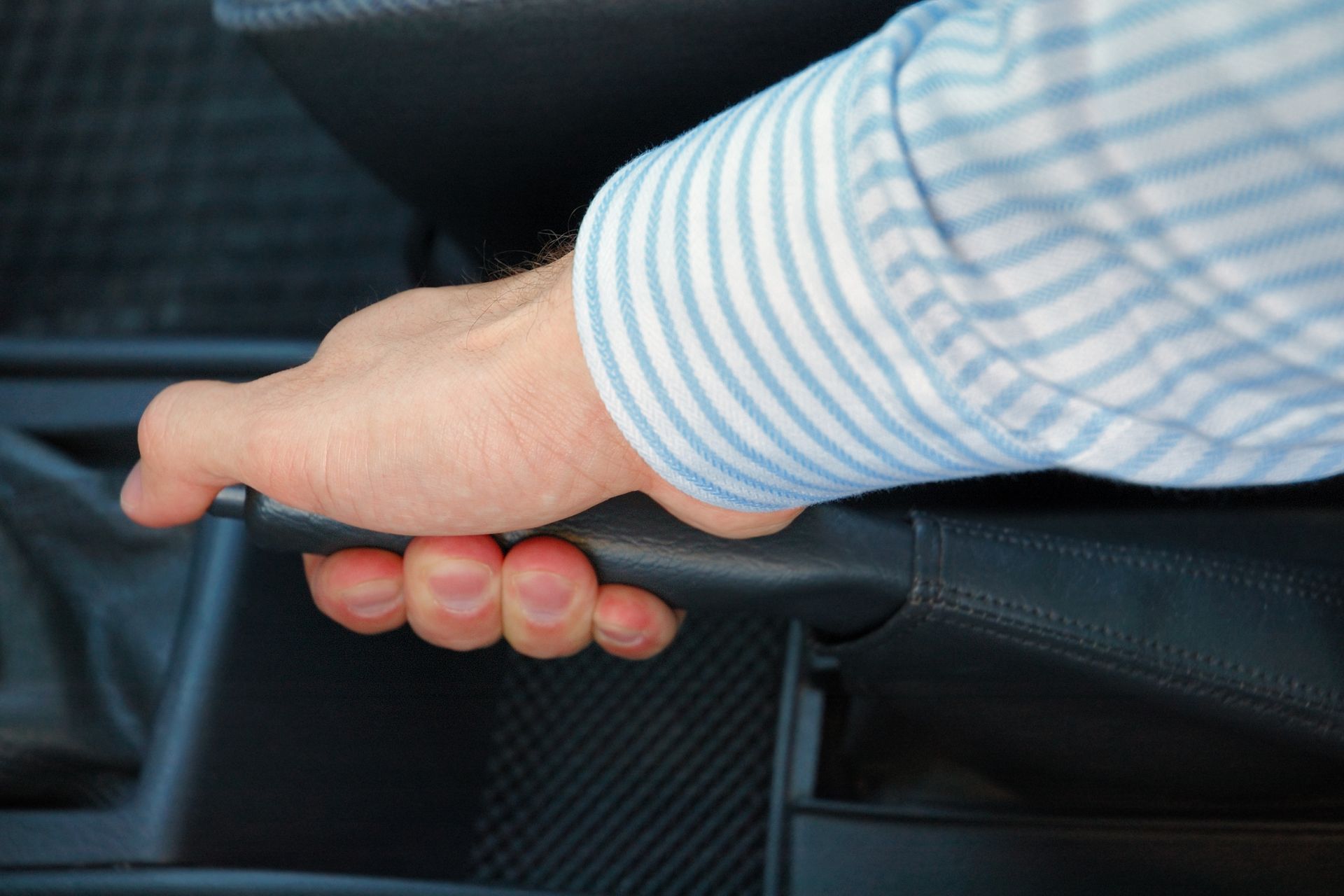
- Pulling a handbrake while a vehicle is moving can instantly destabilise the car and cause a crash.
- A passenger who interferes with key controls may legally be treated as the driver.
- The Road Accident Fund can be held liable if that interference causes injuries.
Rondene Charnay Jantjies was driving along Old Kulbaskraal Road in Malmesbury at around 60km an hour on a clear morning with quiet roads.
Zalium George Keating, her boyfriend and colleague, was seated in the passenger seat next to her. Keating was frustrated about being late for a computer examination and, without any warning, suddenly pulled up the handbrake.
Jantjies recalled nothing after that moment, waking up later in hospital with injuries to her legs, arm, spinal cord and face. An eyewitness who had been driving behind the vehicle confirmed that it simply left the road and overturned. Keating died at the scene.
The court found that Jantjies could have done nothing to avoid the collision once Keating pulled up the handbrake. It was satisfied that the collision was caused by his sole negligence.
Why the law treats this as taking control
The primary issue before the court was whether Keating, as a passenger who caused a collision by raising the handbrake, was a driver for purposes of Section 17(1) of the Road Accident Fund Act 56 of 1996. The RAF argued that Keating was not a driver and that it therefore bore no liability to Jantjies. Acting Judge AG Christians, sitting in the High Court in the Western Cape, rejected that argument.
Section 17(1) obliges the Fund to compensate any person for loss or damage arising from the driving of a motor vehicle where that driving was due to negligence or another wrongful act. The RAF Act defines a driver by reference to that same provision, which the court noted was unhelpful on its face and required careful interpretation.
The court began its analysis with the definition of driving set out in Wells and Another v Shield Insurance Co. Ltd and Another. In that ruling, the court said the following: “The word ‘driving’, as used in relation to the insured motor vehicle, means, ordinarily, in my view, the urging on, directing the course and general control of the vehicle while in motion and all other acts reasonably or necessarily incidental thereto.
“It would thus include, inter alia, the starting of the engine and the manipulation of the controls of the vehicle which regulate its speed and direction and also those which assist the driver and other users of the road, such as lights, traffic indicators, etc.”
The court also drew support from Road Accident Fund v Mkhize, where a judge stated that a driver is someone who propels a vehicle by manipulating its controls and is the person who can make it move or not as he pleases.
Judge Christians reasoned that this must equally cover acts that bring a vehicle to a stop or cause it to lose control. He observed that if Jantjies herself had lifted the handbrake and caused the vehicle to overturn, no one would dispute that this formed part of her driving. The question was whether anything changed simply because the act was performed by Keating from the passenger seat.
The court found that it did not. It drew an analogy with the Canadian case of Belanger v The Queen, decided by the Supreme Court of Canada, where a passenger who grabbed the steering wheel of a police cruiser was found to have taken control of the vehicle for the brief period during which he held it. Richie J, writing for the majority, held as follows.
“The fact is that the police cruiser was driven from its own lane directly into the lane reserved for approaching traffic because the appellant had deliberately grabbed the steering wheel and taken control from the hands of the constable.
"Under these circumstances, with the greatest respect for those who hold a different view, I am of opinion that for the brief period during which the appellant assumed control, he was solely responsible for the dangerous driving of the cruiser and he was for those few moments ‘one who drives a motor vehicle on a highway in a manner that is dangerous to the public’ within the natural and ordinary meaning of those words.”
Judge Christians found this reasoning persuasive and directly applicable under South African law. He concluded, “It seems an artificial distinction to draw a line between a steering wheel and a handbrake when, in reality, a person who takes control of either of these mechanisms effectively seizes control of the vehicle itself.”
The liability of the Road Accident Fund
The court held that Keating, by lifting the handbrake, became the driver of the vehicle for the purposes of section 17(1) of the RAF Act. Because the collision was caused by his negligent driving, the RAF was obliged to compensate Jantjies. The RAF was ordered to pay 100 percent of its proven or agreed damages.
The court also addressed what would have happened had Jantjies’s vehicle struck a pedestrian. On the RAF’s argument, the pedestrian would have had no claim against the Fund at all. Judge Christians found that result incompatible with the purpose of the RAF Act, which exists to ensure that victims of negligently caused motor collisions can be compensated. He found no principled reason to treat Jantjies differently from such a pedestrian, since she too was a victim of conduct that stripped her of control over her own vehicle.
Why this matters
The court was careful to limit the reach of its reasoning and noted that not every negligent act by a passenger will suffice. Judge Christians said, “Lest I be misunderstood, my reasoning in no way suggests that any negligent act by a passenger that results in a collision will justify a claim for compensation against the RAF. If, for example, a passenger plays the fool and obstructs a driver’s vision while the vehicle is in motion, and thereby causes a collision in some way or another, such a passenger cannot, based on my judgment, be said to have taken control of the vehicle.”
The decisive factor is whether the passenger’s conduct directly determined how the vehicle moved. Keating’s act of pulling the handbrake met that threshold. The court noted that the legal question before it was novel and not uncomplicated, and that counsel for Jantjies had made compelling oral submissions and assisted the court with useful analogous authorities. Costs were awarded on Scale B.
Get your news on the go. Click here to follow the Conviction WhatsApp channel.


