


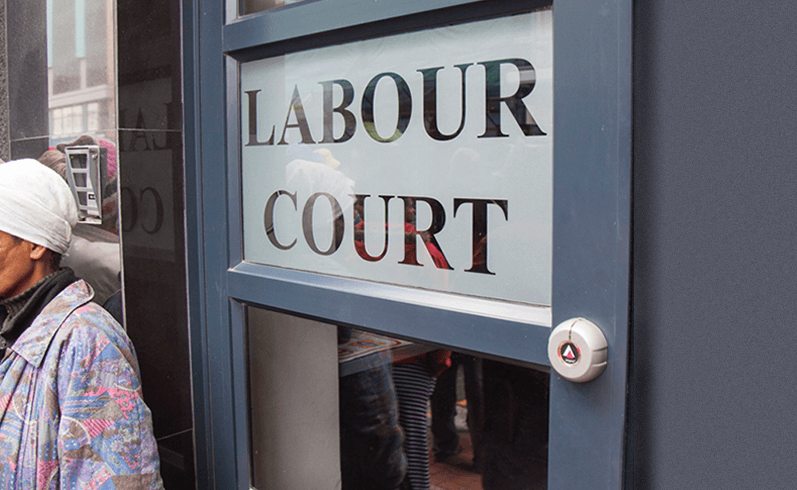
- A senior North West government engineer has won an urgent Labour Court order halting disciplinary action against him.
- An independent arbitrator will first determine if the case should be handled under whistleblower protections.
- The judge found that exceptional circumstances justified urgent intervention.
A senior engineer at the North West Department of Public Works and Roads has stopped disciplinary proceedings against him with an urgent Labour Court order. An independent arbitrator will now decide if his claims qualify as whistleblowing under the Labour Relations Act.
Peter Tebogo Jonker argues that the disciplinary charges were brought because he disclosed what he believed were irregularities involving fuel procurement and the management of the department's vehicle fleet. He says those disclosures are protected by law.
The department disputes that claim and maintains the disciplinary action is based on alleged misconduct, not whistleblowing.
Concerns raised over fuel procurement
Jonker has been the department's Chief Mechanical Engineer since April 2020. He oversees government vehicles and equipment, as well as fuel management and procurement. He told the court that his troubles began in 2022, after a new Head of Department was appointed.
According to Jonker, he was told to assist a private fuel supplier and later asked to support changes to the department's fuel supply arrangements. He said he refused to recommend cancelling an existing National Treasury contract in favour of a specific supplier.
Jonker claims that, after raising concerns, several of his responsibilities were removed. He later reported the matter to senior officials, the Hawks and the Special Investigating Unit, saying he believed there had been irregular conduct.
The department continued with disciplinary action
In January 2026, Jonker was informed that he would face disciplinary charges, including accusations that he made false and defamatory statements about senior officials.
He then invoked Section 188A(11) of the Labour Relations Act, which allows an employee who believes disciplinary action is linked to protected disclosures to request that the matter be heard by an independent arbitrator.
The department declined that request and decided to continue with its internal disciplinary process, prompting Jonker to approach the Labour Court on an urgent basis.
Judge finds urgent intervention justified
Justice T Gandidze found that Jonker would lose the benefit of the statutory process if the disciplinary hearing went ahead before the General Public Service Sector Bargaining Council decided whether there should be an independent inquiry.
Justice Gandidze said, "He has elected to exercise a right afforded to him in terms of Section 188A(11) of the LRA, and he is entitled to make that election. Jonker cannot obtain substantial redress in due course."
The judge also made it clear that the court was not deciding whether Jonker is, in fact, a protected whistleblower. Instead, the immediate question was whether he had acted in good faith when claiming that the disciplinary process was linked to his disclosures.
Justice Gandidze said, "There is no obligation on an employee who seeks to rely on Section 188A(11) to prove that the holding of the disciplinary hearing constitutes a contravention of the PDA. Rather, what is required is that the employee alleges in good faith that the holding of an inquiry does so."
An independent arbitrator must decide first
The court found that if the disciplinary hearing went ahead, Jonker could be permanently denied the independent process provided by the Labour Relations Act.
Justice Gandidze said, "Once the disciplinary hearing is completed, the outcome cannot be reversed. That harm is irreparable."
The judge also found that the department would suffer little prejudice by waiting because no witnesses had yet testified, and it would still be able to pursue disciplinary action if Jonker's request was ultimately rejected.
The court further said an employee who alleges, in good faith, that disciplinary action is being taken because of protected disclosures demonstrates exceptional circumstances that justify the Labour Court's intervention while the independent process runs its course.
Order
The Labour Court ordered that the department's disciplinary proceedings be suspended until an arbitrator appointed by the General Public Service Sector Bargaining Council decides whether the matter should proceed under section 188A(11) of the Labour Relations Act.
If the arbitrator accepts the referral, the department's internal disciplinary process will come to an end and the allegations will instead be heard by the independent arbitrator. If the referral is rejected, the department may resume its disciplinary hearing.
The court made no order as to costs.
Get your news on the go. Click here to follow the Conviction WhatsApp channel.


