


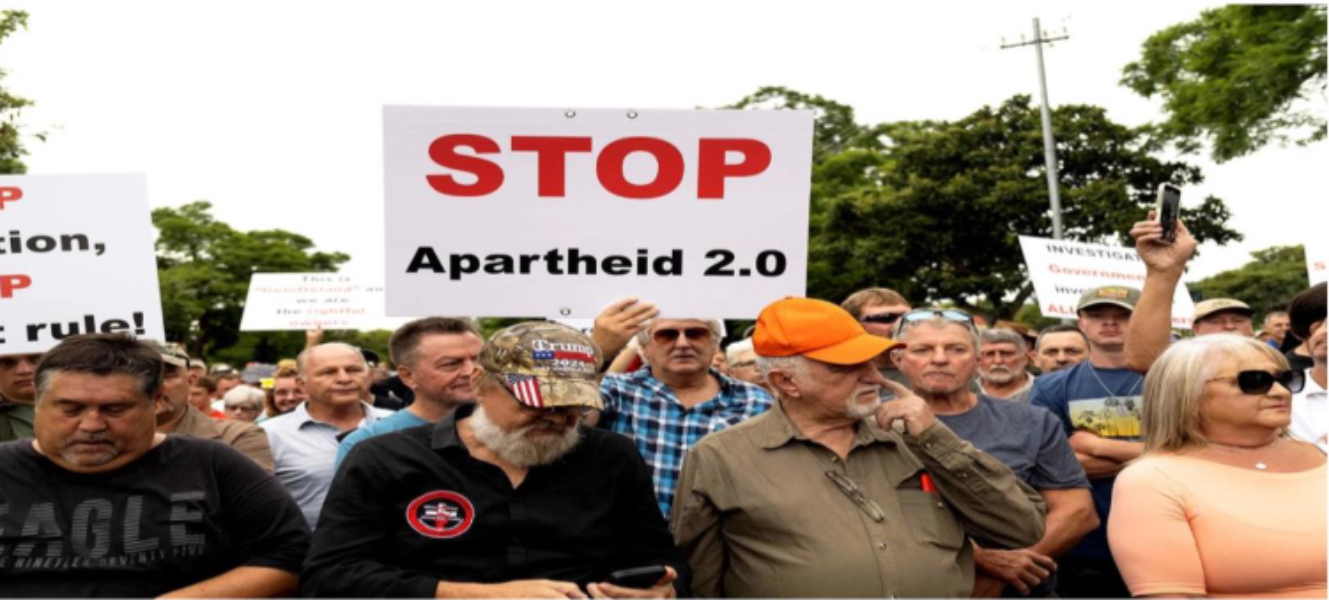
The recent arrival of over 3,000 white South Africans into the United States under Trump’s white refugee resettlement programme is a racial spectacle of historic proportions.
The programme repackages whiteness as victimhood while reasserting racial hierarchies through the veneer of humanitarian concern. Cheryl Harris’s seminal concept of “whiteness as property” is especially instructive here: this programme protects not the displaced, but the entitlements embedded in whiteness—land, social status, and the right to global mobility.
These arrivals, facilitated under a controversial, fast-tracked refugee resettlement scheme, mark the first time in US history that white South Africans have been accepted en masse as refugees. Framed by Trump as a rescue mission from “racial discrimination” and even “genocide” in post-apartheid South Africa, the programme has drawn intense scrutiny and outrage from both sides of the Atlantic.
Politicising Protection: Trump’s refugee gambit
International Relations Minister Ronald Lamola, speaking in Pretoria, described the claims as “unfounded and inflammatory.” He clarified that the United Nations High Commissioner for Refugees was not involved and had consistently found no basis for refugee status for white South Africans. “The resettlement of South Africans under the guise of being ‘refugees’ is a political project to delegitimise our democracy,” Lamola asserted.
The myth that white South Africans are victims of racial persecution, particularly Afrikaner farmers, has long circulated in far-right echo chambers, sustained by groups like AfriForum and amplified by conservative American media. However, no credible human rights body has substantiated claims of systematic violence or oppression based on race in South Africa.
In February 2025, Trump signed an executive order, Addressing Egregious Actions of the Republic of South Africa, suspending non-essential aid. He cited South Africa’s land reform and its support for Palestine at the International Court of Justice. Trump’s language echoed apartheid-era rhetoric cloaked in refugee discourse, framing land expropriation without compensation as proof of “anti-white discrimination.” Evidently, this is not a story about humanitarian rescue but rather about the repackaging of privilege as persecution.
Legal contortions and the repackaging of privilege
Trump's administration, through reclassifying specific “South African communities” for humanitarian parole, has revived the settler-native divide, as noted by Mahmood Mamdani, casting descendants of apartheid's beneficiaries as “refugees” and South Africa as the oppressor. This narrative, as Achille Mbembe would argue, reinforces a global humanism that renders Blackness invisible while privileging whiteness as a passport to refuge and legitimacy. Consequently, while Black refugees languish, whiteness is deemed inherently worthy of protection, effectively enacting a form of apartheid within the asylum system itself.
The 1951 Refugee Convention defines a refugee as someone who is outside their country of nationality due to a “well-founded fear of persecution” and who is “unable or unwilling to return.” But neither the Convention nor US law has ever interpreted that to include the loss of economic dominance or historical privilege. Fleeing land redistribution or reduced social status does not amount to persecution, especially when these changes are legally enacted in a democratic society seeking to redress historical injustice.
As early as 1932, the US-sponsored Carnegie Commission published the “Carnegie Poor White Study”, a report that analysed the problem of “poor whites” in South Africa. This initiative was not rooted in concern for poverty as such but in preserving white supremacy in South Africa. The report warned that poor whites posed a threat to the racial order and recommended state interventions to uplift them, while Blacks were systematically excluded from similar support. It laid the foundation for apartheid's white welfare system and established a pattern of American intervention when white South Africans faced hardship, real or perceived.
This historical precedent now finds its twenty-first-century expression in Trump’s so-called refugee resettlement. The pattern is consistent. White South Africans are framed not as former beneficiaries of a violent racial order, but as victims of transformation, worthy of rescue. Nevertheless, arguments for refugee status based on a perceived loss of historical dominance or economic advantage do not align with the established legal interpretation of “persecution” under the Refugee Convention, which focuses on threats to fundamental human rights.
Moreover, as South Africa’s Constitutional Court recently affirmed, acquiring foreign nationality, also possibly through refugee resettlement or otherwise, does not automatically strip someone of South African citizenship. In a landmark ruling, the Court struck down a section of the Citizenship Act that had quietly revoked citizenship without due process, calling the move irrational and unconstitutional. The ruling emphasised the right of South Africans abroad to participate in politics and freedom of movement.
The question of whether white South Africans granted refugee status in the US will lose their South African citizenship is complex. The Refugee Convention focuses on the reasons for seeking refuge, which are distinct from citizenship, governed by national law. However, the case of these 49 individuals is based on false claims and a political agenda by the Trump administration. Therefore, due to these unique and arguably disingenuous circumstances surrounding their refugee status, South Africa may have grounds to revoke their citizenship by arguing that accepting the US offer could be seen as a voluntary renunciation. Consequently, the recent Constitutional Court ruling on dual citizenship might not be sufficient to prevent this potential loss in this politically charged context.
The myth of the dispossessed Afrikaner and the racial economics of migration
At the heart of this narrative is a stubborn myth: that white South Africans are now victims of the very state they once ruled. Trump has weaponised this myth, presenting white Afrikaners as symbols of civilisation under siege. Yet as journalist Max du Preez notes, the idea that white South Africans are oppressed in their own country is not just “absurd,” it is offensive to the millions of Black South Africans who continue to suffer the real legacy of apartheid, including landlessness, poverty and unemployment.
The outrage in South Africa is therefore justified. Land expropriation without compensation is a constitutional measure designed to address historical injustices. It does not amount to racial targeting, but to a long-delayed effort to restore dignity and equity to the dispossessed majority. That the US would characterise this as persecution reveals how deeply entrenched racial bias remains in its foreign policy priorities.
Nowhere is this hypocrisy more glaring than in the American South. In the heart of the Mississippi Delta, reported the New York Times, a group of six Black farmworkers filed a federal lawsuit in 2021 after being replaced by white South Africans brought in under the H-2A visa programme. The lawsuit alleges that these workers were forced to train their replacements, who were then paid more, housed better and elevated in status simply because they were white. Between 2011 and 2020, the number of South Africans on H-2A visas increased by 441%, making them the second-largest national group in the programme. The majority are white.
Black American workers, many descended from enslaved people who built Southern agriculture, remain underpaid and sidelined. The plaintiffs in the Mississippi case earned just US$ 7.25 per hour, while white South African guest workers were paid over US$11. And although the law requires equal pay for domestic and foreign workers, that legal fiction has long been ignored in practice. The Pitts Farm Partnership, one of the named defendants, has declined to comment.
The message is clear: in the racial calculus of American capitalism, white foreign labour is worth more than Black American lives. Mexican seasonal labourers, once the backbone of US agriculture, are also increasingly excluded, both by border walls and by labour policies that privilege whiteness over need. The result is a reshuffling of the global racial order, disguised as economic necessity. This whitening of America is in full swing as Trump appears to champion nuovo Jim Crow laws, or Apartheid 2.0.
As David Theo Goldberg has argued, racial states organise public policy around preserving whiteness. In this case, public and private capital are being mobilised to protect white rural identity under the guise of refugee resettlement.

Disguised humanitarianism and the global colour line
Princy Mthombeni puts it bluntly: “Behind this historic moment lies a deeper, uncomfortable truth, one that exposes the cracks in America’s moral compass and reveals a tale of privilege disguised as persecution.” From the Cold War to the present, America’s relationship with South Africa has been marked by hypocrisy. In the 1980s, it tolerated apartheid. In 2025, it rolls out the red carpet for white South Africans while Black South Africans are still waiting for the land they were promised. This is not humanitarianism, but rather racial preference disguised in legal language.
This resettlement scheme does not serve the most vulnerable but privileges those who already belong to a global elite by race and heritage. White South Africans admitted as “refugees” are not fleeing statelessness or systemic persecution: many have long benefited from structural advantages rooted in apartheid. That they are framed as deserving victims reflects a global racialised asylum regime that continues to uphold whiteness as the default marker of legitimacy, distorting refugee protections when those closest to historic power are granted sanctuary over those who are genuinely displaced.
Meanwhile, truly persecuted populations, be they Rohingya, Sudanese or Palestinians, remain confined to refugee camps, blocked by bureaucratic hurdles or vague “security threats.” They meet reinforced borders, not resettlement offers. These double standards reveal how politics and prejudice have hijacked the international protection system. Trump’s South African refugee programme is less about humanitarian concern and more about reaffirming a hierarchy of global suffering, where privilege continues to mask itself as victimhood.
What we are witnessing is the reinforcement of a global colour line, where whiteness retains its claim to mobility, safety, and opportunity. At the same time, Blackness and brownness are rendered threats to be contained. The Trump administration has made this line more visible, more brazen. White South Africans were never supposed to be refugees in the first place, but settlers, beneficiaries of conquest, the “civilised” face of African colonisation.
The fact that white South Africans, supported by the Democratic Alliance, Afriforum and global racial supremacists, invoke the language of the displaced, while simultaneously displacing others, reveals not vulnerability but a strategic repackaging of dominance. The implications are profound: refugee systems that prioritise whiteness over need, economic visas favouring white foreign farmers over Black citizens, and historical privilege purposely mistaken for victimhood are not humanitarianism, but neo-colonialism in motion.
Who gets to be a refugee?
Mamdani, Harris, Goldberg and Mbembe all remind us of that liberalism’s claim to universality collapses under scrutiny of race. As the world watches Trump engineer the next stage of global apartheid, we must ask: What kind of refugee is it when only the privileged are welcome? When the persecuted are those invited to share power, not those denied it? When does skin colour ration citizenship, safety and opportunity? These are the questions now facing the United States and the international community. If the notion of “refuge” is to mean anything, it must centre justice, not historical comfort. It must respond to need, not nostalgia for lost power.
Ultimately, the arrival of 49 Afrikaners in the US is not a humanitarian act, but a reallocation of global white privilege. This action draws parallels to historical and contemporary examples of racialised asylum systems, such as Israel’s Nation-State Law, which prioritises (white) Jewish refugees, and Australia’s former “White Australia” policy. It reveals how refugee law, international aid and labour migration remain trapped in a racial logic that prioritises whiteness even in the guise of compassion. And it forces us to ask: Whose lives count when borders open? Whose futures are worth protecting? And whose stories are erased in the name of humanitarianism?
Si ya yi banga le economy!
#Conviction
Get your news on the go. Click here to follow the Conviction WhatsApp channel
