


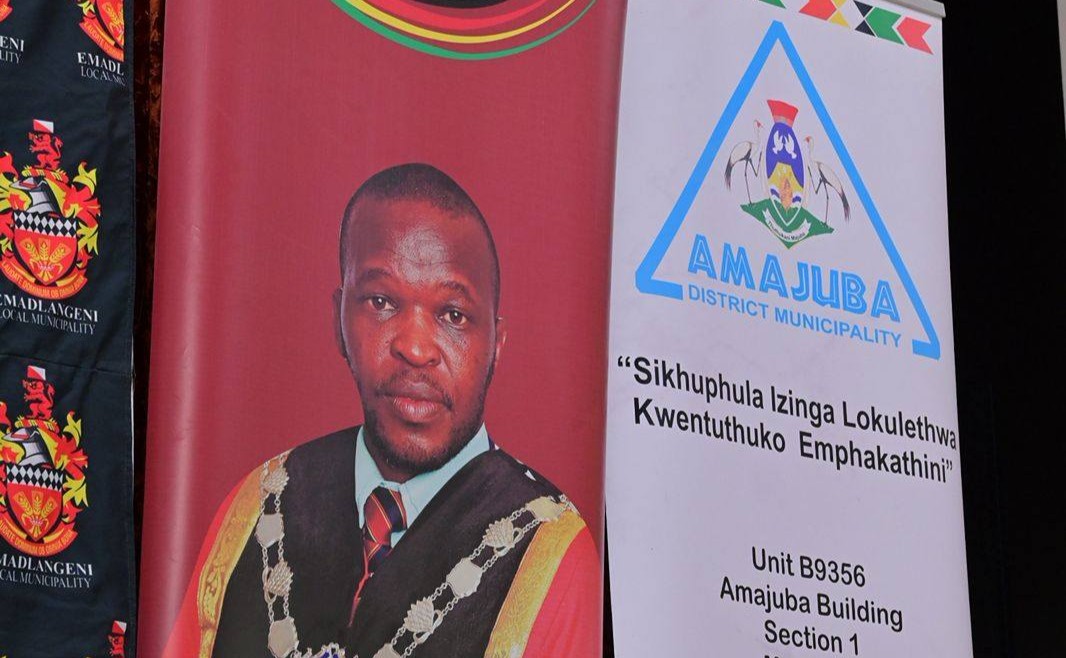
- Court confirms the 20 May 2025 council meeting was unlawfully conducted after councillors were denied access and the sitting was moved without notice.
- Election of the mayor and deputy mayor is set aside, restoring the status quo before the disputed meeting.
- Municipality ordered to pay costs, including the costs of two counsel, after failing to justify police exclusion and quorum compliance.
The High Court in Pietermaritzburg has set aside the election of the mayor and deputy mayor of the Amajuba District Municipality, finding that the meeting at which they were elected descended into chaos, excluded councillors unlawfully and proceeded behind closed doors in breach of the law.
Judge PC Bezuidenhout confirmed a rule nisi granted in May 2025, declaring the 20 May council meeting and all decisions taken there invalid. The ruling restores the position that existed before the disputed sitting, leaving the mayoral post vacant and returning the deputy mayor to that role pending a properly convened election.
The case was brought by 13 councillors led by Ally Khoza after a deeply contested council meeting intended to elect new leadership. The background to the dispute lies in the resignation of then-mayor Prince Ndabukho Zulu in December 2024, after which Deputy Mayor Thembelihle Elvis Mthembu acted as mayor.
In May 2025, a majority of councillors petitioned the speaker in terms of Section 29(1) of the Municipal Structures Act to convene a special meeting to consider a motion of no confidence and to elect a new mayor. That request was ignored. Instead, the speaker later issued a notice calling a special meeting on 20 May 2025 to elect a mayor and deputy mayor, excluding the no-confidence motion.
When councillors arrived, tensions flared after it emerged that one of the applicants, Victoria Fikile Hadebe, had been replaced on the councillor register by another individual without compliance with electoral procedures. The applicants described this as a fraudulent substitution. The meeting quickly became chaotic, prompting a walkout by several councillors.
Crucially, the court found that the meeting was then moved to another room in the municipal building, where it continued without proper notice and with police allegedly barring councillors from entering.
Lockout, secrecy and a tainted vote
Judge Bezuidenhout was particularly critical of the municipality’s failure to explain how councillors were informed of the change of venue or why police officers were stationed at the door of the room where the meeting resumed.
“This is a very serious allegation as it would indeed make the whole meeting totally unlawful and invalid if police members refused councillors who were entitled to be at the meeting entrance into the room,” the judge said, noting that the answering affidavits offered only bare denials without detail.
The applicants argued that because councillors were excluded, there could not have been a lawful quorum. Even if a quorum might technically have existed, the court held that this was not enough. Councillors who were entitled to participate had not been expelled under the rules and were unlawfully prevented from attending.
“The fact that even if there may have been a quorum, it is not sufficient because the applicants were entitled to be at the meeting,” Judge Bezuidenhout said. “By not allowing them to be at the meeting, the meeting was irregular and should not have been proceeded with.”
The court also criticised the closed nature of the sitting, pointing out that Section 31 of the Structures Act requires municipal councils to conduct their business openly, particularly on matters of significant public interest such as the election of senior political leadership.
No escape through technicalities
The municipality argued that the application was fatally flawed because the newly elected mayor and deputy mayor were cited only as councillors, not in their official capacities and that a declaratory order was inappropriate. The court rejected this argument, finding that the officials were properly before the court, fully aware of the case against them, and that no interdictory relief was being sought.
“The persons elected as Mayor and Deputy Mayor are indeed parties to the proceedings as Respondents,” the judge said. “The only difference is that they were not cited twice.”
What mattered, the court emphasised, was the unlawfulness of the process itself and the exclusion of elected representatives from a meeting they had a right to attend.
Costs and consequences
With the rule nisi confirmed, the court ordered the Amajuba District Municipality and its council to pay the applicants’ costs, including the reserved costs of the earlier hearing and the costs of two counsel.
Get your news on the go. Click here to follow the Conviction WhatsApp channel.


