






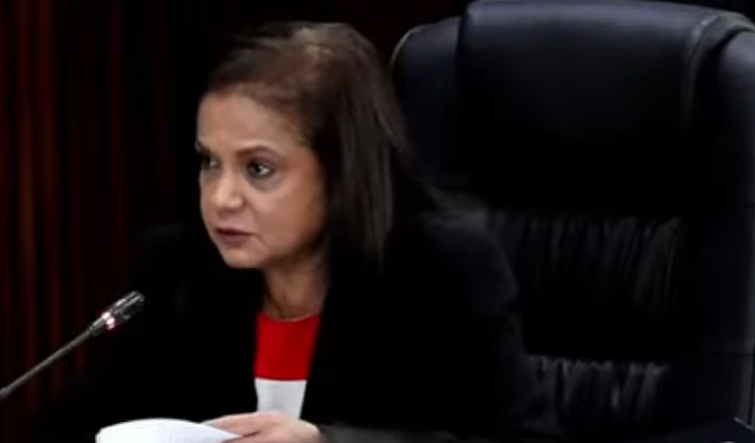
- Shamila Batohi, the former National Director of Public Prosecutions, was unsuccessful in her attempt to submit written arguments in the fitness enquiry concerning Andrew Chauke.
- The panel decided Batohi was only a witness, not a party to the proceedings, so written submissions were not allowed.
- Justice Nkabinde ruled that because Batohi chose not to return and finish her testimony, she must accept the consequences of that choice.
Former National Director of Public Prosecutions Shamila Batohi has failed in her attempt to file written submissions before the panel investigating whether Andrew Chauke is fit to hold office as Director of Public Prosecutions in South Gauteng.
The panel dismissed her application, finding that she was merely a witness in the proceedings and had no entitlement to place written arguments before the enquiry after declining to complete her testimony.
Batohi had argued that written submissions would assist the panel in understanding the context of her incomplete evidence and the reasons she decided not to return to complete her cross-examination.
The panel accepted that her evidence remained unfinished but found that her decision not to continue testifying did not justify a departure from the enquiry’s established procedures.
Background to the Application
The dispute stems from events on 15 December 2025 when Batohi was under cross-examination before the enquiry. During a lunch adjournment, she left the proceedings and did not return when the hearing resumed.
When summoned back before the panel, Batohi said, “I decided, Chairperson, that I was not going to come back pending getting proper legal counsel.”
She further said, “I am not prepared to continue. I am not withdrawing. I am not prepared to continue pending getting good legal advice.”
When questioned about why she had not sought permission before leaving, Batohi replied, “Chairperson, I was not seeking permission; it is something that I decided I needed to do because it is about me and my integrity.”
The enquiry thereafter remained open for several months while the panel awaited clarity on whether Batohi intended returning to complete her evidence. During that period, she launched an application seeking permission to consult legal representatives while under cross-examination. That application was dismissed in April 2026.
Following the dismissal, the State Attorney requested confirmation on whether Batohi intended to return to the enquiry. Her attorneys later confirmed that she would not be returning.
Attempt to Place Explanation Before Panel
On the final day of the enquiry hearings, Batohi’s attorney sought to hand up a letter explaining her reasons for not returning to complete her testimony. The panel refused the request after objections were raised and concerns emerged about introducing such material through correspondence rather than evidence.
According to the ruling, Batohi subsequently sought to achieve the same result through written submissions attached to a formal application. Justice Nkabinde was sharply critical of that approach.
Justice Nkabinde said in the ruling, “This inexplicable tactic is extraordinary. It offends the principles of procedural law. If this is not a display of a disdainful attitude toward the Panel, it is not clear what it is.”
The panel further found that the information Batohi wished to place before it largely repeated the contents of the earlier letter that had already been refused.
Justice Nkabinde said, “This approach is not only disingenuous but also disregards due process and the principle of finality and legality.”
Witnesses Cannot Make Submissions
A central issue before the panel was whether a witness could file written submissions despite not being a party to the enquiry.
The panel accepted arguments advanced by Chauke and the Evidence Leaders that Batohi’s role was confined to giving evidence and that she had no right to supplement her incomplete testimony through written argument.
In her own founding affidavit, Batohi said, “I acknowledge that written and/or closing submissions are ordinarily confined to parties or their legal representatives and not witnesses.”
She further accepted that once her testimony and cross-examination were completed, her role in the enquiry would ordinarily come to an end.
The panel found that allowing Batohi to file submissions would prejudice Chauke because her explanations would not be subjected to cross-examination.
Justice Nkabinde recorded, “Adv Chauke correctly argues that if the relief sought is granted, he will be prejudiced because Adv Batohi’s curated, untested, self-justifying narrative on matters relevant to her credibility and her evidence would not be subjected to cross-examination.”
Panel Rejects Fairness Argument
Batohi argued that fairness required the panel to consider her explanation before assessing the significance of her incomplete evidence and her decision not to continue testifying. The panel disagreed.
Justice Nkabinde found that Batohi knowingly elected not to return to the witness stand and could not later seek to mitigate the consequences of that decision through written submissions.
The ruling states, “Adv Batohi must make peace with her election not to return and complete her evidence and must stand by her election.”
The panel also rejected the suggestion that her reasons for abandoning her testimony were relevant to the enquiry’s mandate of determining Chauke’s fitness for office.
Justice Nkabinde wrote, “The point regarding the circumstances informing Adv Batohi’s decision not to continue with her testimony is irrelevant to the work of the panel.”
The panel further remarked, “Adv Batohi cannot and will not be allowed to meddle with the Enquiry procedures to do as she pleases.” Having concluded that the application lacked merit, the panel dismissed it in its entirety.
Get your news on the go. Click here to follow the Conviction WhatsApp channel.


