


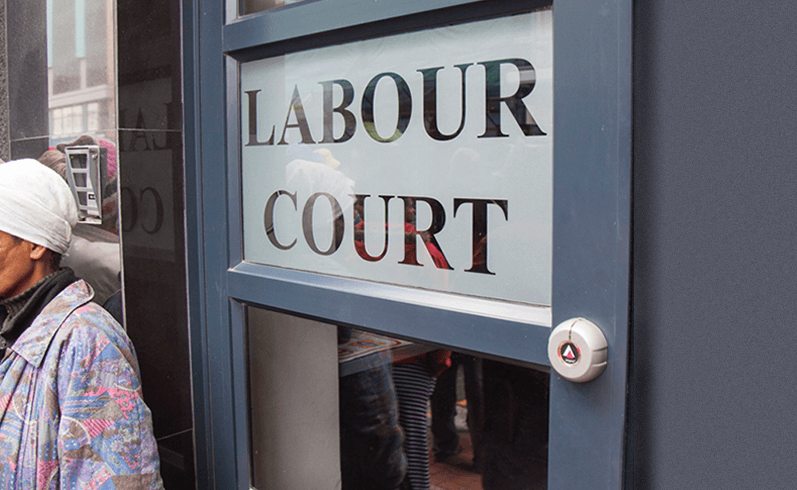
- Labour Court overturns CCMA reinstatement in workplace racism case.
- Judge finds that admitted racist conduct could not be treated as just insensitivity.
- The court replaces the arbitration award and confirms that the dismissal was fair.
A team leader who told colleagues that his dog named "Hitler" was trained to bark at and bite black people, compared African and coloured employees in the workplace, and later admitted that some of his actions amounted to racism, has lost his attempt to return to work after the Labour Court overturned a CCMA ruling that reinstated him.
The judgment, delivered by Acting Judge C Daniels in the Labour Court in Cape Town, found that the Commission for Conciliation, Mediation and Arbitration (CCMA) fundamentally misdirected itself by treating the employee's conduct as simple "insensitivity" rather than deciding whether it amounted to racial discrimination.
The court said racism in the workplace cannot be trivialised and that employers have a responsibility to protect employees from discrimination.
Complaints led to disciplinary action
The dispute began when Shaun Williamson was working as a team leader at Full Circle Contact Centre Services (Pty) Ltd, trading as Capita South Africa, where he managed a team of about 15 call centre agents.
In November and December 2022, several team members complained that Williamson had repeatedly made racially discriminatory remarks and acted unprofessionally towards African employees. The concerns were first raised in a skip-level meeting held without him, before staff submitted written complaints.
According to evidence before the Labour Court, Williamson allegedly compared the abilities of African and coloured women, claimed his dog "Hitler" was trained to bark at and bite black people and joked about the dog chasing a black child. He also expressed discomfort about previously reporting to an African woman because of her race and gender, referred to certain behaviour as "a black thing", and was accused of favouring coloured employees over African colleagues.
Williamson was suspended in January 2023 and later faced disciplinary charges for discrimination based on race and gender, as well as conduct unbecoming of a manager. After a disciplinary hearing in April 2023, he was found guilty and dismissed.
CCMA ordered him to be reinstated
Williamson challenged his dismissal at the CCMA, arguing that dismissal was too harsh for a first offence and that a lesser sanction should have been considered. The commissioner agreed the disciplinary process was fair, but found the dismissal itself was substantively unfair.
Instead of finding that Williamson had engaged in racial discrimination, the commissioner concluded he had just been insensitive to the feelings of black employees. The commissioner also accepted that Williamson had shown remorse by apologising during the arbitration, and noted that some employees said they would have accepted his apology.
On that basis, the CCMA ordered Capita South Africa to reinstate Williamson with back pay of more than R57 600.
Court refuses late challenge
Before considering the merits of the review, the Labour Court addressed Williamson's attempt to oppose the application even though he filed his affidavit more than 15 months late.
Judge Daniels found that Williamson had failed to provide a satisfactory explanation for the delay, noting he had earlier said he did not plan to oppose the review, but later changed his mind.
The court held that his explanation did not account for the entire period of delay and refused to grant condonation, allowing the review to go ahead unopposed.
Racism cannot be reduced to insensitivity
Turning to the merits, Judge Daniels found that the commissioner misunderstood the central question he needed to answer.
The judgment said the commissioner never properly considered whether Williamson had committed racial discrimination, even though that was the main allegation before the CCMA. Instead, the commissioner described behaviour that was clearly race-based as simply insensitive.
Judge Daniels said that this approach ignored South Africa's constitutional values and history of racial discrimination. The court stressed that racism in the workplace undermines the dignity of employees and that courts have repeatedly highlighted the need to address it firmly.
Citing Constitutional Court authority, Judge Daniels observed that South Africa is still dealing with the legacy of institutionalised racism and that workplace racism remains a serious social problem needing a clear response from the courts.
Employee admitted comments were racist
One of the most significant issues identified by the court was the commissioner's failure to consider Williamson's own admissions during the arbitration.
The Labour Court noted that Williamson admitted under cross-examination that his comments about the dog were not just insensitive, but also offensive. More importantly, he also agreed that those comments amounted to racism.
Judge Daniels said those admissions went to the heart of the dispute and made it impossible to justify the commissioner's finding that the conduct was merely insensitive.
The judgment found that any reasonable commissioner would have viewed the conduct as racist and derogatory, especially in light of South Africa's history, including the use of dogs to intimidate black people during apartheid and the symbolism of the name "Hitler".
Dismissal remained justified
The Labour Court also rejected the commissioner's reliance on Williamson's apology as proof of genuine remorse. Judge Daniels pointed out that the apology was made only during arbitration, months after the disciplinary hearing and after Williamson had already lost his job.
The court held that a late apology could not outweigh the seriousness of proven racist conduct. It also noted that Capita South Africa's disciplinary code allows dismissal for a first offence involving discrimination on a listed ground.
According to the judgment, employers have a constitutional duty to ensure workplaces are free from racial discrimination and should not be expected to keep managers whose actions undermine that responsibility.
CCMA award replaced
Instead of sending the matter back to the CCMA for another arbitration, Judge Daniels concluded that the Labour Court was in as good a position as the commissioner to decide the dispute because all the evidence had already been heard and the employee had made important admissions.
The court therefore set aside the arbitration award and replaced it with an order declaring Williamson's dismissal substantively fair. No order was made as to costs.
Get your news on the go. Click here to follow the Conviction WhatsApp channel.


