


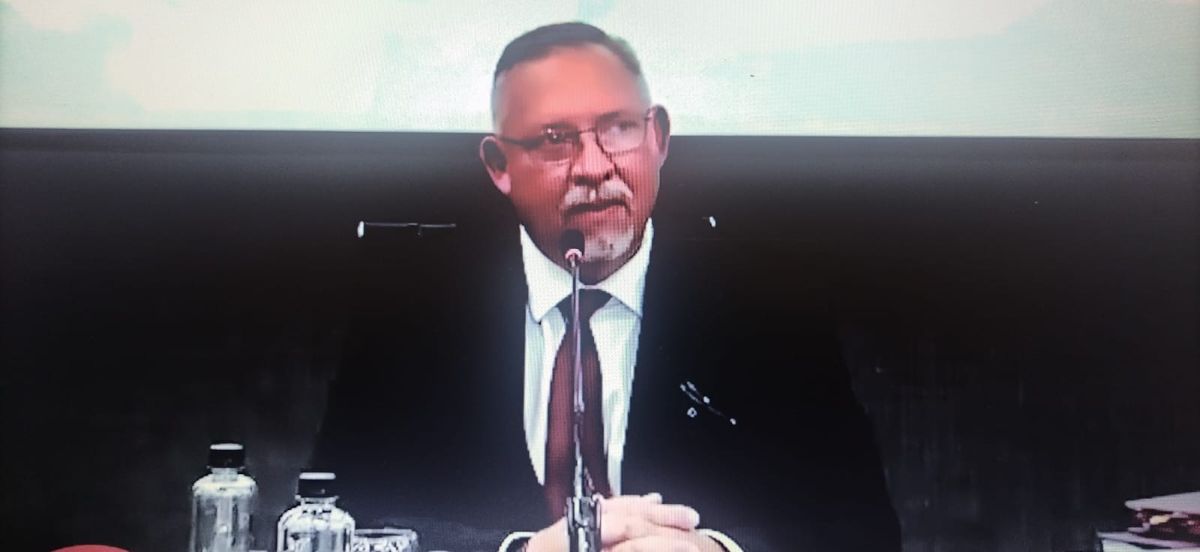
- Supreme Court of Appeal overturns a High Court judgment that upheld the JSC's recommendation.
- Court finds the JSC failed to consider important information about advocate Johannes Hendrikus Roelofse.
- Matter sent back to the Judicial Service Commission to reconsider his candidature.
The Supreme Court of Appeal has declared the Judicial Service Commission's (JSC) decision to recommend Advocate Johannes Hendrikus Roelofse for appointment as a judge of the Mpumalanga Division of the High Court unlawful, unconstitutional and invalid.
The court found that the commissioners decided without considering important information about his judicial temperament and financial affairs.
Judge of Appeal T Makgoka, with other judges concurring, upheld an appeal brought by the Mpumalanga Society of Advocates against the JSC, the President of South Africa and Roelofse.
The appeal overturned an earlier decision of the High Court in Johannesburg, where Deputy Judge President Roland Sutherland dismissed the society's review application and upheld the JSC's recommendation.
The Supreme Court of Appeal has now ordered the JSC to reconsider Roelofse's candidature. The President had delayed making the judicial appointment while the review proceedings were pending.
Society challenged recommendation
The Mpumalanga Society of Advocates, an affiliate of the General Council of the Bar of South Africa, challenged the JSC's decision after it recommended Roelofse for appointment during its October 2021 interviews.
Roelofse has practised as an advocate since 2003. He was a member of the Pretoria Bar before becoming one of the founding members of the Mpumalanga Society of Advocates when the Mpumalanga Division of the High Court was established. From 2018, he regularly served as an acting judge in the division.
He unsuccessfully applied for a permanent appointment in 2019 before being shortlisted again in 2020 and 2021. During those applications, the society repeatedly objected to his appointment.
Concerns raised about Bar fees, legal ability and temperament
The society raised three principal objections. First, it said Roelofse was not in good standing because he owed more than two years' worth of Bar fees.
It is alleged that he knew he could not obtain the required letter of good standing from the society and instead obtained one from the Provincial Legal Practice Council without disclosing this to the JSC. The society argued that this bordered on dishonesty.
Secondly, it questioned his knowledge of the law and his commitment to constitutional values based on judgments he had delivered and his conduct in court.
Thirdly, it raised concerns about his judicial temperament, alleging that he frequently interrupted advocates during argument, behaved abrasively, was not open to persuasion and displayed conduct unbecoming of a judicial officer.
In March 2020, the society also instituted disciplinary proceedings against Roelofse arising from his unpaid Bar fees.
Among other allegations, it claimed he attempted to reduce his indebtedness through an unauthorised cession of invoices, failed to disclose that attorneys were already pursuing recovery of his outstanding debt and failed to disclose that he was not in good standing with the society when applying for judicial office. Roelofse later resigned from the society.
April interview focused on disciplinary charges
During the April 2021 JSC interview, commissioners questioned Roelofse about the disciplinary charges. He denied attempting to avoid accountability, explaining that the charges had never been properly pursued because they had been initiated by the society's chairperson rather than the Bar Council itself.
He also said he resigned because he could no longer afford the Bar fees. Roelofse further claimed the charges were linked to litigation involving the Walele communal dispute, where he believed the society's chairperson had acted against him because of a judgment he had delivered. The JSC ultimately decided not to recommend him for appointment following that interview.
Fresh objections never reached commissioners
When Roelofse was shortlisted again later in 2021, the society once more submitted objections to his appointment. Although the objections arrived after the deadline, together with an application for condonation, they were never placed before JSC commissioners. Instead, the JSC secretariat decided not to circulate them because they had been submitted late.
Justice Makgoka said this was a serious flaw. "At the very least, the Acting Chief Justice should have been alerted to the MSA's late comments," he wrote.
The appeal court said it was not for officials within the secretariat to decide that commissioners should never see potentially important information about a judicial candidate.
Interview highlighted concerns
Unaware of the society's latest objections, the JSC interviewed Roelofse in October 2021. During questioning by Commissioner Madonsela SC about his unpaid Bar fees and resignation from the society, Roelofse repeatedly interrupted the commissioner, resulting in a tense exchange.
He also had difficulty answering legal questions posed by Commissioner Cane SC regarding the National Credit Act litigation. After the interview, commissioners debated whether his conduct reflected a temperament problem.
Some commissioners regarded the incident as isolated. Others expressed concern. Commissioner Cane SC said, "There's that intemperance and lack of patience, which is really concerning to me as an advocate."
Commissioner Madonsela SC warned against assuming that his temperament would improve after appointment because judges enjoy security of tenure. Despite those concerns, the JSC voted by 18 votes to three to recommend Roelofse for appointment.
Appeal court criticises High Court
Justice Makgoka found that the High Court had misunderstood the evidence. The High Court concluded that the JSC had already considered the society's complaints about Roelofse's temperament during the earlier interview. The appeal court disagreed.
It found that commissioners had never properly questioned him about those concerns in April 2021 and that the written objections submitted before the October interview never reached them.
As a result, the issue "fell through the cracks". The court also rejected the High Court's view that Commissioner Madonsela was responsible for the tense exchange during the interview.
Instead, Justice Makgoka said the transcript showed that Roelofse repeatedly interrupted the commissioner. "The respondent's conduct before the JSC thus confirmed, in real time, the MSA's complaints about the respondent's temperament," the judgment states.
The court added that if commissioners had considered the interview together with the society's written objections, "the minds of the JSC commissioners might have been engaged differently."
Financial disclosure criticised
The appeal court also found problems with Roelofse's financial disclosures. Although he told the JSC he would have settled his outstanding Bar fees before the October interview, R20 000 remained unpaid.
The court said he had a duty to disclose this fact during the interview. In addition, a civil judgment had been granted against him over unpaid school fees owed to Laerskool Nelspruit.
Roelofse said he had never received the summons because it had been served at a previous address and only became aware of the judgment in 2023, after which he settled the debt.
The Supreme Court of Appeal accepted that explanation regarding the judgment itself. However, it found he should nevertheless have disclosed the underlying school fees debt to the JSC when completing his judicial questionnaire.
Justice Makgoka said, "Only the JSC has the right, and indeed the obligation, to weigh the impact of the debt on the respondent's overall candidature."
The court also observed that Roelofse had received acting judges' salaries during lengthy acting appointments, meaning commissioners might reasonably have questioned why those debts remained unpaid.
Recommendation declared invalid
The Supreme Court of Appeal held that the JSC's recommendation suffered from two fundamental defects. First, commissioners failed to consider the society's complaints about Roelofse's judicial temperament.
Secondly, they made their decision without material information concerning both the society's objections and his financial affairs.
Justice Makgoka said judicial temperament is "a central attribute of a judge" and that failing to consider such information rendered the decision reviewable under the Promotion of Administrative Justice Act.
The court also held that decisions taken in ignorance of material facts are unlawful because public bodies must make decisions based on all relevant information.
The judges declined to consider a later 2026 Full Court judgment involving Roelofse because it arose years after the JSC's 2021 decision and would have been unfair to rely upon in these proceedings.
Final order
The Supreme Court of Appeal upheld the appeal without making any order for costs. It set aside the Gauteng High Court's judgment and declared the JSC's recommendation of 21 October 2021 unlawful, unconstitutional and invalid. The recommendation to the President to appoint Roelofse as a judge was reviewed and set aside.
The matter has been remitted to the JSC to reconsider Roelofse's candidature for judicial appointment. Each party must pay its own costs.
Get your news on the go. Click here to follow the Conviction WhatsApp channel.


