


- A simple haircut conversation exposes how the public views lawyers and high-profile cases.
- Moafrika Wa Maila explains that legal outcomes are never guaranteed despite public expectations.
- The exchange highlights the gap between public perception and the ethical realities of legal practice.
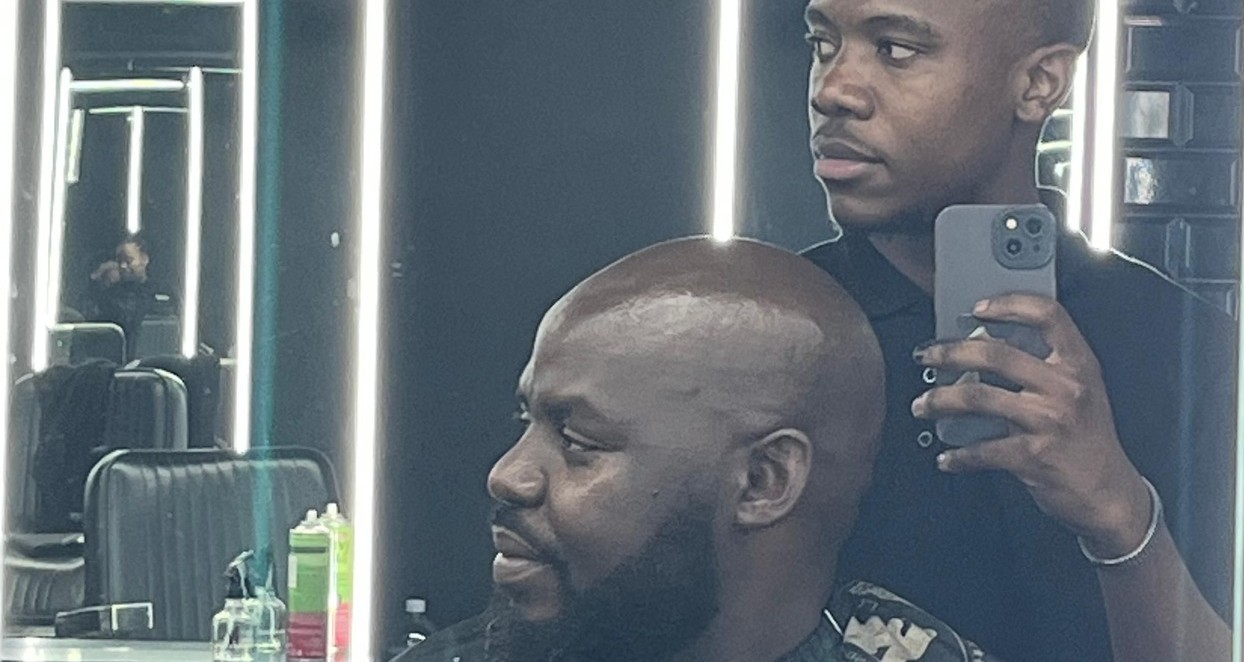
I always come to Kollonade Mall to do my hair. I am always attended to by the young man in the picture. His name is Tokelo “TK”.
He is very conversational and inquisitive, and he always has a lot of questions for me. We move through many topics and themes during our hair-cutting sessions.
I was shocked. He started on a high note, and I could see that it would be a long session. He said, “Will you be able to take Mabena out?” I immediately thought about the Madlanga Commission. I said, you mean Cat Matlala? He said, “No, Shebeshxt. I saw your name being called to rescue him.” I really did not know how to answer that question.
Explaining what lawyers actually do
I had to explain and expand on our work in court. I told him that results are not guaranteed. I will definitely be in court when handed a brief and given instructions, but I do not know if I will get him out. All I can promise is that I will fight and apply my knowledge of the law to the best of my ability. The results are never guaranteed, and there is no assurance of any outcome in court.
He then asked me why people say I am one of the best. I suppose it comes down to results, the cases you win, and the difficult matters where you are able to get favourable outcomes. The length of time you have worked, your track record, and your skills, knowledge, and experience all contribute to how your name becomes recommended as a lawyer.
After that, he said, “You know, people I tell that I do your hair, they do not believe me. Are you a celebrity?”
I said, “Do you see Julius Malema, Cyril Ramaphosa, Maphorisa, or even your Shebeshxt? Those are celebrities. I am just an advocate. I might be popular to a certain extent, but I am known within what is called a sectional interest. People who follow the law, news, criminal cases, and legal issues might have an idea of who I am. But that is not celebrity.”
Praise, criticism, and public perception
He then asked me if I feel good when people recommend me in big cases. I told him something simple. If praise excites you, then criticism will destroy you. You must learn to take both as part of the journey. Praise will not take anything from me, and criticism will not take anything from me. At the end of the day, you spoke about me and made my work known.
He came back again and asked, so can you do the Shebeshxt case? I asked him, why do people like him so much? I only know his voice from Twerka Wena. I know my son and daughter like him, but what is he really about?
He explained that Shebeshxt is the king of Lekompo and that in December alone, he had 150 bookings, and could make at least 1.5 to 3 million. I was shocked because I thought Lekompo was a small genre compared to amapiano. He went on to tell me a lot about Shebeshxt. I realised I knew very little beyond the news clips about his life. He even mentioned a series of incidents where the beloved and celebrated Shebeshxt had been in trouble with the law.
Defending unpopular clients and professional ethics
He then said, “But you are fine with such cases, you also did Thabo Bester. So Shebe is also a person.”
I explained to him that I personally try to do what Jesus Christ did on earth. He defended a woman who was caught in the act of adultery. He said, let he who is without sin cast the first stone. No one could cast the first stone. I can defend any person, even those hated by the whole country, because your judgment does not make you righteous; it can make you a hypocrite. I choose not to discriminate against clients based on false morality. Even a criminal has a right to legal representation. After all, we all need grace from God.
Why lawyers do not choose cases the way people think
For the entire 60 minutes, we spoke about my career and the possibility of my involvement in the Shebeshxt case. At the end, he asked, “So because we said go and assist him, are you going to do it?”
I had to explain again that in our profession, you only enter where you are invited. A lawyer cannot be a meddlesome antelope, someone who runs around looking for clients and calling people to involve themselves in cases. Even if recommended, you wait to be called and formally briefed. I cannot carry my black bag and robe and enter a fight uninvited. I also reminded him that I must be paid. He laughed and said they could donate as fans. I laughed with him.
Finding consistency and accepting public attention
I genuinely enjoy working with this young man. He is intelligent and engaging, and he makes me look forward to coming back to Legends Barber.
As a disclaimer, I stopped doing my hair in Kasi because the trimming of beards was inconsistent, sometimes too deep, sometimes too wide, sometimes too long. I needed to maintain a consistent appearance and image. It became frustrating because some days I would look sick and other days completely different after a haircut.
I have made peace with the fact that wherever I go, I will be asked many questions. I will answer them. I am not the type to hide my opinions or my views.
Get your news on the go. Click here to follow the Conviction WhatsApp channel.


