


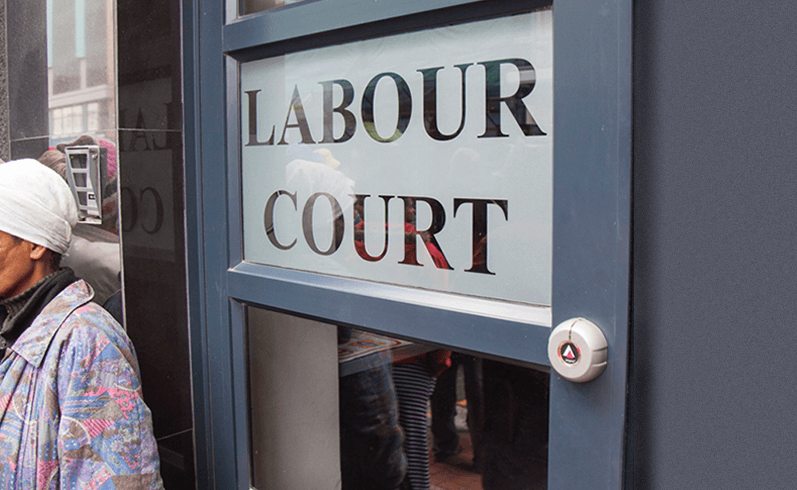
- The Labour Court found that Alfred Alekhine Abrahams was dismissed for making a protected disclosure, not just for breaching NSFAS ICT policies.
- The court found that NSFAS used the email policy breach to act against a whistleblower who raised concerns about alleged irregularities in an office accommodation tender.
- NSFAS was ordered to reinstate Abrahams with full back pay and cover all his legal costs.
A former National Student Financial Aid Scheme facilities manager who raised concerns about an office accommodation tender has won a major Labour Court victory, with the court finding that his dismissal amounted to unlawful retaliation against a whistleblower.
Acting on concerns about what he believed were procurement irregularities and wasteful expenditure, Alfred Alekhine Abrahams provided information to investigators from the Special Investigating Unit. He was later dismissed by NSFAS for allegedly breaching information technology policies after forwarding work-related emails to his personal email account.
However, the Labour Court in Cape Town concluded that the disciplinary charges were inseparable from the disclosure itself and that the real reason for the dismissal was Abrahams' protected disclosure.
Judge R Lagrange ordered NSFAS to reinstate Abrahams with full retrospective effect to the date of his dismissal on 23 May 2023, pay all remuneration lost since then and cover his legal costs.
Concerns over office relocation project
Abrahams joined NSFAS on 1 February 2020 as Facilities Manager in Corporate Services. His duties included overseeing buildings, lease agreements and office space planning.
During preparations for the organisation's relocation to new offices, Abrahams became involved in determining the amount of office space required. According to his evidence, calculations showed that NSFAS needed between 6 000 and 7 200 square metres of office space, including room for future growth.
He became concerned when a tender specification was issued for approximately 8 000 square metres despite his calculations indicating a smaller requirement. He testified that the specification was approved and advertised without sign off from either him as the end user representative or his immediate manager.
Abrahams also criticised the project timelines, saying management expected a new office to be identified, procured and occupied within six to seven months, a period he regarded as unrealistic for a public sector procurement process.
Over time, he raised concerns through reports, memoranda, risk registers and submissions to management and board structures. He maintained that his warnings received little attention.
According to his evidence, one available building was cheaper and largely ready for occupation, yet another property in Cape Town's Foreshore precinct was selected despite being an empty shell that required extensive fit out work before staff could move in.
He told the court that NSFAS began paying approximately R2 million per month in rent from March 2022 while much of the building remained unoccupied because it was not yet ready for use. He further pointed to proposals to extend the lease by an additional five years as reinforcing his concerns about potential wasteful expenditure.
Disclosure to the SIU
After the President authorised an SIU investigation into irregularities at NSFAS in 2022, Abrahams approached an internal forensic audit official with his concerns.
He was advised to share the information directly with SIU investigators. Believing internal channels had failed, he met investigators and disclosed details about the procurement process and what he regarded as irregularities.
To support the disclosure, he collected documentary evidence, including emails relating to the office procurement project. On 13 September 2022, he emailed documents to his personal account and then forwarded them to the SIU.
Abrahams explained that he feared victimisation and wanted to preserve evidence in case action was taken against him. He also testified that sending work material to personal email addresses had become common practice during the COVID-19 period and that he did not believe he was violating policy.
Leak investigation leads to disciplinary action
The information later entered the public domain when United Democratic Movement leader and Member of Parliament Bantu Holomisa disclosed similar allegations publicly.
The day after those allegations emerged, NSFAS launched an investigation to identify the source of the leak.
The court heard that investigators searched NSFAS email systems using terms connected specifically to the office relocation and building project. That search identified emails Abrahams had sent to himself before forwarding information to the SIU.
By 23 March 2023, NSFAS charged him with misconduct for breaching ICT policies by sending confidential information to his personal email address.
NSFAS insisted that he was not disciplined for making disclosures but for violating information security rules. After a disciplinary process, he was dismissed in May 2023.
Abrahams argued that the policy breach was merely a pretext and that only the emails connected to the SIU disclosure had been targeted, despite similar conduct occurring elsewhere in the organisation.
ICT policy defence rejected
NSFAS called senior manager O Selekisho, who explained that organisational policies prohibited employees from forwarding work emails to personal accounts because doing so exposed information to potential security risks and removed it from NSFAS-controlled systems.
Selekisho testified that employees acknowledged ICT policies every time they logged into organisational systems and that breaches could result in disciplinary action, including dismissal.
However, under cross-examination, it emerged that Selekisho had not been employed by NSFAS when the events occurred and had no direct involvement in the circumstances surrounding Abrahams' dismissal.
The court also heard that the prohibition on sending emails to personal accounts was not clearly stated in the login prompt itself, but appeared in a more detailed information security policy.
Court finds dismissal linked to protected disclosure
Judge Lagrange found that the central question was the true reason for the dismissal.
The judge accepted that the disclosure triggered a chain of events that ultimately resulted in disciplinary action. According to the judgment, the ICT investigation was not a general effort to identify policy breaches but was aimed at discovering who had leaked information exposing alleged wrongdoing within NSFAS.
The court found that Abrahams was identified because investigators searched for communications containing specific information that had reached the public domain.
Judge Lagrange concluded that forwarding emails to a personal account was not separate from the disclosure but was the means through which the disclosure had been made.
The judge found that if the information had not become public, there would likely have been no investigation into the emails and no dismissal.
The judgment described the reliance on the email policy as an attempt to punish conduct for which Abrahams should have been protected rather than disciplined.
The court held that the disclosure was the overwhelming cause of the dismissal and that NSFAS failed to prove the dismissal was unrelated to protected whistleblowing activity.
Full relief granted
In granting relief, Judge Lagrange said there was every reason to restore Abrahams to his position.
The court ordered NSFAS to reinstate him with full retrospective effect from 23 May 2023 and pay all remuneration lost between dismissal and reinstatement.
NSFAS was also directed to pay Abrahams' legal costs on the punitive attorney and own client scale, reflecting the court's view that he had acted responsibly and in good faith when attempting to expose alleged wrongdoing after internal reporting mechanisms failed.
Get your news on the go. Click here to follow the Conviction WhatsApp channel.


