


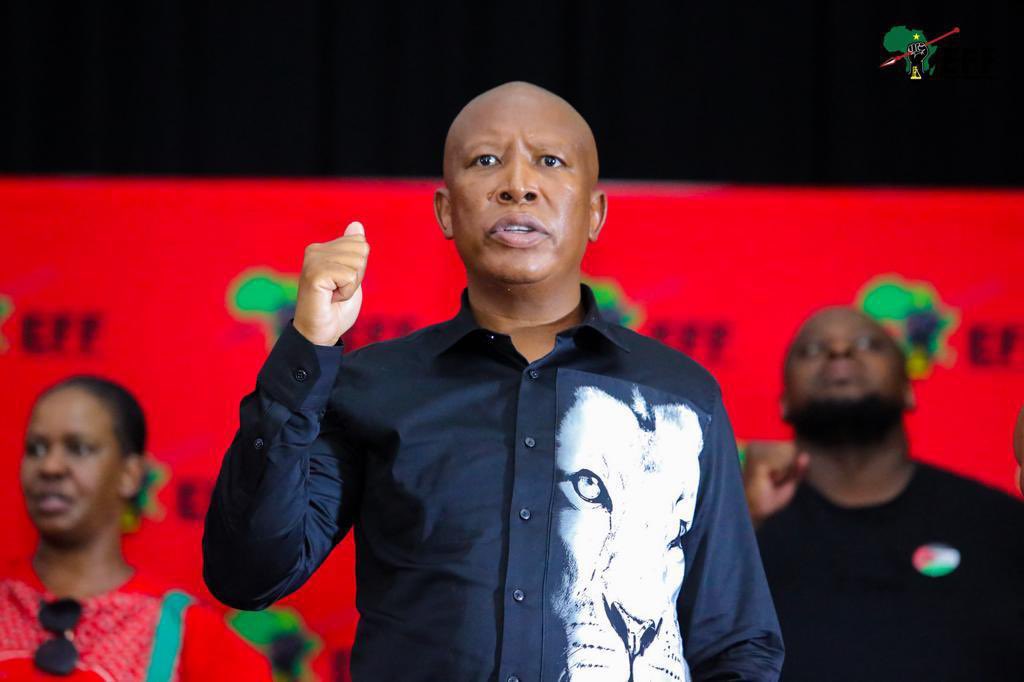
- The Equality Court has ruled that Julius Malema’s 2022 speech constituted hate speech under South African law.
- The judgment confirms that incitement to violence, even when politically framed, violates constitutional protections.
- Both Malema and the EFF have been held jointly liable, with costs awarded to the complainants.
In a judgment delivered on 27 August 2025, the Equality Court of South Africa in the Western Cape has declared that Julius Malema’s speech at the EFF’s third provincial People’s Assembly in October 2022 constituted hate speech.
The ruling, handed down by Judge M Sher, marks a significant moment in South Africa’s constitutional democracy, reaffirming that political rhetoric cannot override the foundational rights to dignity, equality, and protection from harm.
The case was brought by the South African Human Rights Commission (SAHRC) and Dante Van Wyk, who alleged that Malema’s remarks incited violence against white males, particularly those involved in a 2020 confrontation outside Brackenfell High School. In the speech, Malema urged EFF members to “follow up” on a “white man visible on camera,” take him to an “isolated space,” and “attend to him properly.” He declared that “revolution demands killing,” and that “racism is violence, and violence can only be ended by violence.”
Judge Sher found that these statements were not metaphorical or abstract; they were a direct exhortation to violence. The speech demonstrated a clear intention to incite harm and to promote or propagate hatred based on prohibited grounds: race and gender.
The linguistic and legal analysis
Dr Karien Van Der Berg, a forensic linguist, provided expert testimony that the speech was not nuanced or symbolic but a literal call to action. Her analysis revealed repeated use of polarising language and modal verbs that framed killing as a revolutionary imperative. She concluded that a reasonable listener would interpret the speech as a directive to commit violence against white males perceived as racists.
In contrast, the respondents’ expert, Professor Steven Friedman, argued that the speech targeted conduct rather than identity. However, under cross-examination, he conceded that the language was unequivocal and inciting, and that the instruction to “attend to” the white man was a call to violence. He maintained, however, that it was not hate speech because it was directed at actions, not racial identity.
The court rejected this argument. It found that the speech was clearly based on prohibited grounds, race and gender, and that the targets were identified as white males. The court emphasised that hate speech need not be directed at an entire group; it may target individuals based on their membership in a group. Section 10(1) of the Promotion of Equality and Prevention of Unfair Discrimination Act prohibits speech against “any person” on prohibited grounds, and the Constitution protects against speech that incites harm or promotes hatred.
Ideological context and political responsibility
The ideological context of the speech was also examined. The EFF, according to its constitution, is a radical, leftist, anti-capitalist movement grounded in Marxist-Leninist and Fanonian thought. Its manifesto calls for the overthrow of the “neo-liberal, anti-black state” and the capture of power “through whatever revolutionary means necessary.” Malema, as President and Commander-in-Chief, is empowered to orientate and direct the party’s activities and pronouncements.
The court found that Malema’s statements were made in his official capacity and endorsed by the EFF, which issued a media advisory defending the speech. As such, the EFF was held jointly liable for the hate speech.
Judge Sher noted that when such a call emanates from the leader of the third-largest political party in the country, it has the potential to foment racial violence on a large scale. He emphasised that South Africa, in terms of the noble aims set out in the Equality Act, is trying to heal from a racially oppressive and violent past and to foster reconciliation, social cohesion, and goodwill among all races.
The limits of truth and political expression
The court also addressed the argument that the speech was justified because it referred to a real incident of racial violence. Drawing from Canadian jurisprudence, including Keegstra and Whatcott, Judge Sher affirmed that even truthful statements, if used to stir up hatred, can constitute hate speech. The invocation of racial identity to justify violence, he ruled, is not protected political expression, it is incitement.
He further clarified that calling someone a racist, if based on their conduct, may be permissible, but calling for their death is not. Such incitement, especially from a national political leader, risks igniting exclusion, hostility, and violence.
Final ruling and implications
The court issued a declaratory order that the statements made by Malema on 16 October 2022 constitute hate speech under Section 10 of Act. Both Malema and the EFF were held jointly and severally liable for the complainants’ legal costs, including fees for expert witness Van Der Berg and two counsel.
The court declined to rule on the secondary complaints of harassment and unfair discrimination, finding that the primary declaration of hate speech rendered further determinations unnecessary.
This ruling is not merely a legal finding, it is a reaffirmation of South Africa’s constitutional values. It draws a clear line between robust political critique and unlawful incitement, and it reinforces the principle that freedom of expression, while vital, is not absolute.
Conviction.co.za
Get your news on the go. Click here to follow the Conviction WhatsApp channel.
