


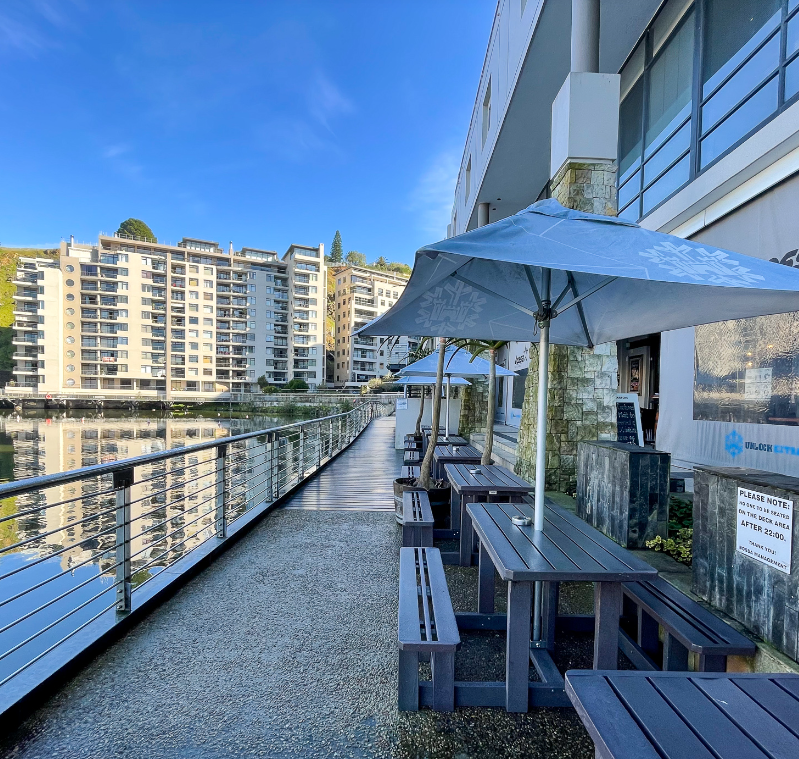
- Tyger Lake restaurant operators asked the High Court to order the body corporate and others to make at least 40 parking bays available, as required by zoning conditions.
- Acting Judge A Kantor ruled that parking bay lessees must be joined to the case, since their contractual rights could be affected.
- Compliance expert Johlene Wasserman says the case reveals the same structural problem that plagued Rosebank Mall litigation 10 years ago.
Almost 10 years after Rosebank Mall’s legal saga, Tyger Lake in the Western Cape has become the latest example of how South Africa’s mixed-use property developments can stumble over structural flaws in zoning compliance. That is according to Johlene Wasserman, Director of Compliance and Community Schemes at VDM Incorporated.
Wasserman, commenting on the recent High Court decision in Snap Shot Investments 1043 CC and Others v Tyger Lake Body Corporate and Others, says the case highlights how private commercial deals can end up dismantling zoning compliance at the scheme level. “This isn’t just a parking dispute,” she says. “It’s a case study in how zoning conditions, public law obligations that actually bind the land, can be eroded by private structuring long after a development is approved.”
She explains that zoning conditions differ fundamentally from internal rules adopted by sectional title schemes. “Zoning conditions are public law obligations attached to the land itself. When compliance infrastructure gets fragmented and monetised, a scheme can end up structurally unable to meet the legal obligations that bind the property.”
The Tyger Lake parking dispute explained
The litigation began when the operators of BOSSA Tyger Lake restaurant went to the High Court in the Western Cape, seeking an order that the Tyger Lake Body Corporate, Capitalgro (Pty) Ltd, and the Tyger Falls Owners Association ensure enough parking for restaurant patrons.
The applicants, Snap Shot Investments 1043 CC (owner of Unit 50 in the Tyger Lake sectional title scheme), BOSSA Country (Pty) Ltd (the BOSSA franchise brand owner), and R and D Foods (Pty) Ltd (the franchisee running the restaurant), claimed that zoning conditions require one parking bay for every three seats. For BOSSA, this meant a need for 40 parking bays.
Acting Judge A Kantor explained the nature of the relief being sought, stating that “the relief sought in Part B of the Notice of Motion was for final mandatory interdictory relief directing the respondents to make available at least 40 parking bays for use by patrons of the BOSSA Tyger Lake restaurant.”
How private deals changed the parking picture
The court heard that parking within Tyger Lake had been restructured through commercial deals. In October 2024, Capitalgro bought several parking sections from the scheme’s developer. Many of these bays were then leased out with exclusive use rights, others were sold off or reserved for casual paid parking. This left far fewer visitor bays than the zoning required.
The applicants argued that they “were at no stage made aware that they would have to purchase or lease parking bays for the restaurant.” They also pointed out that “by the nature of sectional title ownership, it is impossible for individual owners to ensure and enforce compliance with statutory prescripts applicable to the scheme as a whole.”
The respondents disagreed, saying it was up to the restaurant operator to secure enough parking for its customers.
Court rules lessees must be joined before main issue decided
Before tackling the actual parking compliance issue, the court had to decide whether parking bay lessees needed to be joined to the litigation. The respondents argued that the applicants were effectively seeking access to bays owned or leased by third parties who were not before the court.
Judge Kantor agreed. The judgment states that “the rights of the third-party lessees derive purely from the leases concluded between them and Capitalgro.” The court explained that those rights “were obtained independently of the zoning obligations forming the basis of the litigation.” As the judge noted, “in other words, the rights as lessees were derived from something other than the right which is the subject matter of the litigation.”
The court relied on the Rosebank Mall precedent, which established that anyone whose rights might be affected by a judgment must be included in the proceedings.
With the lessees not yet joined, the case was postponed indefinitely. Capitalgro was ordered to provide the applicants with the names and contact details of all parking bay lessees, who must then be formally notified and given the chance to participate in the case. The applicants were also ordered to pay the wasted costs of the postponement for two of the respondents.
Rosebank Mall’s shadow
Wasserman notes that Tyger Lake echoes the earlier Rosebank Mall case, where owners granted exclusive rights over key infrastructure, like loading bays and service corridors, through private contracts, not via the scheme’s governance structures. When management later tried to enforce zoning or municipal obligations, the private rights became obstacles. The court halted that case too, demanding that every business with such rights be joined, an administrative nightmare that left the development in limbo. “Now, the same thing is happening at Tyger Lake,” Wasserman notes.
What this means for mixed-use developments
Wasserman warns that the Tyger Lake case shows the same underlying risk, even more sharply. Zoning conditions requiring 40 parking bays for the restaurant are binding public law, not optional rules. Yet private deals have left the scheme unable to meet its own zoning approval, creating a structural inability to comply.
When the matter reached court, the same procedural stalemate as Rosebank appeared. The court ordered joinder of lessees, the case was postponed, and the development is left in legal limbo.
Why it matters
For Wasserman, the Tyger Lake dispute highlights a growing legal risk in South Africa’s mixed-use property market. Zoning compliance infrastructure may be in place when a development is approved, but over time, private deals can fragment it, leaving no single party able to ensure compliance. Private rights can block enforcement, and the responsibility for compliance may fall to individual operators who lack the power to fix the problem.
Her warning: “If zoning compliance can be undermined by private structuring, zoning schemes risk becoming aspirational, not binding. That is not how land use regulation or sectional title governance are supposed to work.”
What’s next
The Tyger Lake case will return to court after all parking bay lessees have been notified and given the chance to participate.
Get your news on the go. Click here to follow the Conviction WhatsApp channel.
