


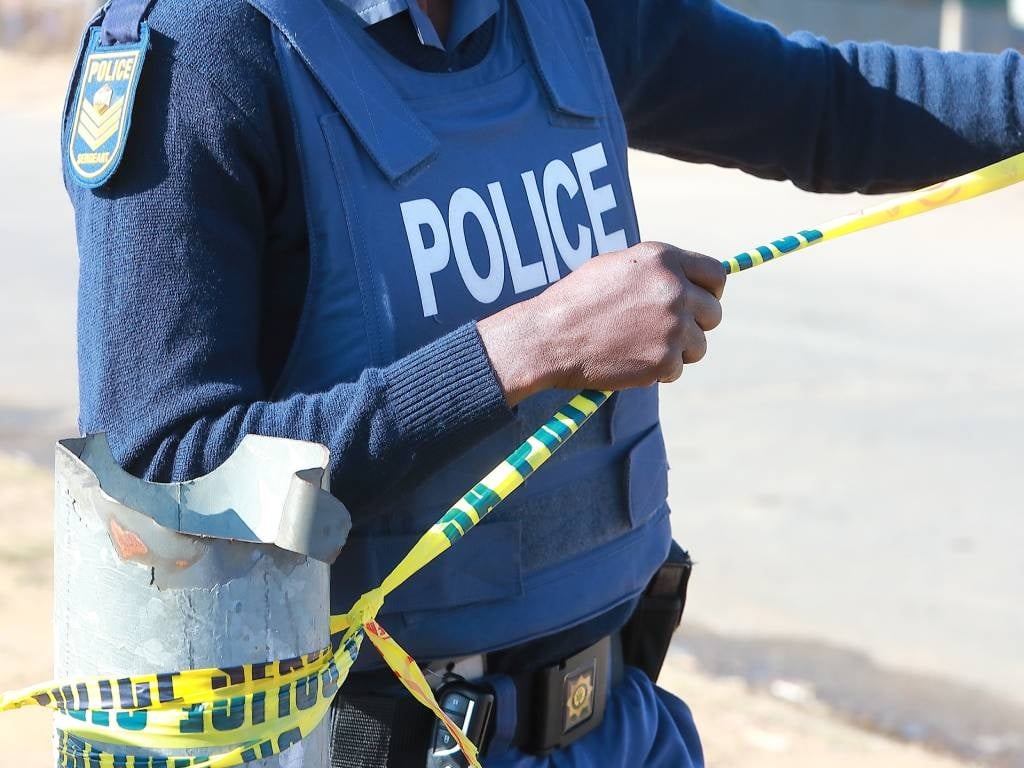
- The allegations levelled by senior police leadership point to a serious breakdown in internal accountability within SAPS.
- Public disclosures by senior officers suggest growing distrust in formal reporting and oversight structures.
- Meaningful reform, according to Professor Mofokeng, will require independent vetting, merit-based leadership appointments, and restored investigative autonomy.
The soulful, rhythmic pulse of Stimela’s song Whispering in the Dark has long served as a metaphor for the unseen struggles of the South African people.
Today, however, that whisper has moved from the shadows of history into the brightly lit corridors of the South African Police Service. It is no longer a song of hope, but a siren of institutional decay.
The recent media briefing by suspended Mpumalanga Police Commissioner, Lieutenant-General Semakaleng Daphney Manamela, has cracked open a door that many in the SAPS top brass would have preferred to keep bolted.
By levelling explosive allegations of political interference, bribery, and the “deliberate collapse” of investigative integrity, Manamela has done more than defend her own reputation; she has signalled the terminal failure of internal police reporting structures.
The breakdown of internal reporting
As a criminologist, I have long observed that the health of a law enforcement agency is measured by the integrity of its internal reporting lines. When a senior officer of Manamela’s rank concludes that the National Commissioner, General Fannie Masemola, and the Ministry itself are sources of rot rather than solutions, the chain of command is effectively dead.
The SAPS response urging against “trial by media” is a predictable defence. Yet it ignores the fundamental question of where a senior officer should turn when the very bodies meant to oversee integrity are perceived as compromised.
The Independent Police Investigative Directorate and internal ombudsmen should be the frontline of accountability. Instead, they are increasingly bypassed in favour of the media, suggesting a deep-seated belief that internal processes are either toothless or partisan.
The Mkhwanazi effect and the precedent of blunt truths
Manamela’s actions do not exist in a vacuum. They follow a precedent set by Lieutenant General Nhlanhla Mkhwanazi, whose blunt public assessments of internal corruption and political meddling have earned him both public acclaim and professional isolation.
The “Mkhwanazi effect” has created a new, albeit risky, pathway for reform. It suggests that in an environment of systemic silence, public disclosure is the only remaining disinfectant. However, SAPS leadership currently finds itself in a state of fragmented fiefdoms. As the right hand no longer trusts what the left hand is doing, the result is a paralysis of morale.
A crisis of morale and selective discipline
My research into police management and corruption consistently highlights that morale is at an all-time low. This is not merely due to a lack of resources, but because of the perception of selective discipline. When junior officers see their generals trading public blows and accusing one another of taking bribes, the incentive to follow protocol vanishes.
This creates a retention trap. High-ranking officers under a cloud of suspension, whether legitimately or politically motivated, leave a vacuum. This void is often filled by less experienced personnel who may be more susceptible to the very political interference Manamela has described. When expertise exists because of factionalism, the public’s safety becomes the immediate casualty.
Technical decay and the case for forensic integrity
One of the most damning aspects of Manamela’s briefing was the allegation of mysterious docket transfers and the disbanding of task teams. This points to a broader technical decay within the service. During my testimony before the Madlanga Commission of Inquiry, I highlighted the critical state of our forensic services and the staggering backlog of cases.
When dockets dating back to 2011 are allegedly stalled or seized by national headquarters, it is no longer a matter of administrative error. It is a systemic effort to shield specific interests. Whether it is typing mistakes on affidavits or the deliberate withholding of ballistics evidence, the integrity of the entire justice system is at stake.
A house divided and the search for a shepherd
The current state of SAPS forces us to look beyond policy papers and into the very soul of the institution. In the biblical narrative, King David famously asked, “Is there anyone still left of the house of Saul to whom I can show kindness for Jonathan’s sake?”
Today, as we survey the wreckage of police leadership marked by allegations of multi-million rand bribes and systemic procurement capture, we must ask a similar and more piercing question. Is there anyone still living in the house of SAPS who remains untainted by the factionalism and rot of the past?
Is there a general left in the corridors of power whose hands are clean enough to reach across the divide? We need those who, like the prophet Isaiah, can hear the cry for justice and respond with a clear, unwavering voice, “Here am I. Send me.” This is the true essence of the Thuma Mina spirit, not as a political slogan, but as a sacrificial commitment to credible leadership.
A roadmap for reform
If the Madlanga Commission is to move beyond documenting the whispering in the dark and actually clear the chest of this institutional rot, it must prioritise three urgent reforms.
The first is independent vetting of the top brass. The Commission must mandate a comprehensive, independent lifestyle audit and security re-vetting of all officers from the rank of Brigadier upward, conducted by an external body.
The second is professionalising the appointment of the National Commissioner. South Africa must move toward a merit-based appointment system in which candidates are interviewed publicly and vetted for their ethical credentials before a parliamentary committee, thereby decoupling the role from political whims.
The third is restoring investigative autonomy. The Commission should recommend that high-profile dockets be digitally tracked and managed by a decentralised unit shielded from administrative interference by political appointees.
The time for whispering is over. It is time for the truth to be spoken, and for that truth to finally lead to justice.
Get your news on the go. Click here to follow the Conviction WhatsApp channel.
