


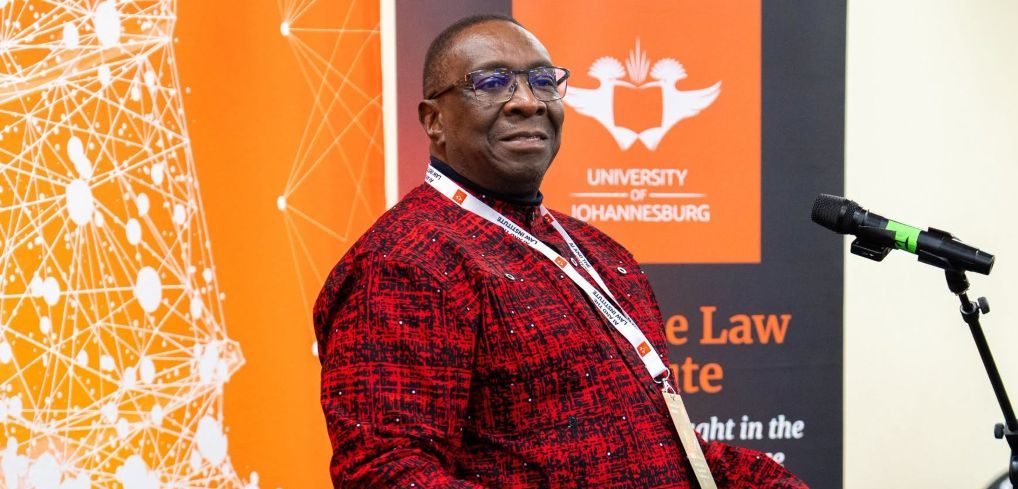
- Deputy Chief Justice Dunstan Mlambo says South Africa’s courts have already entered the digital era through platforms such as Court Online and CaseLines.
- Artificial intelligence can reduce delays, improve efficiency and expand access to justice when implemented responsibly.
- Constitutional rights, judicial independence and human discretion must remain central to every legal decision.
South Africa’s justice system has already entered the digital age, but the constitutional challenge is ensuring that artificial intelligence strengthens, rather than undermines, the values on which the country’s democracy is built.
That was the central message delivered by Deputy Chief Justice Dunstan Mlambo during the opening keynote address at the University of Johannesburg’s inaugural AI and the Law Conference.
Among those in attendance were Minister of Justice and Constitutional Development Mmamoloko Kubayi, United Nations Under-Secretary-General and Rector of the United Nations University Professor Tshilidzi Marwala, UJ Vice-Chancellor and Principal Professor Letlhokwa George Mpedi, as well as legal practitioners, academics and technology experts.
Justice Mlambo said South Africa’s courts are already using digital technologies and that the debate is no longer about whether technology should form part of the administration of justice.
He told delegates, “The constitutional question is not whether South Africa will use new technologies in the administration of justice. We already do.”
According to Justice Mlambo, the real constitutional question is whether those technologies will be used in a manner that preserves the country’s founding values.
He added, “The constitutional question is whether we will do so in a manner that preserves human dignity, equality, openness, accountability and, importantly, human discretion.”
Justice Mlambo pointed to Court Online and CaseLines as examples of how technology is already modernising the administration of justice by enabling electronic filing, digital case management and improved access to court services.
He said these innovations have the potential to reduce delays, lower costs, improve efficiency, expand access to justice and curb opportunities for corruption.
Justice Mlambo cautioned, however, that technological advancement must never come at the expense of constitutional rights, judicial independence or public confidence in the courts.
Technology must strengthen justice
Justice Mlambo warned that algorithmic bias, privacy concerns, unequal digital access and excessive reliance on automated systems could undermine the very principles the justice system is intended to uphold. “A faster system may still be an excluding system,” he cautioned.
He stressed that every technological innovation introduced into the justice system should ultimately be measured against a simple constitutional principle. “A court must not only be fair; it must be intelligibly fair,” Justice Mlambo emphasised.
Artificial intelligence must protect constitutional values
Justice Mlambo said the responsible use of artificial intelligence is one of the defining challenges facing South Africa’s justice system.
He emphasised that the debate is no longer about whether new technologies should be used in the administration of justice, but whether they can be implemented in a manner that preserves human dignity, equality, openness, accountability and human discretion.
Get your news on the go. Clickto follow the Conviction WhatsApp channel.
