


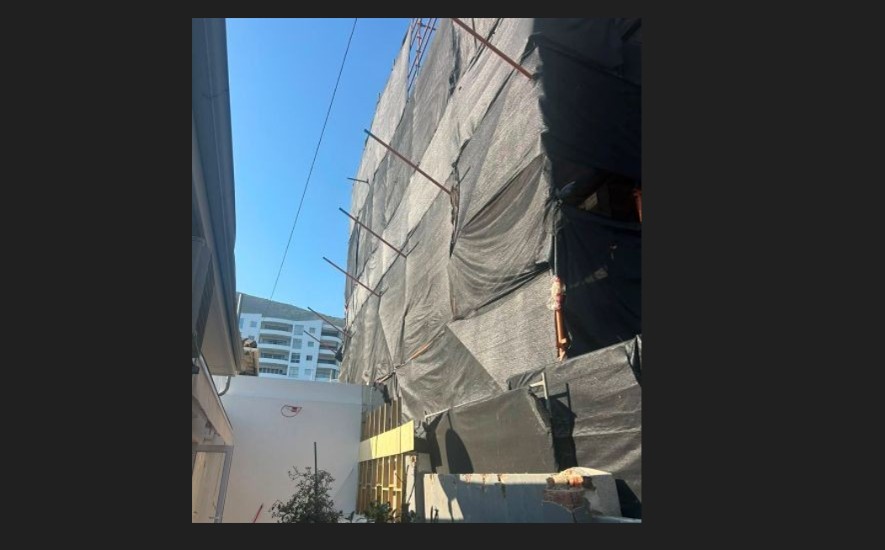
- The dispute centred on rear common boundary building lines in Sea Point.
- Judge A Kantor ruled that the City approved the plans due to a material error of law.
- The court declared the approvals unlawful but allowed the development to continue.
A residents association has succeeded in proving that the City of Cape Town unlawfully approved building plans for a luxury Sea Point development, with the High Court finding the municipality had misinterpreted its own Development Management Scheme.
The High Court ruled that approvals granted on 3 June 2024 for two neighbouring five-storey apartment blocks did not comply with the City’s planning rules.
Judge A Kantor found that the approvals were tainted by a material error of law, but chose not to set them aside because construction is already underway. The application was brought by the Save Our Sea Point Residents Association against SBG Real Estate, the trustees of the Sky Trust, and the City of Cape Town.
The fight was over one planning rule
The dispute involved two adjoining erven on St Johns Road, where the developer received permission to construct luxury residential apartments.
Residents argued that the approved plans unlawfully allowed the buildings to stand only 1.68 metres from a rear common boundary instead of the required 4.5 metre setback. The developer maintained that an exception in the Development Management Scheme permitted the reduced building line because the properties were less than 18 metres deep.
Judge Kantor said the legal battle ultimately came down to a single question. The judge wrote that “the issue which crystallised in argument” was whether the plans complied with the City’s Development Management Scheme.
The City chose to abide by the court’s decision while the developer opposed the review.
Judge Kantor says the City misread its own scheme
The judgment found that the City interpreted the 18-metre exception incorrectly by applying it to rear common boundaries.
Judge Kantor held that the exception applies only to common boundaries that intersect a street boundary and not to boundaries that do not intersect a street.
The judge concluded, “The plans were approved in consequence of a material error of law”. The judge said the City’s 2021 advisory had contributed to confusion over the meaning of the planning rules.
Judge Kantor added that “the answer lies not in them being side or rear” but in whether the boundaries are street-intersecting building lines.
Residents formed a new association to take the matter to court
The properties were purchased in 2022 before demolition permits were obtained and building plans were submitted during 2023.
The plans were approved in June 2024 and later extended into 2025. A separate application to consolidate the erven was approved before the Mayor upheld an internal appeal against that consolidation in November 2025. The building plan approvals, however, remained valid.
Construction began in February 2026. Residents then started corresponding with City officials and sought support from the Sea Point, Fresnaye, and Bantry Bay Ratepayers and Residents Association. After the ratepayers association declined to pursue litigation, they established the Save Our Sea Point Residents Association and launched the review in April 2026.
Judge Kantor extended the statutory 180-day period after finding it was in the interests of justice to hear the matter because residents had consistently opposed the development and only discovered the legal flaw once construction had started.
Why the buildings will stay
Although the court found the approvals unlawful, it refused to invalidate them. Judge Kantor said substantial construction had already taken place and the developer had relied on approvals lawfully issued by the City.
The court also found that setting the approvals aside would have little practical effect, as the buildings could still be redesigned to comply with the 4.5-metre setback or a planning departure could be sought.
Instead, the court issued a declaratory order confirming that no building may be erected nearer than 4.5 metres to a common boundary that does not intersect a street boundary.
SBG Real Estate and the Sky Trust were ordered to pay the residents association’s legal costs, while the association must pay the wasted costs of an earlier postponed hearing.
Get your news on the go. Click here to follow the Conviction WhatsApp channel.
