



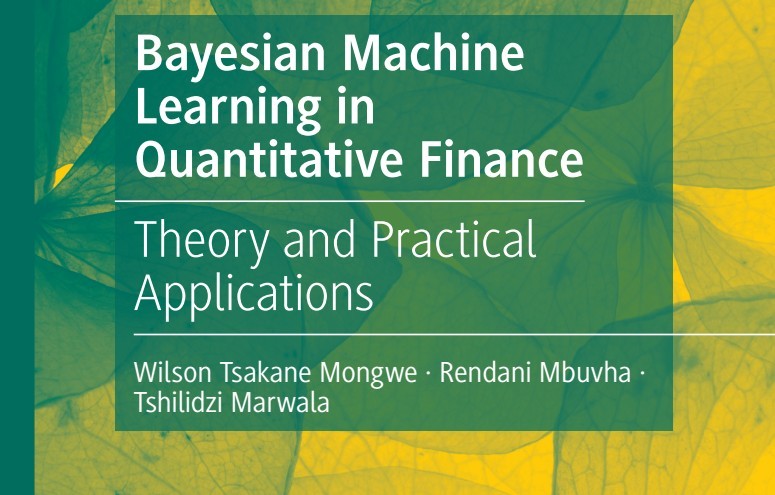
- A new book shows how Bayesian machine learning can be applied to real financial decisions in banking, insurance, and investment.
- Mongwe and his co-authors question models that provide single answers without addressing uncertainty.
- The work emphasises transparency and measurable confidence as key aspects of modern financial systems.
Financial institutions make high-stakes decisions daily, often using models that present a single answer without indicating its reliability. The gap between output and confidence is what Bayesian Machine Learning in Quantitative Finance aims to address directly.
Written by Wilson Dr Tsakane Mongwe, Rendani Mbuvha, and Tshilidzi Marwala, the book reflects a practical frustration within the financial sector.
Mongwe shares, “After it came out, we kept getting the same question from colleagues working in banks and insurers, who said, ‘This is interesting, but how do I actually use it in my job?’”
That question arose following their earlier book, Hamiltonian Monte Carlo Methods in Machine Learning, and became the foundation for this new work. He adds, “We wanted to take these methods out of research papers and demonstrate how they apply to everyday problems in finance, such as pricing insurance, making lending decisions, and managing investments.”
From Tzaneen to quantitative finance
Mongwe’s perspective on the subject combines technical depth with personal experience. Born in Tembisa and raised in Tzaneen by his grandmother, he finished his schooling in Limpopo before studying actuarial science at the University of Cape Town.
He earned a master’s degree in Mathematical Finance and later obtained a computer science qualification from the University of South Africa. Eventually, he completed a PhD in Artificial Intelligence at the University of Johannesburg, under Marwala's supervision.
He describes his attraction to the field plainly: “I enjoy mathematics, and in finance, the mathematics has real effects on people’s savings, their insurance premiums, and their access to credit.”
Why one number hides more than it reveals
A main argument in the book is that traditional financial models create a false sense of certainty. They offer a single estimate and treat it as the answer, even when the answer may come from weak or incomplete information.
Mongwe notes, “If I ask a regular financial model what a share will be worth next month, it gives me one number, say R120. That is useful, but it hides a lot. It does not tell me whether R120 is a strong estimate or a rough guess.”
The book introduces a probabilistic framework. Instead of one number, models provide a range of outcomes along with a measure of confidence.
He explains, “A Bayesian model offers a range instead. It still gives you the most likely value, but it also shows how wide the range of possibilities is and how confident the model really is.”
He adds, “It’s the difference between someone saying it will rain tomorrow and someone saying there’s a 70 percent chance of rain. You behave differently depending on which one you hear.”
What this looks like in practice
The book’s strength lies in how it translates these concepts into real financial settings. One of the clearest examples is in insurance pricing, especially when data is limited.
Mongwe explains that traditional models perform well with large data sets, such as in major cities, but struggle in smaller or rural areas. In those cases, models may still deliver precise outputs without recognising their own uncertainty.
He elaborates, “A Bayesian model is more honest. It will still give you a premium, but it indicates when the estimate relies on limited information.”
He describes the consequences: “When an insurer prices a policy without realising how little it knows, it can make costly mistakes. It might price too high and lose customers or too low and take on more risk than expected.”
Transparency is becoming unavoidable
The book consistently returns to the issue of explainability. Financial models do not work alone. Their outputs impact real people and must be justified.
Mongwe states, “If a model denies your loan or sets your insurance premium, someone has to explain why, to you, to a regulator, to the board.”
He points out that black-box systems have difficulty in this context because explanations may be absent or only created after the fact.
Mongwe explains, “What is pushing everyone in this direction is not necessarily the technology. It is mainly the regulators. They are asking tougher questions about how models are built, when they fail, and what the institution does to verify them.”
He adds that some institutions are already adapting while others continue to use models that overlook uncertainty.
Mongwe says, “Our data is often patchy. The methods that properly quantify uncertainty are especially useful in these situations.”
He notes that South Africa has a chance to adopt these approaches earlier, as it is less constrained by outdated systems.
Opening the door for others
Mongwe concludes, “I did not know any actuaries growing up. I did not know anyone who worked in a bank. Mathematics opened the door, and the scholarship guided me through it.”
Get your news on the go. Click here to follow the Conviction WhatsApp channel.
