


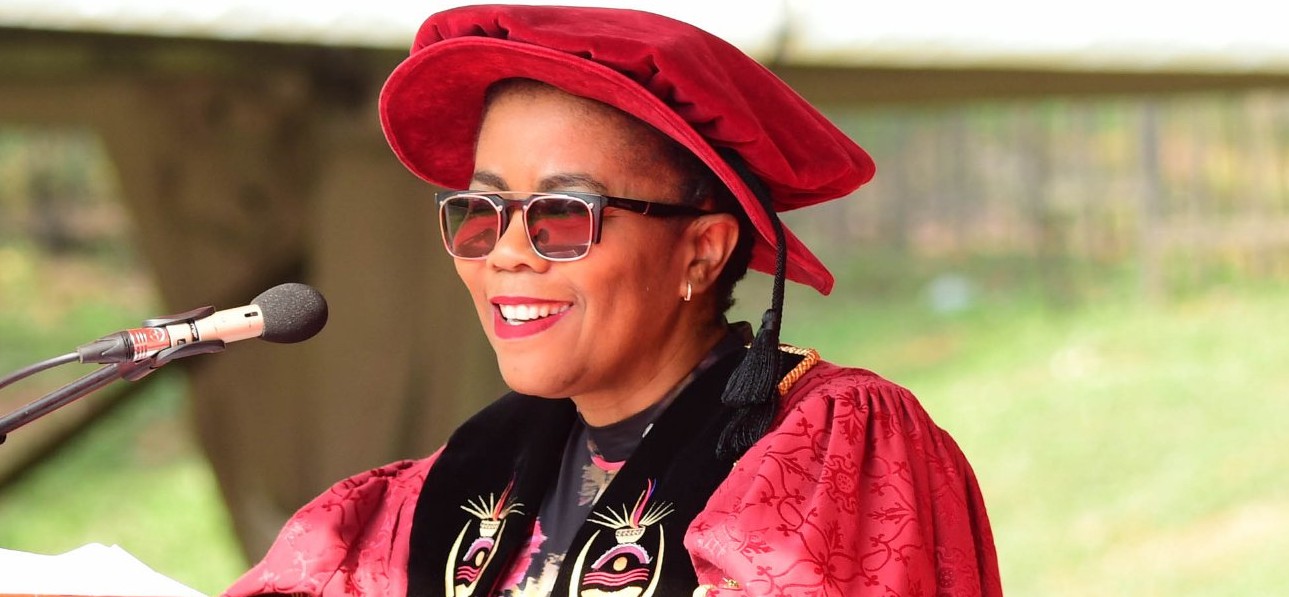
- Unisa recorded 2,608.3 research output units and contributed approximately 10% of South Africa's total research output.
- Professor Puleng LenkaBula's leadership coincided with Unisa's rise from sixth to second position nationally for research productivity.
- The achievement challenges stereotypes about women, particularly black women, in leadership and academia.
There is a famous observation by civil rights activist Malcolm X that "the most disrespected person in America is the Black woman."
Decades later, the sentiment still resonates deeply, even beyond America. Across all societies, black women continue to face disproportionate scrutiny, exclusion and doubt, particularly when they occupy positions of power. Leadership spaces remain contested terrains for women.
In academia, where intellectual authority and institutional influence have historically been concentrated in male hands, women leaders are often expected to prove themselves repeatedly before they are afforded the legitimacy automatically granted to their counterparts. Yet history continues to demonstrate that when women lead, institutions flourish.
The recently released Department of Higher Education and Training (DHET) 2024 Universities' Research Outputs Sector Report offers compelling evidence of this reality.
Unisa's remarkable rise in research productivity, under the able leadership of Professor Puleng LenkaBula, is more than an institutional achievement. It is a powerful statement about what is possible when visionary leadership is entrusted to women and when institutions deliberately cultivate environments where excellence can thrive.
The University of South Africa recorded an impressive 2,608.3 research output units, placing it second nationally among South Africa's universities and contributing approximately 10% of the country's total research output. Journal article outputs increased significantly to 2,221.6 units, while book chapters and conference proceedings also demonstrated substantial growth.
These are not merely statistics. They represent knowledge creation, intellectual advancement, postgraduate development and solutions to societal challenges. They represent scholars producing work that influences policy, shapes communities and contributes to global conversations.
Importantly, this achievement comes within five years of Professor LenkaBula's appointment as Unisa's first black woman Principal and Vice Chancellor. Her appointment was met, as many pioneering appointments are, with questions, reservations and scepticism. Some wondered whether a black woman could successfully lead one of the largest distance learning institutions on the African continent. Today, the evidence speaks for itself.
Under her leadership, Unisa has experienced extraordinary growth in research outputs, rising from sixth to second position nationally and emerging as one of South Africa's most significant contributors to knowledge production. The university's research trajectory reflects strategic vision, institutional stability and an unwavering commitment to academic excellence.
Challenging assumptions about women leaders
Let's be clear, though. This article is not about elevating one individual above others. It is about what Professor LenkaBula's leadership symbolises in a broader struggle for recognition, representation and transformation. For generations, women have been told that leadership is not their natural domain.
They have been encouraged to remain in supportive roles rather than decision-making positions. Even today, women leaders are often judged through the lens of gender rather than competence.
The achievements reflected in the DHET report directly challenge these assumptions. They challenge the notion that women are less capable of steering complex institutions. They challenge the stereotype that leadership requires traditionally masculine traits. They challenge the enduring belief that black women should occupy the margins rather than the centre of institutional power.
Perhaps most importantly, they demonstrate that excellence and transformation are not mutually exclusive. This is particularly significant when viewed through the lens of one of Unisa's catalytic niche areas, Feminist, Womanist and Bosadi Theorisations.
This area recognises that mainstream understandings of gender justice often fail to account for the unique experiences of African women and black women whose realities are shaped by the intersections of race, class, culture and gender.
Bosadi and Womanist perspectives remind us that representation alone is insufficient. Transformation requires creating spaces where women can lead authentically, shape institutional cultures and influence knowledge production itself.
The story emerging from Unisa's research outputs is therefore not only about performance indicators. It is about what happens when leadership creates conditions for others to excel. It is about nurturing scholars across eight colleges. It is about strengthening postgraduate supervision, expanding doctoral production and cultivating a research culture that positions African knowledge at the centre of global conversations.
Expanding possibilities for future generations
As the late Nobel Laureate Wangari Maathai once observed, "The higher you go, the fewer women there are." Her words capture a reality that remains stubbornly true in many sectors, including higher education. Yet every woman who succeeds in leadership expands possibilities for those who follow.
Echoing these sentiments, former United States First Lady Michelle Obama also reminds us that "There is no limit to what we, as women, can accomplish." Such statements are often dismissed as inspirational rhetoric. But the DHET report demonstrates that they are, in fact, grounded in reality.
The significance of Unisa's achievement, therefore, extends beyond institutional rankings. It sends a message to young women entering academia, to aspiring researchers, to doctoral candidates and to future university leaders. There is space for you here. You do not have to choose between being a woman and being a leader. You do not have to choose between transformation and excellence. You do not have to apologise for ambition.
The future of higher education depends on diverse voices, inclusive leadership and the courage to challenge outdated assumptions about who belongs at the helm. When black women lead successfully, they do more than occupy positions of authority. They disrupt historical patterns, create new possibilities and leave institutions stronger than they found them.
The 2024 Universities' Research Outputs Sector Report is therefore more than a record of research productivity. It is a reminder that leadership should be judged not by prejudice, perception or stereotype, but by outcomes. Most importantly, it tells a story of what becomes possible when women are allowed not merely to participate, but to lead.
Get your news on the go. Click here to follow the Conviction WhatsApp channel.
