


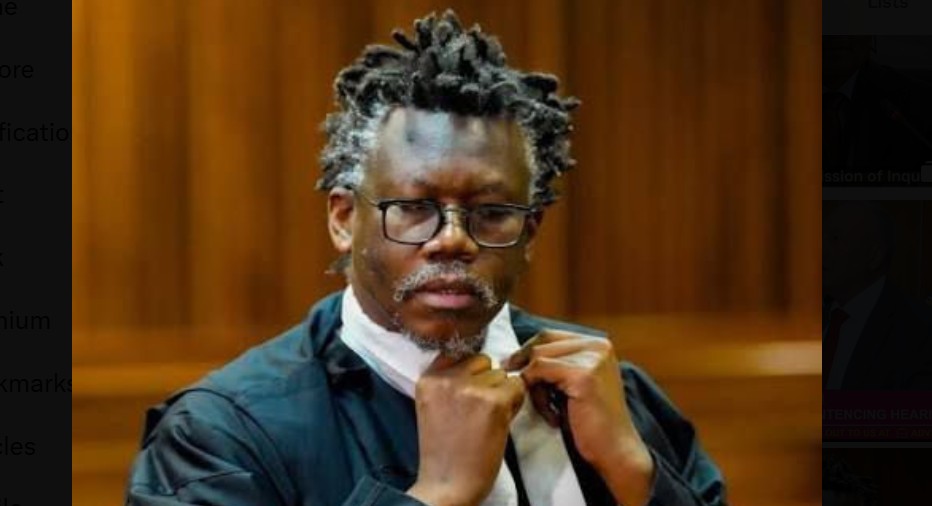
- The backlash against Advocate Tembeka Ngcukaitobi has reignited debate over the meaning of blackness in post apartheid South Africa.
- Black professionals and intellectuals continue to operate within systems shaped by white supremacist capitalism and inherited inequality.
- Steve Biko’s philosophy of Black Consciousness is presented as requiring re-examination within a society that claims to be non-racial.
Some self-appointed police and spokespersons of Black Consciousness cannot sleep. They lie awake gnashing their teeth in anger because Advocate Tembeka Ngcukaitobi has chosen to stand alongside white law firms and AfriForum to oppose the enforcement of BEE-type legislation in the legal fraternity.
To them, this is betrayal. They question his allegiance, his commitment, his very claim to “Blackness”. It is assumed that he is a radical Pan-Africanist or BC exponent. After all, he wrote an exposé on This Land about dispossession.
But look closer. We find that, like millions of others, the advocate is working within the prescriptions of the supremacist capitalist economic system and the Constitution of the country. In this place, Lady Justice is supposed to be blind, non-racial, and impartial. This legal gig to defend alleged racists offers prestige and money, presumably.
Yet the real discomfort lies deeper. It forces us to ask what “Blackness” means in a society that claims to be non-racial. Is it still relevant? We must look at the man in the mirror to answer whether anyone here is truly outside the system we claim to oppose. We are in the belly of the beast.
Defining “Blackness” in a non-racial society
The first confusion is linguistic and political. In post apartheid South Africa, we speak of a “non-racial” society. The Constitution prohibits unfair discrimination based on race. There are no blacks or whites, just South Africans. Yet our policy framework, our discourse, our reaction to the advocate, and our lived experience remain saturated with racial categories. This is apartheid baggage.
Here, Steve Biko’s definition remains the sharpest tool we have. For Biko, Blackness was never primarily about skin colour. It was a mental attitude, a political identity of people who were committed to fighting oppression in the supremacist system and chose to see themselves as part of a common struggle for liberation and dignity. “Black” included Africans, Coloureds, and Indians who shared the experience of racial domination and chose solidarity over division.
It must be said that this definition was narrow in that it did not necessarily include those who opposed white privilege and voluntarily chose to be part of the struggle. In a non-racial society, there is a need to re-examine and redefine the meaning of black. The nativist definition of black has become problematic and provocative.
Thus, its redefinition becomes both more urgent and more contested. If the state no longer officially recognises race, what holds the concept of Blackness together? Is it history, culture, class position, or a political posture toward power?
What about young blacks who have neither exposure to nor experience of black living conditions that are mostly associated with suffering, misery and, above all, oppositional politics to apartheid created injustice and inequality?
The current confusion stems from collapsing Biko’s political Blackness into a biological category. When people ask, “Does Advocate Ngcukaitobi act Black enough?”, they are using skin colour as a proxy for political loyalty.
But Biko warned against this. The fact that you are not white does not make you black in the political sense. Conversely, a white person who aligns with the liberation struggle could, in Biko’s framework, be part of the Black Consciousness project. Sadly, self-proclaimed BC exponents have struggled to grasp this idea.
So the first task for black intellectuals and activists is to reclaim this distinction. We must ask whether Blackness is a label assigned by the state for redress purposes, or a living philosophy of resistance, self-reliance, and psychological liberation. If we cannot answer that, every public action will be read either as betrayal or as a purity test.
What would Biko say?
Biko died 50 years ago on 12 September 1977. Sadly, his philosophy has neither been updated nor correctly interpreted in public discourse. He would likely be unimpressed by both sides of this fight.
To those who condemn Ngcukaitobi for working with white law firms and AfriForum, Biko would ask: What is your theory of power? If your entire politics is reactive, built on who you oppose rather than what you build, then you have already lost.
Black Consciousness was about self-definition, not about policing who speaks to whom. If a black advocate uses the legal system to challenge legislation he believes undermines the Constitution, that is not automatically capitulation. It is using the tools available to contest power from within.
To those who celebrate the move as evidence that we are now “beyond race”, Biko would be equally sceptical. He understood that legal formalism without material change is a trap.
A blind Lady Justice in a society where 80% of land, capital, and professional networks remain in white hands is not neutrality. It is a veneer that preserves the status quo.
Biko would push us back to the core question: Does this action increase the self-reliance, dignity, and power of Black people as a group? If not, then it is just movement within the cage.
Justice is blind, but the system is not
The phrase “Lady Justice is blind” is often invoked as if it settles the matter. It does not. Blind justice means the law applies equally, regardless of race, gender, or class. In theory, this is the ideal. In practice, equality before the law means little when the parties entering the courtroom do not start from equal positions.
One side owns the firms, the client networks, the intergenerational capital, and the institutional memory. The other side is trying to break in through legislation designed to redistribute access.
When Ngcukaitobi opposes BEE-type enforcement, he is arguing from within the logic of formal legal equality. That argument has weight. But it also ignores that formal equality in an unequal society reproduces inequality.
This is the contradiction of liberal legalism in post-colonial contexts. The Constitution is non-racial, but the economy is not. The courts are blind, but the market sees colour very clearly.
So the question is not whether the advocate is right on legal grounds. The question is whether legal rightness alone advances the project of liberation, or whether it becomes a mechanism for maintaining existing hierarchies.
We come from a history where the law was morally wrong. Doing the right thing and doing things right are not the same thing.
Black professionals in a white-owned economy
Here lies the material reality that complicates every moral stance. Most Black professionals work in a white-dominated society and white-owned companies.
The legal fraternity, banking, accounting, engineering, media, and academia are all structured around networks, capital, and cultural norms established during colonialism and apartheid and never fully dismantled.
This creates a structural bind. To practise law at scale, you need access to corporate clients, who are overwhelmingly white-owned. To publish, you need distributors and funders embedded in the same networks. To lecture, you need accreditation and funding from institutions with historical advantages.
Afrikaner poet Breyten Breytenbach put it bluntly, “We have all become part of the system we fought against.” The supremacist capitalist economic system did not disappear in 1994. It adapted. And many of us now manage it, defend it, and benefit from it, even as we critique it.
This does not mean everyone is a sellout. It means the choice is never clean. Every Black professional who takes a brief from a white firm, lectures at a historically white university, publishes with a legacy house, or sends children to white schools is operating inside the system.
The ethical question is not “are you inside?”, but “what are you doing with your position inside?” Are you redistributing access? Are you changing the culture? Are you pushing boundaries and building alternatives? Or are you simply managing your career?
The role and struggle of every man must be left to the conviction and conscience of every man. It is the right of every man to strive for security, safety, and comfort as his conscience dictates.
This right to be the kind of black you want to be is, in its nature, inalienable. After all, blacks are not homogeneous.
Racial reconciliation against racism and inequality
The final tension is between reconciliation and transformation. South Africa chose a path of negotiated transition that prioritised political stability and formal equality. That choice prevented civil war, but it deferred the question of economic justice.
Racial reconciliation without addressing inequality becomes an empty ritual. You can have joint braais, shared sports teams, and non-racial constitutionalism while the material gap widens.
Conversely, aggressive redress without a shared political identity risks reproducing the very racial consciousness we claim to transcend.
What is needed is a politics that holds both together. Reconciliation that does not confront white supremacist capitalism is cosmetic. Anti racism that does not build new institutions, new ownership patterns, and new cultural centres is performative.
Biko’s Black Consciousness was never about hating white people or refusing to work with them. It was about Black people refusing to be defined by white power and building their own psychological and material base. That project remains unfinished.
Conclusion
The honest answer is almost no one, in the strict sense. If you earn a salary, pay taxes, use banks, consume, and operate within South Africa’s economy, you are part of a system rooted in colonial extraction and racial capitalism. The more useful question is who is consciously working to change it.
Ngcukaitobi’s case is a mirror. It forces us to confront the gap between our rhetoric and our reality, between Biko’s political Blackness and our current racial essentialism, between legal formalism and material justice.
If we are serious about moving beyond this, Black intellectuals, activists, and academics must do the hard work Biko demanded, update the philosophy, redefine Blackness as a political project of liberation, and build institutions that give that project teeth.
Until then, we will keep fighting over individuals while the system keeps running. And we will all remain, to varying degrees, part of the Establishment we claim to oppose.
Get your news on the go. Click here to follow the Conviction WhatsApp channel.
