


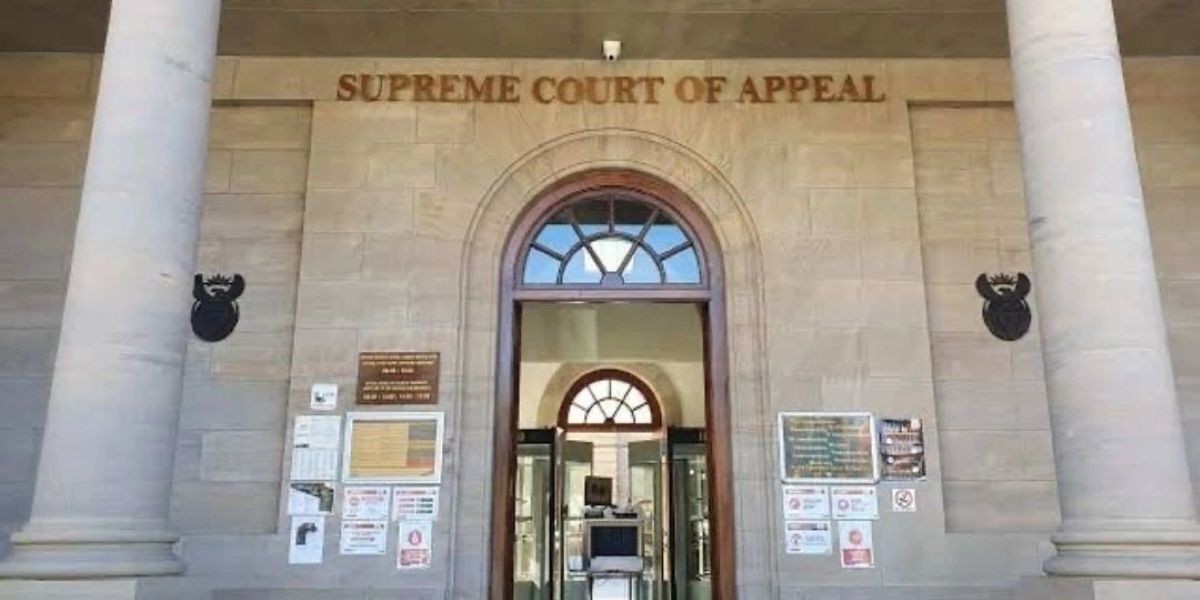
- The High Court in Pretoria has declared unconstitutional the Supreme Court of Appeal rule that limited document filing to attorneys practising in Bloemfontein.
- Judge Davis found that the requirement unfairly increased litigation costs and restricted access to justice.
- The ruling removes a procedural barrier that has affected appeals to South Africa’s second-highest court for decades.
For decades, attorneys representing clients in the Supreme Court of Appeal generally had to appoint a correspondent attorney in Bloemfontein simply to lodge court documents, even when they were already handling the appeal themselves.
That long-standing practice has now ended, after the High Court in Pretoria declared unconstitutional the part of the Supreme Court of Appeal Rules that restricted the lodging of documents to attorneys practising in Bloemfontein.
The court found the requirement imposed unnecessary costs on litigants, unfairly differentiated between legal practitioners based on where they practised, and unjustifiably limited the constitutional right of access to courts.
Judge N Davis delivered the judgment in two consolidated cases brought by Marweshe Attorneys and members of the Buta family, as well as Bongani Silence Baloyi.
The respondents included the Minister of Justice and Constitutional Development, the Rules Board, the Legal Practice Council, and the Black Lawyers Association. The Association of Bloemfontein SCA Practitioners opposed the applications as an intervening party.
Why Bloemfontein mattered
The challenge focused on the definition of “lodging of documents with the registrar” in Rule 1(1) of the Rules Regulating the Conduct of Proceedings in the Supreme Court of Appeal.
The rule required documents to be lodged through an attorney practising in Bloemfontein, unless the litigant was unrepresented. In practice, attorneys from other parts of South Africa could prepare and argue an appeal, but they could not complete the final administrative step of lodging the documents with the registrar.
The applicants argued that this forced litigants to hire a second attorney simply because of geography, adding to the costs of appeals and making access to the Supreme Court of Appeal more expensive than it needed to be.
Marweshe Attorneys told the court that the issue became clear when members of the Buta family, whom the firm represented pro bono, were quoted R25 000 by a Bloemfontein practitioner just to lodge their appeal record.
Baloyi, who is serving a prison sentence, faced a similar challenge after being quoted around R87 000 to compile his appeal record, not including the costs of lodging it.
Court finds geography cannot determine access
Judge Davis found that the rule created an unjustifiable distinction between attorneys admitted to practise nationally, simply because some happened to be based in Bloemfontein.
The judge noted that an attorney who could lodge documents while practising in Bloemfontein would lose that right immediately if they moved elsewhere, even though they would still be an admitted legal practitioner.
“I therefore find that the impugned rule infringes on the Buta family’s right of access to courts guaranteed by section 34 of the Constitution,” Judge Davis said.
The court also rejected the argument that restricting lodgement to Bloemfontein practitioners was necessary to ensure compliance with the Supreme Court of Appeal’s filing requirements.
“Having regard to the above and the anomalies already referred to regarding the nature of the limitation, I find that the infringement on the rights of appellants to access the SCA outweighs any attempt at ensuring compliance with the SCA rules by granting the Bloemfontein practitioners exclusive rights to lodge documents with the SCA. The limitation in the impugned rule is therefore not justifiable and should be removed,” the judge ruled.
Judge Davis also found that this differentiation impaired the dignity of attorneys practising outside Bloemfontein and amounted to unfair discrimination, since there was no rational basis for the distinction.
Bloemfontein practitioners defended the rule
The Association of Bloemfontein SCA Practitioners argued that the rule was not meant to protect financial interests, but reflected the practical realities of filing documents at the Supreme Court of Appeal, where paper-based processes are still in place.
The association told the court, “The filing of documents in the SCA is a meticulous process. It is important to bear in mind that, for now, the SCA still uses manual filing.”
The association argued that practitioners who regularly deal with the registrar are better placed to ensure compliance with the court’s procedural requirements.
Electronic filing request refused
The applicants also asked the court to order the introduction of electronic filing in the Supreme Court of Appeal.
Judge Davis accepted that digital filing is still “a work in progress” but declined to issue a mandatory order. He held that implementing an electronic filing system involves policy and administrative decisions that should not be dictated by the court.
Order removes a long-standing procedural requirement
The High Court declared unconstitutional the definition of “lodging of documents with the registrar” in Rule 1(1), to the extent that it limited the lodging of documents to attorneys practising in Bloemfontein.
The court ordered that the words “practising in Bloemfontein” be removed from the rule. Judgment was delivered on 30 July 2026.
Get your news on the go. Click here to follow the Conviction WhatsApp channel.
