


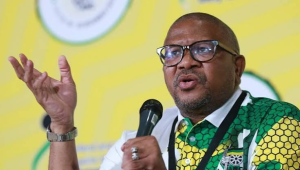


- Nel links corruption to weakened justice and prolonged suffering for families of the missing.
- Progress noted in anti-corruption reforms, but prosecutions remain slow and uneven.
- Calls for stronger whistle-blower protections, transparent procurement, and whole-of-society effort.
Deputy Minister of Justice and Constitutional Development, Andries Nel, used the International Day of the Disappeared commemoration in Pretoria to deliver a sharp warning on the cost of corruption in South Africa.
Speaking at the gathering on 28 August 2025, he described corruption as a crime that robs not only public coffers but also the dignity, safety, and hope of ordinary people.
“Corruption is not a victimless crime. Each rand stolen is a classroom not built, a clinic not staffed, a road not repaired,” Nel said, addressing families of the missing, civil society, and international partners gathered for the event. “The stakes are not abstract; they are felt daily in the lives of South Africans.”
When weak institutions deepen family pain
The commemoration, hosted by the International Committee of the Red Cross (ICRC) and the South African Red Cross Society, highlighted the anguish of families still searching for missing loved ones. In this regard, Head of ICRC in Southern Africa Jules Amoti said addressing the issue of missing persons will pave the way for peace and reconciliation and for people to continue with their lives.
For Nel, the occasion was a reminder that corruption and weak governance deepen social pain by delaying justice and denying answers. “Our Constitution enshrines accountability, responsiveness, and openness,” he said. “When corruption undermines these principles, it compounds tragedies like forced disappearances by weakening the very institutions that should provide truth and closure.”
Progress and shortcomings in anti-corruption work
Nel acknowledged progress made through the National Anti-Corruption Strategy: better coordination among law enforcement agencies, stronger whistle-blower protections, and reforms to procurement and anti-money laundering legislation.
But he was equally blunt about shortcomings. “Too often, investigations do not translate into prosecutions, and prosecutions do not translate into convictions. Capacity constraints, siloed operations, and slow consequence management frustrate citizens and embolden the corrupt.”
He urged the council to focus on three priorities: transparent digital procurement to close loopholes, stronger protections for whistle-blowers and activists, and tighter consequence management across the justice cluster.
Rebuilding trust, restoring hope
For families of the missing, the absence of answers remains a personal tragedy. For Nel, it is also a political and social challenge, one that corruption makes worse by hollowing out state capacity.
“Corruption cannot be defeated by government alone,” he stressed. “Business, labour, religious communities, academia, and civil society must all be partners. Together, we can reweave the fabric of trust that corruption has torn apart.”
As the ICRC reminded, every missing person is more than a statistic, and every family’s unanswered questions are wounds that linger. Nel’s message was clear: defeating corruption is inseparable from delivering justice, healing, and dignity to families and communities across South Africa.
“Our success will not be measured in reports written,” he concluded, “but in lives improved, institutions strengthened, and trust restored.”
Conviction.co.za
Get your news on the go. Click here to follow the Conviction WhatsApp channel.


