


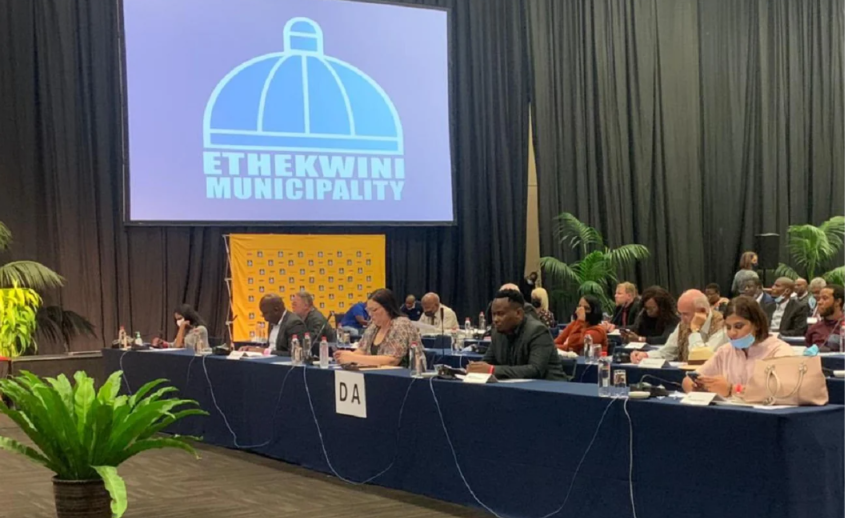
- The High Court set aside eThekwini Municipality’s decision to appoint three senior managers, declaring the appointments unlawful and unconstitutional.
- The recruitment process was materially flawed, including incomplete background screening, failure to consider relevant information and the appointment of a candidate who did not meet the advertised qualifications.
- The municipality, its mayor, municipal manager and the three appointees were ordered to pay the Democratic Alliance’s legal costs jointly and severally.
The Democratic Alliance has succeeded in its legal challenge to the appointment of three senior managers at eThekwini Municipality. The High Court set aside the appointments after finding serious irregularities in the recruitment process.
In a judgment delivered on 10 November 2026, Judge SD Hlatshwayo of the High Court in Durban declared the municipal council’s decision unlawful, invalid and inconsistent with the Constitution. The court found the municipality failed to comply with important recruitment requirements, including proper candidate screening, verification of qualifications and meaningful consideration of adverse performance findings.
Recruitment process found to be fundamentally flawed
The dispute arose from the municipality’s decision on 13 November 2025 to appoint Lindokuhle Mkhize as Executive Director: Operations Management, Cyril Bhekinkosi Mkhize as Executive Director: Public Safety and Ednick Msweli as Executive Director: Technical Management. The appointments followed a restructuring process that began in December 2024. The municipality advertised the three positions on 1 June 2025, with applications closing on 20 June 2025.
The selection panel was appointed in September 2025. Candidates underwent shortlisting, screening, competency assessments and interviews. The municipal manager presented recommendations to the executive committee, which supported the appointments. The municipal council approved the appointments on 13 November 2025.
The DA challenged the appointments on several grounds. The party argued the municipality failed to comply with the Local Government: Municipal Systems Act and the Regulations on Appointment and Conditions of Employment of Senior Managers.
Concerns were raised about the qualifications of the public safety appointee, adverse Auditor-General findings involving the technical services appointee, and whether the recruitment process had followed prescribed procedures.
The municipality opposed the application, claiming the candidates were suitably qualified and the process had substantially complied with the regulations. It argued that not every deviation from stipulated timeframes would automatically invalidate an appointment.
Incomplete screening undermined interviews
Judge Hlatshwayo found that some delays in the recruitment process did not, on their own, invalidate the appointments. The municipality provided explanations for the delays, which the court did not consider sufficiently serious to render the entire process unlawful. The court also rejected the DA’s argument that conducting psychometric assessments before interviews was irregular, as the regulations did not prohibit this approach.
However, the judge found a more serious problem with the screening process. Although the screening report was dated 15 October 2025, key information was obtained only later. Previous misconduct checks for candidates were received on 25 October, while reference checks for Msweli were received on 24 October and 4 November.
The selection committee should have completed the necessary screening before conducting interviews. This information was important for the interview panel to question candidates about relevant findings and give them a chance to respond. The court concluded that conducting interviews without complete screening information was an irregularity that tainted the process.
Council failed to satisfy itself before approving appointments
Another problem was the municipal council’s failure to independently establish whether the candidates met the requirements for their positions.
Regulation 17 requires a municipal council to satisfy itself that candidates meet the relevant competency requirements, have undergone the prescribed screening and do not appear on the record of employees dismissed for misconduct.
Judge Hlatshwayo found that the council did not have all the necessary information before approving the appointments. The municipality argued that councillors were not required to scrutinise every document and that the municipal manager’s report was sufficient.
The judge rejected this argument, finding that the council could not simply rely on the municipal manager’s recommendations without the information necessary to independently assess the candidates. The failure to do so amounted to an irregularity at the heart of the appointment process.
Public safety qualifications and water management findings
The court also found the municipality had appointed a candidate to the public safety executive director position who did not meet the advertised minimum qualification requirements.
The position required a Bachelor of Laws degree or an equivalent qualification. The candidate held a Bachelor of Arts degree and a Bachelor of Arts Honours degree, which the court found were not equivalent to the advertised requirement.
Judge Hlatshwayo said the municipality could not advertise a specific qualification and then appoint someone who did not possess it. Doing so was a serious irregularity that could unfairly exclude other applicants who might have qualified had the municipality advertised the position differently.
The judge also criticised the appointment of Msweli in light of adverse findings by the Auditor-General concerning the municipality’s water services directorate, which he had headed. The findings included failures relating to water-loss reduction, the provision of basic water services and the filling of vacant positions.
The Auditor-General also raised concerns about the municipality’s failure to address pollution at its northern wastewater treatment works, resulting in raw sewage being discharged into the Umhlathuzana and Umgeni rivers.
The court found Msweli had not been called upon to explain these findings before his appointment was approved. Judge Hlatshwayo said the municipality could not rely on a majority vote to avoid meaningfully engaging with information relevant to a candidate’s suitability for a senior management position.
Salary increase request raised further concerns
The judgment also considered the municipality’s decision on 4 December 2025 to apply to the Minister of Cooperative Governance and Traditional Affairs for the annual salaries of the three appointed managers to be increased to R2 916 751.
The judge found the municipality failed to provide a satisfactory explanation for seeking the increase less than a month after the appointments. Although the salary request was made after the appointment decision, the court considered it relevant to the broader recruitment process. The judge found that it suggested the appointments may have been a foregone conclusion and made in bad faith.
Appointments set aside
Judge Hlatshwayo concluded that the municipality had committed several material irregularities, including incomplete screening, failure to independently assess the candidates, appointing a candidate without the advertised qualifications and disregarding adverse Auditor-General findings.
The court rejected the municipality’s argument that the appointments should be preserved to ensure continuity in senior management and avoid disruption to service delivery. The judge found the recruitment process was fundamentally flawed and that the appropriate remedy was to set aside the appointments rather than preserve decisions that had not been made lawfully.
The court reviewed and set aside the municipal council’s decision of 13 November 2025 to appoint the three senior managers, declaring the appointments invalid, unlawful and inconsistent with the Constitution. It also declared that councillors did not breach the confidentiality provisions of the Local Government: Municipal Structures Act by disclosing information discussed during closed council sessions when bringing the judicial review application.
The eThekwini Municipal Council, the mayor, the municipal manager and three appointed managers were ordered to pay the costs of the application jointly and severally, including the costs of two counsel on Scale C.
Get your news on the go. Click here to follow the Conviction WhatsApp channel.
