


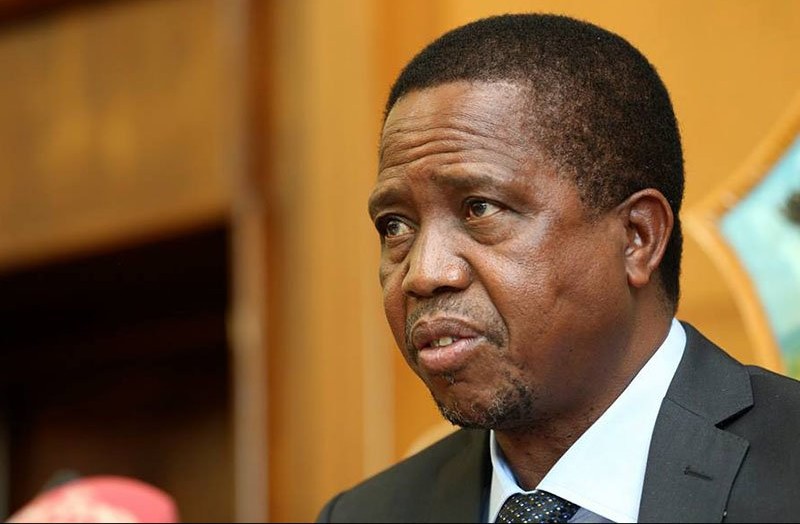
- The Supreme Court of Appeal ruled that Edgar Lungu’s family has the right to decide his burial arrangements.
- Judges rejected Zambia’s claim that it could repatriate and bury the former president for a state funeral.
- The court found there was no binding agreement requiring the family to allow a state funeral in Zambia.
The Supreme Court of Appeal has ruled that the family of former Zambian president Edgar Lungu, not the Zambian government, has the final say over his funeral and burial arrangements.
In a majority judgment, the appeal court overturned an earlier decision by the High Court in Pretoria that had authorised the Zambian government to repatriate Lungu’s body to Zambia for a state funeral and burial at Embassy Park in Lusaka.
The appeal court upheld an appeal brought by Lungu’s widow, Esther Lungu, along with other family members and spokesperson Makebi Zulu. It ordered the Zambian government’s application to be dismissed with costs.
Dispute followed former president's death in South Africa
Lungu travelled to South Africa in January 2025 for medical treatment after becoming seriously ill. He died on 5 June 2025 after being diagnosed with terminal oesophageal cancer.
Following his death, the Zambian government sought to repatriate his remains for a state funeral, to be attended by President Hakainde Hichilema, and for burial at Embassy Park, the designated burial site for former Zambian presidents.
His family opposed the plan, saying Lungu had repeatedly expressed the wish that President Hichilema should play no part in his funeral or burial.
According to Esther Lungu, the former president consistently stated during his final months that he did not want the Zambian government, and Hichilema in particular, involved in his funeral arrangements. He believed he had been mistreated after leaving office. The court accepted evidence that Lungu had expressed these wishes to family members and others before his death.
Court examines relationship with government
The judgment outlined several incidents that occurred after Lungu left office in 2021. These included being removed from a flight to South Korea, being prevented from attending a church service, restrictions on his ability to travel abroad, and the withdrawal of benefits usually granted to former presidents after he returned to active politics.
The court noted that Lungu later travelled to South Africa without official approval to get urgent medical treatment after his condition worsened. Judge of Appeal R Keightley said the evidence showed that these events helped explain why Lungu did not want President Hakainde Hichilema involved in his funeral.
The judgment stated that Lungu saw himself as unwelcome in Zambia and that his burial wishes were linked to his experiences after leaving office.
Family rights prevail
The appeal court found that South African common law generally recognises the right of a deceased person's next of kin to decide burial arrangements. It held that this principle is consistent with constitutional rights to dignity, privacy, and family autonomy.
The court said the dispute was unusual because it was not a disagreement between family members but between a family and the state. "Without a clear and convincing legal basis for finding differently, it would not be constitutionally permissible for the Zambian Government’s interests to override those of the family," the court held.
The judges also found that the constitutional value of ubuntu supported respecting Lungu’s wishes rather than overriding them.
Zambia failed to prove legal authority
The Zambian government argued that Zambian law, customs, and state funeral protocols gave it the authority to decide how a former president should be buried. The appeal court rejected that argument.
It found that no independent expert evidence had been presented to establish the content of the foreign law relied upon by the government. In the absence of such evidence, the court applied South African legal principles.
The court also rejected the government’s reliance on Zambia’s Benefits of Former Presidents Act. It found that Lungu’s benefits had been withdrawn before his death and that the legislation did not grant the government authority to make burial decisions.
No agreement reached
The Zambian government also argued that the family had agreed to repatriation and a state funeral during negotiations after Lungu’s death. However, the appeal court disagreed.
The court found that the documents relied upon by the government were part of ongoing discussions and did not amount to a binding agreement. It also held that the media reports cited by the government did not prove that the family had accepted a funeral presided over by Hichilema. "The family’s version that there was no agreement must prevail," the judgment stated.
Appeal succeeds
The majority of the court concluded that the Zambian government had failed to establish any legal basis to override the family's decision regarding Lungu’s burial.
As a result, the earlier order authorising the repatriation of his remains and burial in Zambia was set aside, leaving the family with the authority to determine the former president’s final resting place.
Get your news on the go. Click here to follow the Conviction WhatsApp channel.


