


- Sahrawi struggle for self-determination dismissed by MKP as 'Balkanisation', contradicting South Africa’s decolonial diplomacy.
- MKP exploits pan-African rhetoric to justify Morocco’s occupation, downplays ICJ and UN finding.
- Resource extraction from Western Sahara mirrors apartheid-era tactics and neocolonial exploitation.
The Sahrawi Arab Democratic Republic is a complete AU member state and is currently recognised by over forty United Nations (UN) member states. Despite decades of occupation by Morocco and the ongoing struggle for self-determination, its existence is a testament to the resilience of its people and the enduring principles of international law regarding decolonisation.
The UN classified this contested territory as a non-self-governing territory in 1963, following Spain’s submission of information under Article 73(e) of the UN Charter. However, the territory has remained in a state of legal limbo despite multiple resolutions, diplomatic interventions and a protracted conflict involving Morocco, the Polisario Front and Algeria.
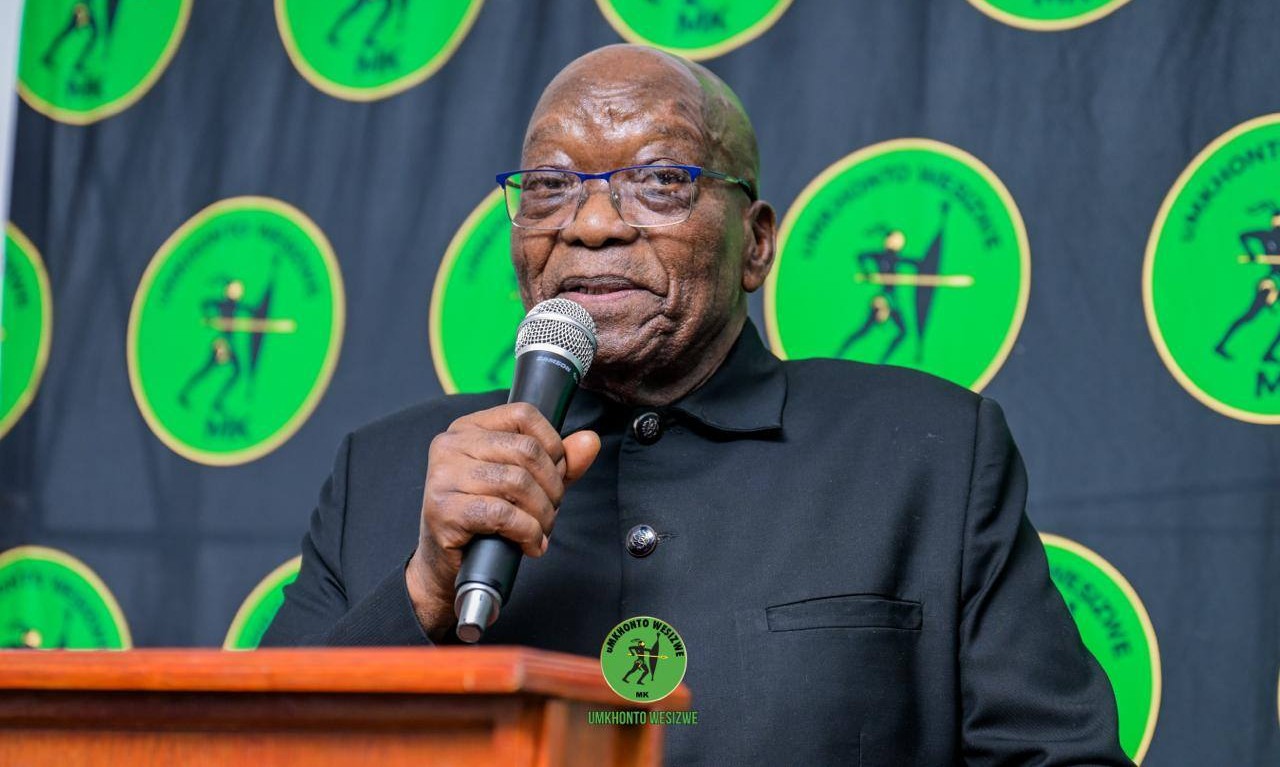
This status affirms that the Sahrawi people have yet to exercise their right to self-determination under international law. The recent political stunt by Jacob Zuma’s Umkhonto weSizwe Party (MKP), which dismissed this right as ‘Balkanisation,’ reflects a troubling ahistorisation of a people’s identity and a flagrant disregard for international legal norms.
South Africa’s genocide case against Israel at the International Court of Justice (ICJ) relied on its reputation for principled support of the occupied peoples. The MKP’s stance on Western Sahara would cripple this moral standing, inviting accusations of hypocrisy. Worse, Zuma’s use of the national flag during party-to-government talks with Morocco was improper, as he acted solely in his MKP capacity, not in any official national role.
Warped geopolitics of MKP locked in oppressive historical myths
In an op-ed, MKP parliamentarian Mzwanyele Manyi attempts to reframe the MKP’s position as a rejection of ‘Eurocentric binaries’ and a commitment to precolonial African structures. A closer examination reveals a deeply contradictory and, frankly, two-faced approach that undermines the very principles the MKP claims to uphold.
Manyi’s argument hinges on a romanticised and selective interpretation of history, conveniently overlooking the realities of international law and the fundamental right to self-determination that the African Union (AU) has consistently championed. To suggest that Western Sahara was merely ‘integrated with Morocco’ through ‘trade, kinship and religious institutions’ before colonialism, and that this somehow equates to legitimate sovereignty, is to deliberately blur the lines between historical influence and political dominion.
While precolonial connections existed, they do not negate the distinct identity of the Saharawi people or their internationally recognised right to choose their destiny. The assertion that Moroccan Sultans exercised “spiritual and political suzerainty” akin to the British monarch’s role over the Commonwealth is a disingenuous comparison. Based on colonial logics, the Commonwealth is a voluntary association of so-called independent states. Thus, it does not provide a historical justification for territorial claims over a people who have consistently sought their statehood.
Furthermore, equating Morocco’s actions in Western Sahara to an “African character” while simultaneously dismissing the Saharawi’s struggle for independence as “intellectually lazy and historically dishonest” reveals a profound bias. Who, then, defines ‘African character’ in this narrative? Is it only those who align with pre-colonial monarchies, regardless of the aspirations of indigenous populations?
A false MKP narrative of historical Moroccan suzerainty
Nevertheless, the 1975 International Court of Justice (ICJ) advisory opinion found no ties of territorial sovereignty between Western Sahara and Morocco. Manyi’s dismissal of this advisory opinion as “just that…an opinion, not a binding judgment” is a classic legal evasion, as it ignores its foundational role in the UN and AU’s stance on decolonisation. While advisory opinions are not directly binding in the same way as contentious judgments, they carry significant legal weight and are highly influential in international law.
The ICJ explicitly stated that it “did not find any ties of territorial sovereignty between the territory of Western Sahara and the Kingdom of Morocco or the Mauritanian entity.” This critical finding, conveniently downplayed by Manyi, directly challenges the MKP’s narrative of historical Moroccan suzerainty. To suggest that those who rely on this opinion are “disingenuously using it as a hammer” is to accuse the international legal framework itself of being disingenuous when it doesn't align with the MKP’s preferred outcome.
Furthermore, it is crucial to recall that Spain’s 1975 tripartite agreement with Morocco and Mauritania, which ceded administrative control of Western Sahara without a referendum, was a direct violation of UN General Assembly Resolution 1514 (XV) on the Declaration on the Granting of Independence to Colonial Countries and Peoples, which affirms the right to self-determination for all colonial territories.
The MKP’s purported “rejection of the Balkanisation of Africa” is perhaps the most glaring hypocrisy. For a party to claim it stands “firmly against the further splintering of our continent into externally sponsored micro-states” while simultaneously advocating for the annexation of Western Sahara by Morocco is a monumental contradiction.
The Saharawi Republic is a member of the AU, recognised by a significant number of African states, including South Africa. Its struggle is one of decolonisation and self-determination, not “external sponsorship” designed to create a “micro-state” for foreign interests. This is a classic case of projection, where the MKP attributes to the Saharawi what many accuse Morocco of pursuing: territorial expansion under the guise of historical claims.
The appeal to “African sovereignty” and the “legitimacy of political structures that preceded colonial conquest,” specifically the Moroccan monarchy, is a dangerous precedent. While respecting indigenous institutions is crucial, it cannot come at the expense of human rights or the universally accepted principle of self-determination.
If the MKP genuinely champions African Renaissance, it should uphold the rights of all African peoples, not just those aligned with powerful historical monarchies. To suggest that the AU’s decision to readmit Morocco was purely an act of “African agency” without considering geopolitical manoeuvring or economic influence is naive at best and intellectually dishonest at worst.
Morocco had voluntarily left the continental body in 1984 because it disagreed with the decision of the AU’s predecessor, the Organisation of African Unity, to admit the Sahrawi Republic as a full member – effectively refusing to share a room with the very people it claims to share heritage and historical ties with.

Morocco’s claim on the Sahrawi territory is colonialism by proxy
What Manyi omits to mention is that Western Sahara suffered a similar fate to that of black South Africans during the 1960s, when Britain conferred political independence on Afrikaners. Spain ceded the territory to Rabat instead of the Sahrawi people, leading to a political standoff with Mauritania, which had also made a concurrent claim.
Following the colonial terra nullius myth, Afrikaners also make false claims that the land was empty or unused prior to their arrival and that Black South Africans were latecomers, erasing centuries of indigenous presence, land use, and political organisation by African communities. Moroccans follow almost an identical logic in Western Sahara, portraying the territory as historically ungoverned or inherently part of Morocco, thus denying the Sahrawi people’s longstanding political identity and their right to self-determination.
Like Zambia and others, MKP appears to have also fallen under the spell of the despotic foreign policy of a pariah state that seeks validation from former colonial powers. In effect, Morocco exercises what Moses Ochonu calls ‘colonialism by proxy,’ a form of indirect rule on behalf of European interests eager to exploit Western Sahara’s rich mineral wealth, particularly phosphates and iron ore, without Sahrawi consent. Phosphates are crucial for fertiliser production and global agriculture.
Morocco’s extractivist agenda violates international law and entrenches neocolonial control over resources that rightfully belong to the Sahrawi people. The export of phosphates from Boucraa has been the subject of international legal challenges, including rulings by the European Court of Justice that trade agreements with Morocco cannot legally include resources from Western Sahara without the consent of the Sahrawi people.
Beyond phosphates, Morocco has developed significant wind and solar farms in the occupied territory, such as Nareva’s 50MW Foum el Oued farm, specifically powering the Bou Craa phosphate mines. Furthermore, European Union and Russian fishing fleets continue to plunder Western Sahara’s rich Atlantic waters under trade agreements that, per ECJ rulings, cannot lawfully apply to Sahrawi territory. Similarly, Morocco has permitted large-scale agribusiness exports, including citrus and tomatoes, using water-intensive farming on occupied Sahrawi land, exacerbating local water scarcity and environmental degradation.
Under international law, primarily UN General Assembly Resolution 1803 (1962) on permanent sovereignty over natural resources, the Sahrawi people are the rightful owners of these resources. However, as the territory remains non-self-governing and partially occupied by Morocco, any extraction or export without their free, prior and informed consent is considered illegal by many legal scholars, the AU and the UN.
Underdeveloped alternatives and international complicity
Despite international efforts to find a resolution, including the Baker Plans (Baker I and Baker II), which proposed varying degrees of autonomy for Western Sahara followed by a referendum on self-determination, viable alternatives remain underdeveloped. These UN-backed proposals, though at times accepted by one party and rejected by the other, represent pathways that prioritise the Sahrawi people's right to choose, offering a stark contrast to Morocco’s unilateral autonomy initiative.
Beyond the MK’s internal contradictions, Rabat’s international manoeuvring also merits scrutiny. France's 2024 endorsement of Moroccan sovereignty over Western Sahara, following the US recognition, indicates a concerning shift by major powers, prioritising geopolitical interests over international law and Western Sahara’s self-determination. This trend is further amplified by Morocco’s strategic utilisation of Israel normalisation, particularly through the Abraham Accords. This exploits a complex regional dynamic to garner global support for its occupation, at the expense of established principles of decolonisation and human rights.
In conclusion, the MKP’s position on Western Sahara, as articulated by Manyi, is not a nuanced “African-centred reading of history.” It is a thinly veiled justification for an international relations position that prioritises a selective historical narrative and the interests of a specific state over the fundamental right of a people to determine their future. MKP’s stance effectively legitimises resource theft disguised as anti-Western posturing.
Therefore, the MKP’s foreign relations strategy is not only inconsistent but also fundamentally two-faced: it champions African unity and decolonisation in rhetoric, while actively undermining it in practice, particularly concerning the Saharawi people. The “ghosts of colonial borders” that Manyi wishes to reject seem to linger quite strongly in the MKP’s approach, but only when it suits their political agenda.
There is a need to address the MKP’s rhetoric-reality gap, evident in their endorsement of Morocco’s ‘autonomy plan’ as ‘decolonisation’ while simultaneously silencing Sahrawi self-determination. This constitutes a colonial proxy masked in anti-Western slogans.
Si ya yi banga le economy!
Conviction.co.za
Get your news on the go. Click here to follow the Conviction WhatsApp channel.
