


- The lecture commemorated Percy Qoboza’s legacy as a journalist and activist who challenged apartheid through fearless writing.
- Professor Puleng LenkaBula and keynote speaker Professor Mandla Radebe called for inclusive, ethical journalism that centres on black voices and liberation.
- The event highlighted media transformation, press freedom, and the ongoing relevance of Qoboza’s fight for truth in the digital age.
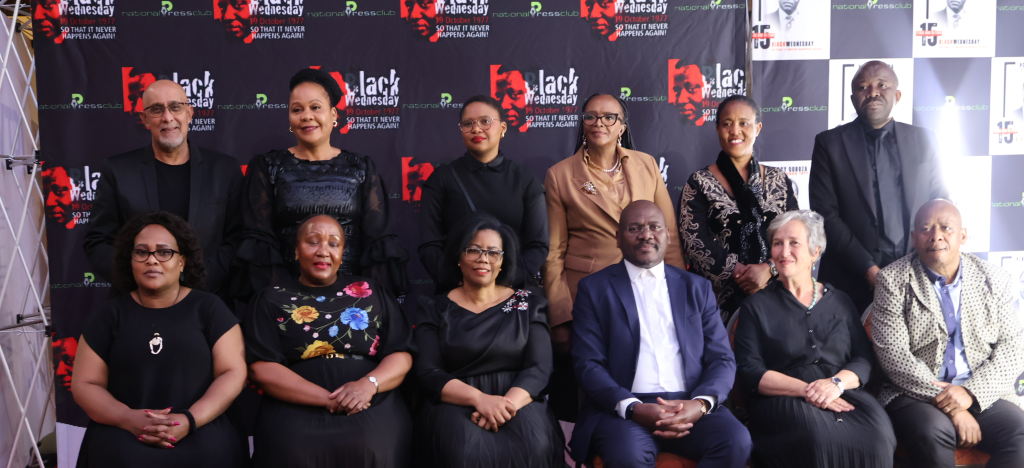
The 15th annual Percy Qoboza Memorial Lecture honoured the late journalism icon’s enduring legacy as a courageous media figure who used his voice and the power of words to challenge apartheid and resist censorship.
“Women should not be silenced in the media space,” said Professor Puleng LenkaBula, Unisa Principal and Vice-Chancellor, addressing academics, media practitioners, and students at the lecture, which was held in partnership with the National Press Club and the Qoboza family.
The memorial lecture takes place each year to remember 19 October 1977, the day the apartheid government banned black consciousness movements and newspapers such as The World and The Weekend. This day became known as Black Wednesday and is now observed as National Press Freedom Day in South Africa.
Qoboza is remembered as a social activist and fearless journalist who fought for truth and freedom of expression during apartheid. He defended blackness through his writings. This year’s theme, “From Qoboza to the Digital Age: Journalism, Justice, and the Global Fight for Truth,” examined how journalism can support justice and truth in today’s media landscape.
Language, ethics, and the fight for inclusion
In her opening address, LenkaBula urged media students, policymakers, and practitioners to engage critically with media ethics and promote the inclusion of black women, who are often overlooked and sidelined. She stressed the need to explore media freedom and the role of journalists in society, especially in light of Qoboza’s legacy.
LenkaBula also called for the support of marginalised voices and the use of African languages. She took a moment to acknowledge the sign language interpreters, praising them for making South Africa’s 12th official language accessible to persons with disabilities.
“Percy Qoboza’s legacy shines a light on the global fight for truth and justice, reminding us that universities should be places for exploring knowledge, critical analysis, comparisons, and sometimes speaking truth to power,” said LenkaBula. “Here at Unisa, we stand for human rights, for voice, for freedom, and for justice. We will ensure that no one is silenced and that all voices are heard. We do this because we know that this freedom came at a cost, and people like Qoboza fought hard for it.”
LenkaBula welcomed the keynote speaker, Professor Mandla Radebe, calling him an appropriate choice for the lecture. Radebe is the award-winning author of Constructing Hegemony: The South African Commercial Media and the (Mis)Representation of Nationalisation and Apartheid Did Not Die: South Africa’s Unfinished Revolution. His work addresses the challenges of misinformation and threats to press freedom that go against Qoboza’s dedication to integrity and courage.
Quoting Frantz Fanon’s Black Skin, White Masks, LenkaBula reflected on the confusion faced by the liberated black elite during colonisation and decolonisation. “After 31 years of democracy,” she said, “we must grapple with how we embody systems, knowledge, ideas, and approaches that undermine the goals of freedom, thus hindering the efforts of those who are building constructive systems, institutions, and processes for our country’s future.”
Journalism as a revolutionary act
Radebe, Associate Professor in the Department of Strategic Communication and Director of the Centre for Data and Digital Communication at the University of Johannesburg, spoke about the need for change in media ownership, which continues to be influenced by race, language, and gender.
Radebe argued that journalism must be a revolutionary act, not just entertainment. He called for arts, journalism, and music in South Africa to be produced and consumed to promote liberation. “We must honour Qoboza not just as a journalist but as a freedom fighter in advancing the struggle for knowledge and the independence of journalism,” he said.
Antoinette Slabbert, Chairperson of the National Press Club, emphasised that freedom of expression is protected in South Africa. She referred to recent local stories that showcase the state of press freedom and briefly discussed how technology is transforming journalism.
The lecture included a panel discussion led by Ashraf Garda, host of SAfm’s The National Pulse. The panel featured Bongekile Macupe (News24), Themba Sepotekele (author of Being a Spokesperson), Sophie Mokoena (SABC international desk), and Lennox Klaas (Radio Freedom). Each participant responded thoughtfully to Radebe’s address, reflecting on the challenges and opportunities present in journalism today.
At the end of the evening, the Percy Qoboza Bursary recipients were announced. Professor Rofhiwa Mukhudwana, Chair of the Department of Communication Science, offered the vote of thanks. Program director Albi Modise, Public Relations Officer of the National Press Club, led the event with professionalism and flair.

Get your news on the go. Click here to follow the Conviction WhatsApp channel.


