


- Eight dismissed workers will return to work after the employer’s review application failed.
- The workers used steel wool, scouring pads, and other unauthorised materials after struggling to meet production targets.
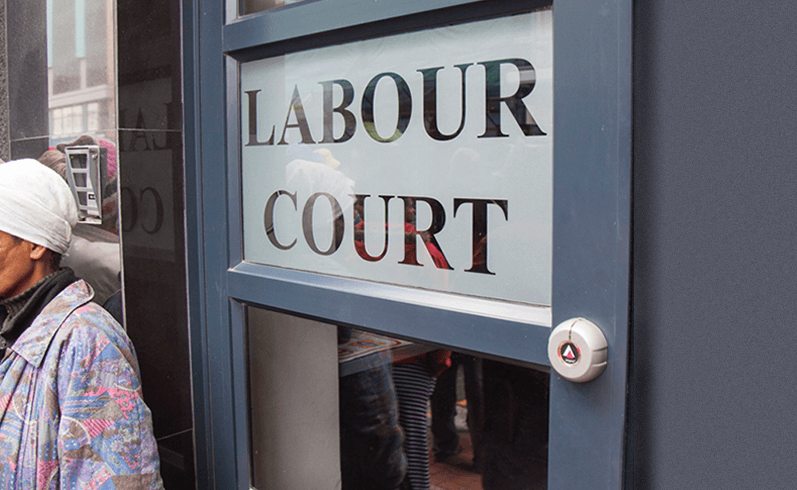
- The Labour Court ruled that reinstatement without back pay was a fair outcome.
Eight workers dismissed for using unauthorised cleaning materials on a solar panel project may return to work after the Labour Court upheld a CCMA ruling in their favour.
Acting Judge MH Mhambi dismissed a review application brought by Tension Overhead Electrification (Pty) Ltd, trading as Tractionel Enterprise, and found that the arbitration award ordering reinstatement was reasonable. The workers will return to their jobs without back pay, while each party will pay its own legal costs.
Production pressure led to the dispute
The dispute arose after the company secured its first renewable energy contract to deep clean about 5,000 solar panel tracking units in the Western Cape.
The eight employees, represented by the Future of South African Workers Union (FOSAWU), had no previous experience cleaning solar panels. They were trained to use a client-approved cleaning method requiring microfibre cloths, isopropanol, and distilled water.
The approved process soon proved too slow. Workers struggled to meet production targets, prompting management, human resources, and team leaders to hold a meeting in January 2023 to discuss how the work could be completed more efficiently. During that meeting, the shortcomings of the prescribed cleaning method and the possibility of obtaining alternative materials were discussed.
Unauthorised materials exposed by a storm
After the meeting, the employees began using steel wool, scouring pads, orange bags, and bath sponges to remove stubborn dirt from the panels. None of the materials formed part of the client’s approved method statement, and the workers concealed them from the client while continuing with the project.
The misconduct came to light only after a storm exposed the hidden materials. The client immediately stopped the work and ordered an investigation. Importantly, the investigation found that the solar trackers had suffered no physical damage.
Despite that finding, the company charged the employees with gross insubordination for using unauthorised cleaning materials and with bringing the employer’s name into disrepute. All eight workers were dismissed following disciplinary enquiries.
CCMA found dismissal was unfair
Commissioner Nonceba Hlaba concluded that the dismissals were substantively unfair after finding that management knew the prescribed cleaning method was failing and was aware that the employees were using the additional materials.
She found, “Management was aware that the employees were using the foreign materials but had cleverly decided not to procure them.”
The commissioner also concluded that the employees “had broken the rule to assist the employer to meet its targets and not out of any mala fides.”
Another important factor was the company’s own disciplinary code, which prescribed a written warning for a first offence of insubordination. The employer’s own witness conceded that dismissal was inconsistent with that code. The employees were reinstated without retrospective pay.
Labour Court upheld the reinstatement
The employer argued that the CCMA relied on unreliable evidence, misunderstood the dispute, and wrongly interfered with its disciplinary powers.
Judge Mhambi rejected those arguments, holding that the production targets, the novelty of the project, and the employees’ lack of experience were all relevant when deciding whether dismissal was an appropriate sanction. The court also accepted that management had acquiesced in the use of the alternative materials.
While acknowledging that concealing the materials from the client was serious, the judge found the employer had failed to prove that the trust relationship had broken down to the point where continued employment was intolerable.
In dismissing the review, Judge Mhambi concluded, “The award is one that a reasonable decision-maker could reach on the material before her. It is not reviewable.”
Get your news on the go. Click here to follow the Conviction WhatsApp channel.


