
Skip to content
Close Menu
ConvictionConviction
  • Home
  • Law & Justice
  • Special Reports
  • Opinion
  • Ask The Expert
  • Get In Touch

Subscribe to Updates

Get the latest creative news from FooBar about art, design and business.

What's Hot

Sectional title schemes explained: Is that parking bay really for you?

September 11, 2026

ConCourt rules KZN government has the final say on removing traditional leaders

September 11, 2026

Sanlam fraud debarment overturned after hearing notice sent to wrong email address

September 11, 2026
Facebook X (Twitter) Instagram
Trending
  • Sectional title schemes explained: Is that parking bay really for you?
  • ConCourt rules KZN government has the final say on removing traditional leaders
  • Sanlam fraud debarment overturned after hearing notice sent to wrong email address
  • Facebook Marketplace ‘Sganai’ scam syndicate gets life and 150 years behind bars
  • Judge blocks Absa-linked company from selling pensioner’s home
  • Mugg & Bean franchise fired waitress, then used alleged racist remark to justify it
  • Eviction law does not protect temporary homeless shelters from court-ordered eviction
  • Heritage without human rights is an empty celebration in democratic South Africa
Facebook X (Twitter) Instagram
ConvictionConviction
Sonneblom
  • Home
  • Law & Justice
  • Special Reports
  • Opinion
  • Ask The Expert
  • Get In Touch
ConvictionConviction
Home » Journalists ‘were not the revolutionaries’ of the 16 June 1976 Soweto Uprising
Opinion

Journalists ‘were not the revolutionaries’ of the 16 June 1976 Soweto Uprising

The headlines that followed Hector Pietersen's death reveal more than media bias 
Sandile MemelaBy Sandile MemelaJune 17, 2025No Comments
Facebook Twitter Pinterest LinkedIn WhatsApp Reddit Tumblr Email
Share
Facebook Twitter LinkedIn Pinterest Email

Summary 

  • June 16 was framed as chaos, not resistance. 
  • Black media often served profit, not liberation. 
  • Real revolution needs bold, truth-telling journalism. 

Black journalists have always been presumptuous or self-delusional enough to carve themselves a front row role in the much-vaunted Struggle. 

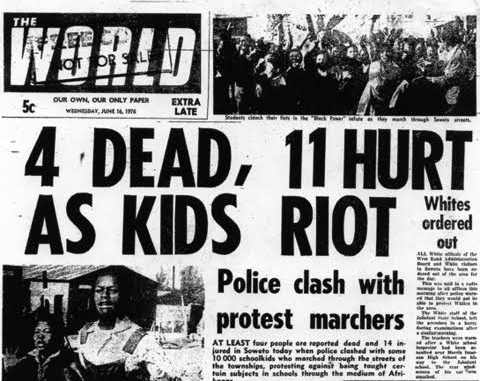
Well, you tell me why the much vaunted The World newspaper would carry such a headline that portrays student upheaval as a riot. 

"4 DEAD, 11 HURT AS KIDS RIOT." 

This was the headline next to the iconic Sam Nzima picture of Mbuyisa Makhubu carrying the limp body of a young Hector Pietersen. 

What this tells us and literally means is that the Soweto pupils allegedly disrubed peace in South Africa. Well, that is what a riot does: disturbs peace. 

The newspaper headline made a statement that by taking to the streets, the pupils threatened to spoil the supposedly harmonious coexistence between blacks and whites. Blacks were happy with the apartheid regime. 

Black journalism under apartheid: Policed thinking and profit motives 

Of course, this was predictable. Black newspapers were neither founded nor financed by blacks. Those that had shares in them, just like today, were chasing profits before politics. In fact, The World was founded by a white farmer who wanted the paper to serve as a vehicle to reach the so-called black market. 

Above all, the aim was to police and depoliticize black thinking. The black market had to make itself comfortable in economic exploitation and political oppression. Remember, traditional editors at The World were always black liberals that advocated integration into the system. They were no threat to the status quo. And it is not a mistake that we are where we are today: the most unequal society on earth. 

A young Tsietsi Mashinini of the Soweto Student Representative Council had to pay a personal visit to the newspaper to confront the editor/s to demand for a paradigm change in black reporting. In fact, a young Duma Ndlovu who covered student politics worked under difficult conditions at The World. He was not popular for his political inclination. 

He was not the editor’s blue-eyed boy because of his proximity to a Tsietsi Mashinini and a Winnie Mandela, if correct. 

Post-apartheid black journalism: Professionalism without purpose 

I don’t quite know if it is a historical fact that black journalists were the automatic vanguard of the struggle. We have to problematize so-called black journalism. To this day, their reporting focuses on the formula of crime, soccer, entertainment and society for ages. Politics was not allowed or encouraged. 

Today, black political reporting is to bash the ANC and dare not write about land dispossession, economic monopoly and its consequent injustice, racism or call for sharing the wealth of the country. 

For example, back in the 1970s underpaid freelancers like Bokwe Mafuna abandoned sham jobs at the Rand Daily Mail to mobilize black journalists. This culminated in the sterile Union of Black Journalists. 

Today black journalists are the most disorganized army with no agenda. It is everybody for himself. And to rise in the ranks you must join the owners. 

Most black journalists, to date, are just over-glorified workers who are mistaken for professionals.Like millions of workers, they wake up to go earn a living in their strife for a better quality of life for themselves and their families. 

Don’t mistake journalists for revolutionaries. Read the headline and smell the black coffee. What does it mean to call a student upheaval a RIOT? Was it not a revolution? How is it different to a revolve-lution where we going around in circles? 

Think about it. 

#Conviction    

Get your news on the go. Click here to follow the Conviction WhatsApp channel    

apartheid history Black journalism June 16 media critique revolutionary reporting Soweto Uprising Student protests
Share. Facebook Twitter Pinterest LinkedIn Tumblr Telegram Email
Sandile Memela

Journalist, writer and cultural critic. He is a former Chief Director: Nation Building & Social Cohesion in the Department of Arts & Culture.

Related Posts

Heritage without human rights is an empty celebration in democratic South Africa

September 10, 2026

Jackie Phamotse dissects the soul of a crime-ridden South Africa in The Big 5 Cartel

September 9, 2026

Protecting South Africa’s teachers starts with truly safe schools for everyone

September 8, 2026
Leave A Reply Cancel Reply

Prove your humanity: 0   +   9   =  

Subscribe to our newsletter:
Top Posts

Your driving licence at the gate: What estates can actually legally scan

Sponsor: My Estate LifeSeptember 6, 2026

Making sectional title rules that work: A practical guide

January 17, 2025

Protection order among the consequences of trespassing in an ‘Exclusive Use Area’

December 31, 2024

Between a rock and a foul-smelling place

November 27, 2024
Don't Miss
Sectional Title Law
4 Mins Read

Sectional title schemes explained: Is that parking bay really for you?

By Kennedy MudzuliSeptember 11, 20264 Mins Read

Parking disputes are common in sectional title schemes. Here’s how South African law determines whether a parking bay is an exclusive use area or common property.

ConCourt rules KZN government has the final say on removing traditional leaders

September 11, 2026

Sanlam fraud debarment overturned after hearing notice sent to wrong email address

September 11, 2026

Facebook Marketplace ‘Sganai’ scam syndicate gets life and 150 years behind bars

September 11, 2026
Stay In Touch
  • Facebook
  • Twitter
  • WhatsApp
Demo
About Us
About Us

Helping South Africans to navigate the legal landscape; providing accessible legal information; and giving a voice to those seeking justice.

Facebook X (Twitter) YouTube WhatsApp Twitch RSS
Latest posts

Your driving licence at the gate: What estates can actually legally scan

Sponsor: My Estate LifeSeptember 6, 2026

Making sectional title rules that work: A practical guide

January 17, 2025

Protection order among the consequences of trespassing in an ‘Exclusive Use Area’

December 31, 2024
OUR PICKS

Lawyers ordered to pay from their own pockets after refusing to abandon hopeless appeal

September 9, 2026

My soul is not happy: Sharpeville survivors take government to court over apartheid reparations

September 4, 2026

Inside the share scheme that brought down former Miss SA Tatum Keshwar-Wheatley

September 5, 2026
© 2026 Conviction.
  • Home
  • Law & Justice
  • Special Reports
  • Opinion
  • Ask The Expert
  • Get In Touch

Type above and press Enter to search. Press Esc to cancel.

Powered by
►
Necessary cookies enable essential site features like secure log-ins and consent preference adjustments. They do not store personal data.
None
►
Functional cookies support features like content sharing on social media, collecting feedback, and enabling third-party tools.
None
►
Analytical cookies track visitor interactions, providing insights on metrics like visitor count, bounce rate, and traffic sources.
None
►
Advertisement cookies deliver personalized ads based on your previous visits and analyze the effectiveness of ad campaigns.
None
►
Unclassified cookies are cookies that we are in the process of classifying, together with the providers of individual cookies.
None
Powered by