


Summary
- June 16 was framed as chaos, not resistance.
- Black media often served profit, not liberation.
- Real revolution needs bold, truth-telling journalism.
Black journalists have always been presumptuous or self-delusional enough to carve themselves a front row role in the much-vaunted Struggle.
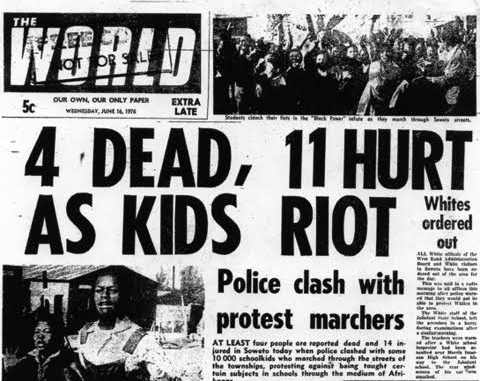
Well, you tell me why the much vaunted The World newspaper would carry such a headline that portrays student upheaval as a riot.
"4 DEAD, 11 HURT AS KIDS RIOT."
This was the headline next to the iconic Sam Nzima picture of Mbuyisa Makhubu carrying the limp body of a young Hector Pietersen.
What this tells us and literally means is that the Soweto pupils allegedly disrubed peace in South Africa. Well, that is what a riot does: disturbs peace.
The newspaper headline made a statement that by taking to the streets, the pupils threatened to spoil the supposedly harmonious coexistence between blacks and whites. Blacks were happy with the apartheid regime.
Black journalism under apartheid: Policed thinking and profit motives
Of course, this was predictable. Black newspapers were neither founded nor financed by blacks. Those that had shares in them, just like today, were chasing profits before politics. In fact, The World was founded by a white farmer who wanted the paper to serve as a vehicle to reach the so-called black market.
Above all, the aim was to police and depoliticize black thinking. The black market had to make itself comfortable in economic exploitation and political oppression. Remember, traditional editors at The World were always black liberals that advocated integration into the system. They were no threat to the status quo. And it is not a mistake that we are where we are today: the most unequal society on earth.
A young Tsietsi Mashinini of the Soweto Student Representative Council had to pay a personal visit to the newspaper to confront the editor/s to demand for a paradigm change in black reporting. In fact, a young Duma Ndlovu who covered student politics worked under difficult conditions at The World. He was not popular for his political inclination.
He was not the editor’s blue-eyed boy because of his proximity to a Tsietsi Mashinini and a Winnie Mandela, if correct.
Post-apartheid black journalism: Professionalism without purpose
I don’t quite know if it is a historical fact that black journalists were the automatic vanguard of the struggle. We have to problematize so-called black journalism. To this day, their reporting focuses on the formula of crime, soccer, entertainment and society for ages. Politics was not allowed or encouraged.
Today, black political reporting is to bash the ANC and dare not write about land dispossession, economic monopoly and its consequent injustice, racism or call for sharing the wealth of the country.
For example, back in the 1970s underpaid freelancers like Bokwe Mafuna abandoned sham jobs at the Rand Daily Mail to mobilize black journalists. This culminated in the sterile Union of Black Journalists.
Today black journalists are the most disorganized army with no agenda. It is everybody for himself. And to rise in the ranks you must join the owners.
Most black journalists, to date, are just over-glorified workers who are mistaken for professionals.Like millions of workers, they wake up to go earn a living in their strife for a better quality of life for themselves and their families.
Don’t mistake journalists for revolutionaries. Read the headline and smell the black coffee. What does it mean to call a student upheaval a RIOT? Was it not a revolution? How is it different to a revolve-lution where we going around in circles?
Think about it.
#Conviction
Get your news on the go. Click here to follow the Conviction WhatsApp channel
