Skip to content
Close Menu
ConvictionConviction
  • Home
  • Law & Justice
  • Special Reports
  • Opinion
  • Ask The Expert
  • Get In Touch

Subscribe to Updates

Get the latest creative news from FooBar about art, design and business.

What's Hot

Lawyers for Human Rights welcomes hate speech ruling against Ngizwe Mchunu

June 20, 2026

The funeral policy looked legitimate until investigators called the consent number directly

June 20, 2026

When intolerable workplace conditions force an employee to resign

June 19, 2026
Facebook X (Twitter) Instagram
Trending
  • Lawyers for Human Rights welcomes hate speech ruling against Ngizwe Mchunu
  • The funeral policy looked legitimate until investigators called the consent number directly
  • When intolerable workplace conditions force an employee to resign
  • Employers who fail to pay pension contributions can be forced to pay from their own pockets
  • Everyone wanted this Bentley, but only one owner had the right to sell it
  • Excluded Xihahele households awarded R21.4 million in land restitution settlement
  • South Africa’s migration tensions reveal deeper economic and governance failures
  • Huawei Care misled consumers by promising theft cover but excluding thefts that did not involve force
Facebook X (Twitter) Instagram
ConvictionConviction
Sonneblom
  • Home
  • Law & Justice
  • Special Reports
  • Opinion
  • Ask The Expert
  • Get In Touch
ConvictionConviction
Home » Judiciary’s efficiency improves amid persistent criminal backlogs and growing pressure
Constitutional Law

Judiciary’s efficiency improves amid persistent criminal backlogs and growing pressure

A year of measurable gains in court efficiency shows progress, but criminal case backlogs and systemic pressures continue to challenge South Africa’s judiciary.
Kennedy MudzuliBy Kennedy MudzuliNovember 25, 2025No Comments
Facebook Twitter Pinterest LinkedIn WhatsApp Reddit Tumblr Email
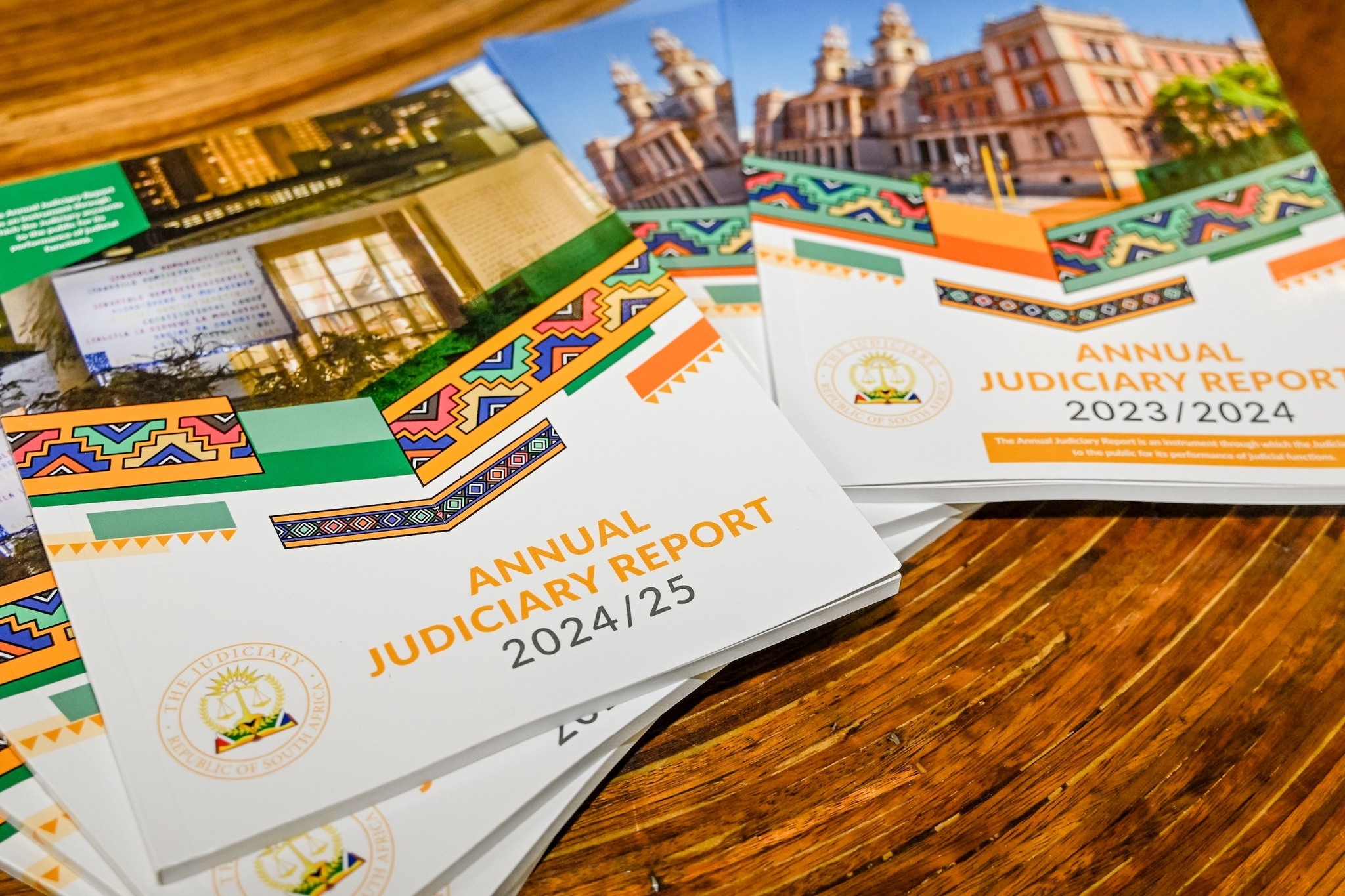
The Annual Judiciary Report 2024/2025, released by Chief Justice Mandisa Maya, highlights court efficiency, ongoing criminal backlogs, and systemic challenges in South Africa’s judicial system.
Share
Facebook Twitter LinkedIn Pinterest Email
  • Efforts to reduce the criminal backlog have stalled at 43 percent, reflecting sustained pressure on the courts.
  • Regional Courts recorded over 65 000 criminal court days, but clearance rates remain inconsistent.
  • District Courts finalised 94 percent of criminal cases, underscoring the benefits of effective systems.

The Annual Judiciary Report 2024 2025, released by Chief Justice Mandisa Maya on 25 November 2025, shows that South Africa’s courts have made notable strides in improving efficiency.

District Courts finalised 94 percent of criminal cases, and Superior Courts met key targets for reserved judgments. However, despite these gains, the reduction of criminal case backlogs has reached only 43 percent, underscoring the constant strain on the judicial system. Chief Justice Maya emphasises that “Reduction of criminal case backlogs (43 percent)” is a challenge needing urgent attention.

Regional Courts faced the heaviest load, logging a combined 65 461 criminal court days and 204 326 hours, averaging just over three hours daily. During this time, 41 512 new cases were registered, while 40 072 criminal trials were finalised, resulting in a clearance rate of 97 percent.

Civil matters showed mixed results, with only 56 percent of civil applications and 60 percent of civil trials finalised. The report notes that no reserved judgments exceeded three months from the date of the last hearing, reflecting progress in timely decision-making.

Superior Courts meet some targets but gaps remain

Superior Courts achieved 71 percent compliance with delivering reserved judgments within three months, surpassing the 70 percent target. Chief Justice Maya states that “All Superior Courts collectively achieved 71 percent compliance with the delivery of reserved judgments within three months against a set target of 70 percent.”

However, uneven progress across divisions is clear. The Supreme Court of Appeal finalised 72 percent of matters, the Labour Appeal Court 71 percent, and the Labour Court 55 percent. Criminal cases across Superior Courts stood at 73 percent, showing that even at higher levels, workloads vary and efficiency depends on the context.

District Courts set a benchmark in efficiency

District Courts demonstrate that structured monitoring and management can yield strong results. Child justice preliminary investigations were finalised at 84 percent, and maintenance matters reached 89 percent within 90 days. These outcomes show that operational systems can deliver efficiency even under heavy workloads.

Despite these successes, the report highlights a slight decline in overall court activity compared to the previous year. Court days fell by three percent, disposed cases by two percent, and court hours by two percent. Systemic obstacles like unavailable courtrooms, faulty recording equipment, load shedding, natural disasters, and bad weather continue to challenge court operations.

Independence, innovation and technology

Chief Justice Maya points out the connection between judicial independence and innovation, stating that “Independence and innovation are not isolated ideals but mutually reinforcing. By safeguarding independence, our Courts remain trusted guardians of rights; by embracing innovation, we improve how we serve the public.”

The rollout of the Court Online system to seven Superior Courts shows how technology can support case management and enhance operational efficiency. Training and capacity building through SAJEI are also recognised for improving performance, equipping judges and magistrates with the necessary skills in judgment writing, digital systems, and case flow management.

Transformation and accountability remain key priorities

The report outlines progress in judicial appointments and demographics under Section 1746, showing steps toward greater representation on the bench. Extra-judicial disclosures boost transparency, allowing the public to evaluate potential conflicts without speculation.

The year also faced loss, honouring judicial officers who passed away, reminding the public that statistics represent real people whose service impacts the lives of ordinary South Africans.

Chief Justice Mandisa Maya, joined by senior judicial officials and dignitaries, presents the Annual Judiciary Report 2024/2025, highlighting progress and challenges in South Africa’s courts.

Conviction.co.za

Get your news on the go. Click here to follow the Conviction WhatsApp channel.

Annual Judiciary Report 2024/2025 Chief Justice Mandisa Maya Court efficiency Criminal backlogs South African courts
Share. Facebook Twitter Pinterest LinkedIn Tumblr Telegram Email
Kennedy Mudzuli

Multiple award-winner with passion for news and training young journalists. Founder and editor of Conviction.co.za

Related Posts

Excluded Xihahele households awarded R21.4 million in land restitution settlement

June 19, 2026

New acting judges’ rules introduce a 12-year legal experience requirement from 1 July 2026

June 18, 2026

Judge broadens murder definition after killing of pregnant woman carrying triplets

June 17, 2026
Leave A Reply Cancel Reply

Prove your humanity: 2   +   4   =  

Subscribe to our newsletter:
Top Posts

Making sectional title rules that work: A practical guide

January 17, 2025

Protection order among the consequences of trespassing in an ‘Exclusive Use Area’

December 31, 2024

Between a rock and a foul-smelling place

November 27, 2024

Irregular levy increases, mismanagement, and legal threats in a sectional title scheme

June 2, 2025
Don't Miss
Human Rights
4 Mins Read

Lawyers for Human Rights welcomes hate speech ruling against Ngizwe Mchunu

By Kennedy MudzuliJune 20, 20264 Mins Read

Lawyers for Human Rights says a judgment against Ngizwe Mchunu sends a strong message that hate speech against LGBTQIA+ people will not be tolerated.

The funeral policy looked legitimate until investigators called the consent number directly

June 20, 2026

When intolerable workplace conditions force an employee to resign

June 19, 2026

Employers who fail to pay pension contributions can be forced to pay from their own pockets

June 19, 2026
Stay In Touch
  • Facebook
  • Twitter
  • WhatsApp
Demo
About Us
About Us

Helping South Africans to navigate the legal landscape; providing accessible legal information; and giving a voice to those seeking justice.

Facebook X (Twitter) YouTube WhatsApp Twitch RSS
Latest posts

Making sectional title rules that work: A practical guide

January 17, 2025

Protection order among the consequences of trespassing in an ‘Exclusive Use Area’

December 31, 2024

Between a rock and a foul-smelling place

November 27, 2024
OUR PICKS

Standard Bank should have investigated mental health concerns before dismissal, CCMA finds

June 10, 2026

Foreign nationals leave SA amid growing tension ahead of planned 30 June deadline

June 17, 2026

Attorney who blames secretary is like surgeon blaming nurse, judge says

June 18, 2026
© 2026 Conviction.
  • Home
  • Law & Justice
  • Special Reports
  • Opinion
  • Ask The Expert
  • Get In Touch

Type above and press Enter to search. Press Esc to cancel.

Powered by
►
Necessary cookies enable essential site features like secure log-ins and consent preference adjustments. They do not store personal data.
None
►
Functional cookies support features like content sharing on social media, collecting feedback, and enabling third-party tools.
None
►
Analytical cookies track visitor interactions, providing insights on metrics like visitor count, bounce rate, and traffic sources.
None
►
Advertisement cookies deliver personalized ads based on your previous visits and analyze the effectiveness of ad campaigns.
None
►
Unclassified cookies are cookies that we are in the process of classifying, together with the providers of individual cookies.
None
Powered by