


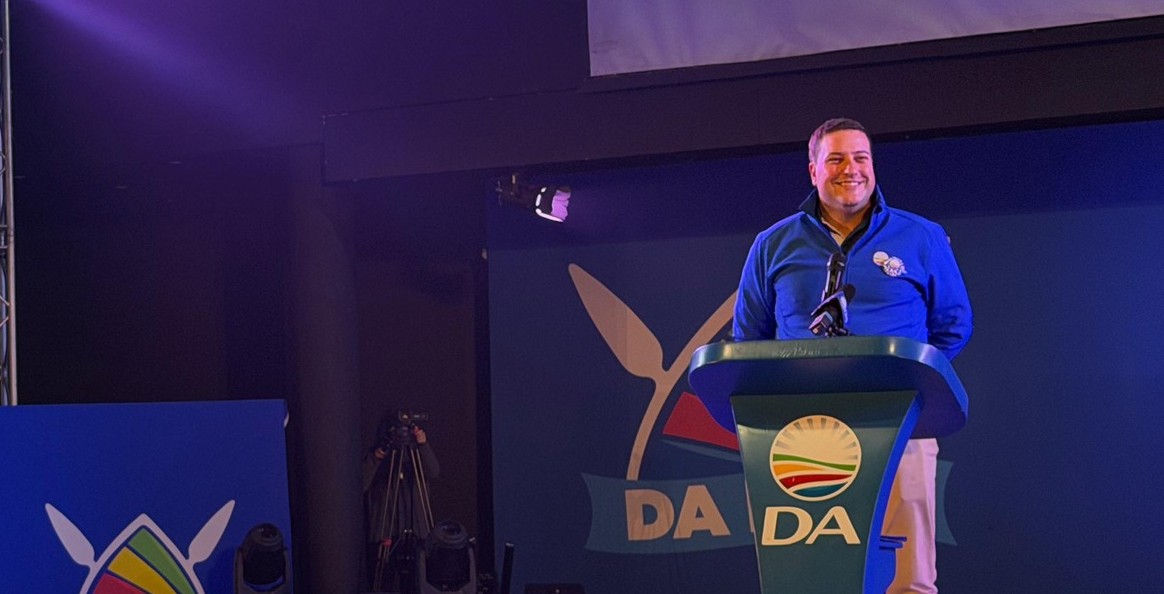
- The DA’s post Phala Phala posture reflects growing confidence after Geordin Hill-Lewis’s election victory.
- Mike Mathabela argues that impeachment threats may ultimately be used to secure greater GNU influence rather than remove Cyril Ramaphosa.
- The ANC faces mounting political vulnerability as corruption allegations and coalition tensions intensify ahead of local government elections.
The new Federal Leader of the Democratic Alliance, Geordin Hill-Lewis, who secured a landslide victory at the party’s 2026 Federal Congress, appeared almost triumphant in the aftermath of the Phala Phala scandal judgment.
Together with the DA leadership collective, Hill-Lewis seemingly sensed a golden opportunity to extract greater political concessions from the ANC-led Government of National Unity.
Responding to a journalist’s question, Hill-Lewis declared his “instinctive willingness … to change things for the better, change direction and fix the country”, adding that he “would jump at the chance” to become South Africa’s president.
In the wake of the Constitutional Court judgment delivered by Chief Justice Mandisa Maya on 8 May, both the Hill-Lewis and DA Federal Chairperson Solly Msimanga embarked on a series of media appearances to proclaim the DA’s readiness to hold President Cyril Ramaphosa accountable, including supporting his impeachment should evidence emerge that he breached the Constitution in relation to the Phala Phala matter.
Both leaders publicly supported calls for the immediate establishment of an impeachment committee and urged it to begin its work without delay. This was despite Ramaphosa’s announcement on 11 May that he would seek a judicial review of the independent panel’s report.
But are the DA’s declarations about holding Ramaphosa accountable genuinely principled? Or are they merely tactical political manoeuvres? I contend that these pronouncements amount to little more than political subterfuge.
A party sensing momentum
What has not escaped the attention of political observers is the DA’s increasingly celebratory mood. One reason for this buoyancy is the departure of former leader John Steenhuisen, who was widely perceived within sections of the party as being excessively accommodating towards Ramaphosa and therefore insufficiently assertive in demanding what many DA supporters believe is the party’s rightful share of influence within the GNU.
Having secured 21.81% of the vote in the 2024 general elections, more than half of the ANC’s electoral support, many within the DA believe the party deserved a proportionally larger share of Cabinet positions than the six it currently occupies, compared to the ANC’s 20 portfolios. The second source of the DA’s optimism is equally obvious.
According to the March and April 2026 Ipsos polls, 47% of South Africans reportedly feel alienated from all political parties, despite more than 500 registered parties contesting elections. The same poll places the ANC at 35% nationally and across the metros, while the DA stands at 22% nationally and 25% in metropolitan areas ahead of the forthcoming local government elections.
Against this backdrop, the Phala Phala judgment has become a political windfall for the DA during an increasingly momentum-driven campaign season. With the ANC weakened by a president simultaneously confronting a judicial review process and the prospect of impeachment proceedings, both of which will inevitably consume significant political energy and attention, the DA has every incentive to maximise the moment.
The situation presents the DA with a potent electoral platform from which to narrow the gap between itself and the ANC, and perhaps even edge closer to its long-standing ambition of securing 30% electoral support.
Calculated pressure within the GNU
Yet, whatever outcome ultimately emerges from an impeachment committee, the DA is unlikely to support Ramaphosa’s removal from office. Doing so would amount to looking a proverbial gift horse in the mouth.
Instead, the DA could strategically leverage an anti-impeachment stance as a bargaining tool to secure additional Cabinet positions and broader influence within the GNU arrangement. It may even seek entry into the Gauteng Provincial Government coalition arrangement, potentially pushing both the Economic Freedom Fighters and the uMkhonto weSizwe Party out of the provincial governing coalition, much to the likely displeasure of Gauteng Premier Panyaza Lesufi. Msimanga would no doubt relish such a prospect in Gauteng.
To say the ANC is politically vulnerable would be an understatement. Allegations of corruption are certain to dominate campaign rhetoric against both the party and the president. With Ramaphosa likely to face relentless political attacks from the EFF and MK Party during impeachment proceedings, the ANC’s best hope of preserving its electoral dominance may well lie in securing a swift and successful judicial review of the PhalaPhala report.
Get your news on the go. Click here to follow the Conviction WhatsApp channel.
