


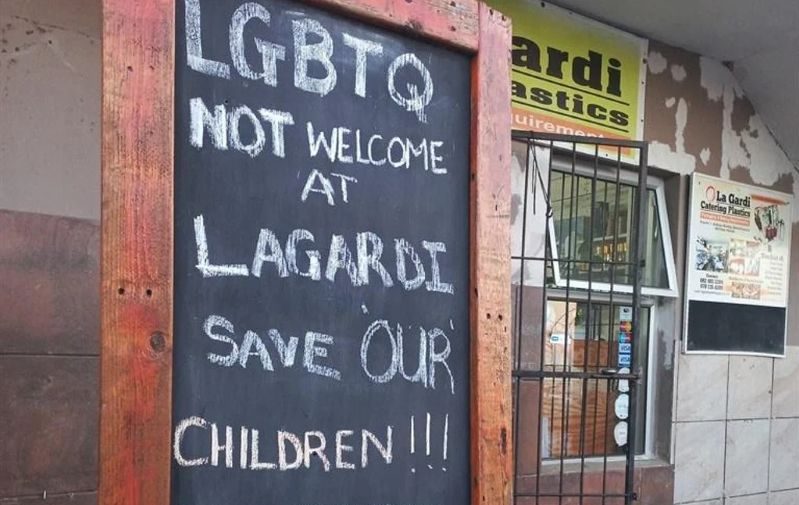
- The Equality Court’s ruling against Lagardien is a landmark for hate speech and discrimination in South Africa.
- The principles established extend beyond LGBTQ+ rights to protect all vulnerable groups, including migrants and refugees.
- The judgment provides practical legal strategies and a call for broader solidarity against hate-fueled movements.
On 6 October 2026, the Equality Court in Gqeberha handed down a judgment that many of us have waited years to read. It concerns a business in Gqeberha. It concerns a sign that read “LGBTQ not welcome at LaGardi. Save our children.” It concerns a WhatsApp group of almost 700 people with the motto “Evil will advance no further”.
Judge BM Pakati found that Dawood Lagardien’s sign and the WhatsApp group he created and ran amounted to hate speech, unfair discrimination and harassment under the Equality Act. He must apologise in public.
He must pay R200,000 to an organisation that works for equality. He is barred from repeating the conduct. The matter now goes to the National Prosecuting Authority for criminal investigation. This is a queer victory. We will celebrate it as one. But I want to talk about who else this judgment protects.
Right now, in this country, another group of people is being told they are not welcome. They are chased from shops, clinics and schools. They are Zimbabwean, Malawian, Mozambican, Somali, Congolese, Ethiopian and Nigerian. Many are refugees and asylum seekers who fled war and persecution. Some have lived here for 20 years and raised children here.
The principles in this judgment do not belong to one community. They belong to everyone the Equality Act protects. They arrive at exactly the moment we need them.
The violence is organised, and it is getting worse
The year 2026 is referred to as the most prolonged wave of organised xenophobic violence since 1994. This is not random anger. It is planned. It has leaders, slogans, deadlines, social media pages and WhatsApp groups.
In April and May, the March and March movement led demonstrations against undocumented migrants in Pretoria, Johannesburg and Durban. Human Rights Watch reported that vigilantes attacked African and Asian foreign nationals while police did little.
A Cameroonian shopkeeper in Durban, who had lived here for almost 20 years, told researchers he was attacked on 17 April during protests against foreign-owned shops. The same groups have blocked foreign nationals from public clinics and schools.
At a rally in KwaZulu-Natal in June, the movement’s leader asked the crowd whether they could run the spaza shops once foreigners abandoned them on 30 June. Everyone in that crowd understood the message.
The world noticed. UN Secretary-General António Guterres raised concern on 27 April. Kenya told its citizens in South Africa to stay vigilant and avoid protests. Nigeria spoke about seeking reparations. Britain’s former anti-apartheid movement wrote to the ANC. People in Ghana, Mozambique and Zimbabwe, countries that sheltered our exiles, condemned what is happening here.
At home, the response has been weak. The Presidency’s spokesperson insisted that South Africans are not xenophobic. A year ago, the SAHRC asked the Durban High Court to stop Operation Dudula and March and March from turning people away at health facilities. The court dismissed the urgent application because it was not urgent. Movement members celebrated outside.
We have seen where this leads. In 2008, 62 people were killed. Twenty-one of them were South Africans. Hate never stays in its lane.
Six lessons from Lagardien for the fight against xenophobia
The Equality Act protects people on grounds that include ethnic or social origin, culture, language and birth. It also covers any other ground that undermines human dignity. Our Constitution protects everyone who lives here, not only citizens. So the reasoning in Lagardien travels. Here is how.
- Taking the sign down does not end the case. Lagardien argued the matter was over because his sign was destroyed and the WhatsApp group had closed. The court disagreed. He still claimed his conduct was lawful, and the public interest required an answer. When a mob disperses, a post is deleted or a “deadline” passes, the harm remains. A court can still rule.
- What you meant does not save you. Lagardien said his sign was a community safety alert to protect children. The court applied an objective test. It asked how a reasonable person would understand the words. Anti-migrant leaders say they only care about the law and illegal immigration. But a reasonable person hears a crowd told to take over foreign-owned shops by a set date. That person knows exactly what is being said.
- If you build the space, you answer for it. Lagardien said he did not write the worst messages in his group. One called on Muslims to “crush these evil vermin”. The court held him responsible anyway. It found that a group with over 600 members is not a private chat, and that hatred drove its creation. Anti-migrant movements organise through exactly these kinds of groups and channels. The people who run them can no longer hide behind their members.
- Harm to one is harm to all. The court said hate speech may be aimed at one couple but wounds the whole group they belong to. When a Somali shopkeeper is chased away, every Somali shopkeeper receives that message.
- Belief is not a licence to harm. Lagardien leaned on his faith. The court said his choice of religion does not allow him to infringe the rights of others. The same logic applies to nationalism. Love of country does not give anyone the right to inflict harm on a refugee.
- Victims do not have to stand alone. Lagardien’s lawyer complained that no affected person had filed an affidavit. Only public bodies came to court. The court ruled anyway. The SAHRC opened the file on its own initiative after reading a news report. This matters enormously for undocumented people and asylum seekers who are terrified to come forward. The Commission can carry the case for them.
The remedies matter too. Public apology. Damages paid to equality work. A permanent interdict. Referral for prosecution. Each of these can be asked for against those who organise xenophobic hate.
A blow to the anti-rights movement
Read Lagardien’s sign again. “Save our children.” Now read the draft African Charter on Family, Sovereignty and Values, produced at the Entebbe inter-parliamentary conferences. It speaks again and again about protecting the “innocence” of African children from foreign ideologies. The words are the same because the playbook is the same.
The Initiative for Strategic Litigation in Africa (ISLA) mapped that playbook carefully. The anti-rights movement keeps the language of rights but empties it. It turns family protection into a weapon against families that do not fit. It raises religion and culture into a veto over other people’s rights. It uses sovereignty as an excuse to escape accountability. And it goes after courts and human rights institutions.
The draft Charter tells judges and human rights commissions to stop applying what it calls gender ideology. It calls for governments to audit national human rights institutions for foreign influence. ISLA points out that this is precisely the kind of interference the UN’s Paris Principles forbid.
In Gqeberha we saw the opposite. Two Chapter 9 institutions, the SAHRC and the Commission for Gender Equality, did their jobs. Lagardien filed a counterclaim accusing the SAHRC of bias and of failing to protect his rights. The court threw it out. He told the court that being made to accept queer people placed a burden on his faith. The judge called that framing inconceivable and said queer people have a right to life too.
There is something else in this judgment I cannot read without grief. The amicus reminded the court that religion and inclusion can live together. It pointed to an Imam in Cape Town who advocated for queer Muslims. That was Imam Muhsin Hendricks, who was gunned down in Gqeberha in February 2025. This judgment came from the same city. His witness still speaks.
The xenophobic movement uses the same tools as the anti-rights movement. It speaks of protection. It speaks of sovereignty. It casts outsiders as a threat to jobs, to safety, to children. It hides violence behind patriotism, as the anti-rights movement hides it behind faith. The xenophobic movement is a subset of the broader anti-rights movement.
Why we must stand together now
Those who hate queer people and those who hate foreigners are often the same people. They share WhatsApp groups. They share slogans. They share funders and conferences. They have learned to work across their causes. We have to learn faster.
Too often our movements work in separate rooms. Queer organisations speak about homophobia. Migrant organisations speak about xenophobia. Faith communities stay quiet on both. Unions worry about jobs. Each of us defends our own corner while the same machine grinds through all of us. A queer Zimbabwean asylum seeker does not get to choose which hatred finds her first.
Solidarity is not a nice idea. It is a survival strategy. Here is what it can look like.
- The SAHRC and the Commission for Gender Equality can use Lagardien to bring Equality Court cases against organised xenophobic hate speech, especially against those who run the groups and set the deadlines.
- Civil society can document. Save screenshots. Record dates, group names and administrators. Report hate crimes. Evidence wins cases.
- Queer organisations can stand at the side of migrants. Migrant organisations can stand at the side of queer people. Let each be seen at the other’s marches.
- Faith leaders can say from the pulpit and the minbar that their scripture is not a weapon against the stranger or the queer believer.
- Lawyers, journalists and funders can back the people who are doing this work without resources or recognition.
- South Africa must refuse to sign the draft Family Charter, and say why at the African Union.
The sign outside a shop came down. The WhatsApp group may be gone. But the principle the court wrote down stays standing. Nobody gets to put up a sign over this country saying who is not welcome. Not over a shop. Not over a clinic. Not over a school. Not over a whole people.

Get your news on the go. Click here to follow the Conviction WhatsApp channel.
The opinions expressed in this article are solely those of the author and do not necessarily reflect the views of Conviction.co.za
