


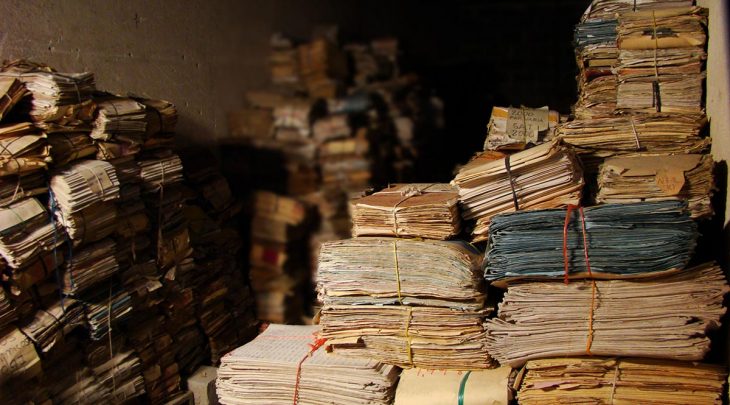
- South Africa’s archival collections continue to reflect the interests and perspectives of those who held power during apartheid and colonialism.
- The destruction of hundreds of thousands of records before democracy has left significant gaps in the country’s historical memory.
- Archivists are being challenged to transform collections and practices so that archives become genuine instruments of justice.
From 8–12 June 2026, the International Council on Archives will celebrate International Archives Week under the theme #ArchivesForJustice.
The theme explores how archives can support rights, preserve memory and shape a fairer future. Indeed, in order to promote justice, protect rights, preserve memory and facilitate accountability, archives are essential. They support legal, social, cultural, environmental, historical, and intergenerational justice by acting as reliable sources of information on choices, obligations and histories.
This year’s theme positions archives as spaces that promote justice and accountability for communities. It draws from the fundamental nature of archival records and emphasises the importance of accessibility in archival repositories worldwide.
However, when we consider the South African context, particularly the history of formerly marginalised, predominantly Black communities, we are compelled to ask: Do archives truly provide justice? Can archives genuinely be regarded as spaces of justice?
Since the dawn of democracy, much has been said about the role of “people’s archives.” Yet, an important question remains: What have we done to align archival repositories with the lived realities of ordinary people, especially those in disadvantaged communities?
Today, the debate is no longer limited to physical access or geographical location. Advances in communication systems have bridged the divide between rural and urban communities, making information more reachable than ever before. The challenge now is relevance and inclusivity.
Archival holdings in South African archive repositories do not reflect the diversity of the nation but mostly the interests of those who were previously in power. As a result, the users of such archives are mostly the beneficiaries of apartheid and colonialism. Thus, archivists risk remaining agents of apartheid-era systems, preserving a selective and unbalanced past that continues to misrepresent the majority.
Missed opportunities for transformation
With the dawn of democracy, the archival scene in South Africa was supposed to transform and reflect the diversity of the country, but it is still mainly the Western-dominated global mainstream. True to the assertion of Erik Ketelaar, a towering Netherlands archivist, the cruel paradox in many revolutions is that what is left after the revolution often resembles the past.
In other words, the more things change, the more they remain the same. In South Africa, the opportunity to transform the archival system has been presented in the past but missed and continued to be missed by the archival communities.
When we consider revelations such as those presented in the documentary The Trials of Winnie Mandela, the situation is scarier. Former apartheid-era operative Paul Erasmus recounts the systematic destruction of records, reportedly over 900,000 files, by the Special Branch.
Furthermore, Verne Harris also blew the whistle on the destruction of records in government before 1994, as in government entities worked day and night to destroy documents before South Africa’s first democratically elected government came into power.
Terry Bell and Dumisa Ntsebeza also point out in their book, Unfinished Business: South Africa, apartheid and truth, that in little more than six months in 1993, 44 metric tons of records from the Headquarters of the National Intelligence Service (now State Security Agency) alone were destroyed.
These records could have contributed significantly to documenting the histories of marginalised communities. Their destruction represents not just a loss of information, but a deliberate erasure of memory and identity. Notably, no one has been held accountable for this large-scale destruction of archives.
Even the Truth and Reconciliation Commission, while addressing many atrocities, did not sufficiently confront this form of historical erasure. The Commission only reported in Volume 1 of Chapter 8 of its report regarding the sanitation of records that started from 1978 to 1993.
Archives and the pursuit of justice
The consequences of such actions continue to shape our archival landscape. South Africa’s archival collections remain, in many respects, insufficiently transformed. While some records document the contributions of Africans, they are often framed within formal political movements. These narratives tend to focus on resistance and political struggle, rather than the everyday lived experiences and injustices faced by ordinary people.
Our history cannot be told through resistance alone. We must also examine systems and actors behind oppression, the instigators, and understand their motivations through authentic records, rather than second-hand interpretations.
As many scholars have argued, apartheid archives reflect deep divisions and the dominance of minority perspectives. This raises a critical question: Are we still preserving and promoting minority-centred heritage at the expense of broader societal representation?
The project of Africanisation must extend beyond rhetoric. It must transform the heritage sector in practical, tangible ways. Archivists must ask themselves: What must we do to ensure that archival collections genuinely reflect the communities we serve?
Addressing this question requires not only institutional reform but also a profound shift in mindset. Oppressive regimes are often meticulous record keepers, but those archives that eventually find the space were selected carefully to serve their heritage and remain silent to the brutality of the past system.
To move forward, we must confront and dismantle systems of exclusion embedded within archival practice. Archives should become spaces where silenced voices are restored and where alternative perspectives are preserved and amplified. In this regard, oral tradition offers a powerful tool. The fragments of memory that remain within communities can still be preserved, documented, and integrated into broader historical narratives.
Oral history can serve as a bridge, helping to reconstruct lost pasts and guide future research. Justice within archives will only be realised through both collection As International Archives Week approaches, questions remain about whether South Africa’s archives truly reflect the histories and experiences of all its people. and intellectual transformation among archivists themselves.
It requires a deep understanding of the profession and its responsibilities. Current trends toward blending archivists and librarians into a single professional category risk undermining the distinct skills and methodologies required in archival work. While collaboration is valuable, the disciplines are not identical, especially in applicable principles and their differences must be respected.
At the same time, archives must embrace technological advancements. Digital tools and new systems offer unprecedented opportunities for access, preservation, and engagement. To resist transformation is, ultimately, to deny communities the justice they deserve.
As we reflect on this year’s theme, we are left with a pressing question: Are we ready to deliver justice through archives without being trapped by the injustices of the past? The answer to this question will determine the future relevance of archives and whether they can truly serve as instruments of justice in a democratic society.
Get your news on the go. Click here to follow the Conviction WhatsApp channel.
