


- A workplace dispute over a piece of equipment escalated into a physical confrontation that was reported to a supervisor immediately afterwards.
- The arbitration hearing was marked by aggressive cross-examination, an emotional breakdown and conduct that the Labour Court later found to be irregular.
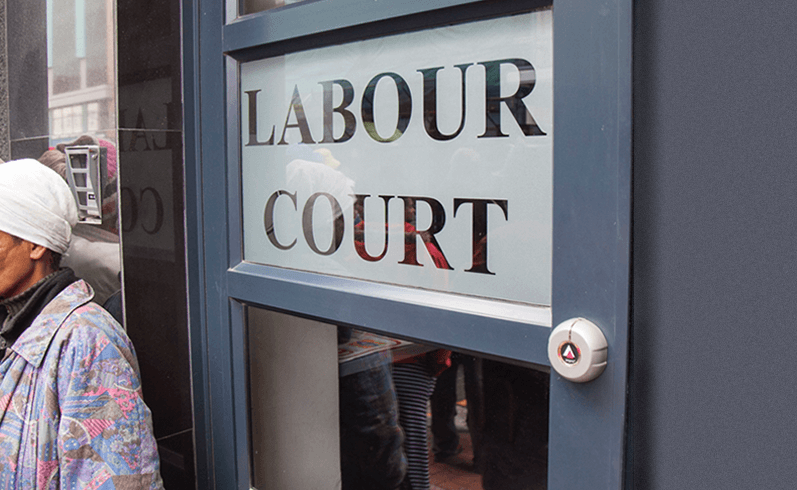
- The Labour Court found that the commissioner had misread the evidence and confirmed the dismissal as substantively fair.
What started as a minor argument over a splicing gun escalated into a moment of rage that ended in a physical blow, tears, and ultimately a dismissal that the Labour Court has now confirmed was justified.
Judge Benita Whitcher was required to determine whether the arbitration outcome properly reflected what unfolded between Bhekinhlanhla Zungu and Noluthando Masinga on the factory floor.
How the incident unfolded
Zungu and Masinga were assigned to work with a splicing gun when a dispute arose over who had brought it to the floor. Zungu took the tool from her. Masinga responded by repeatedly unplugging it each time he went downstairs to charge it, following him and undoing his attempts to continue working.
She accepted this conduct in her evidence and did not attempt to minimise it. Tension escalated as Zungu grew increasingly frustrated with the repeated interference. He warned her, “Just unplug the gun, and you will see what happens.”
Masinga unplugged the machine again. “I unplugged the gun, and that’s when he punched me here,” she said, indicating her neck. “…it was by force, using both hands.” She left the scene in tears and reported the incident immediately.
Her supervisor, Mr Duma, confirmed that she arrived distressed. “[Masinga] came to me crying… said [Zungu] had pushed her.” He confronted Zungu shortly afterwards. “I asked what had happened… and [Zungu] admitted… ‘Yes, I did push her.” He explained the consequence, “The only reason I sent him home was that he admitted pushing the lady.”
Zungu subsequently denied making that admission and maintained throughout that he had not assaulted her.
What happened inside the arbitration room
At arbitration, Masinga’s version remained consistent. She accepted that she had provoked the situation by repeatedly unplugging the machine, but maintained that this did not justify what followed.
She was subjected to prolonged and confrontational questioning that repeatedly implied she had fabricated the assault. She was pressed on the absence of visible injuries and challenged for not having sought medical attention. “It’s the first time I've heard that if you’ve been punched, you have to go to the doctor,” she responded.
She was also challenged on the absence of witnesses, despite having explained that the co-workers present said they had not seen the incident. Contradictory propositions were put to her about whether those same individuals had or had not witnessed the assault.
As the questioning continued, she became emotional and asked to step out of the room. When she returned, she explained, “It’s because everything, it’s too much for me right now.”
The pressure intensified further when it was suggested that her emotional reaction had been staged. During the proceedings, the commissioner asked her, without explanation or apparent relevance, whether she was male or female.
The commissioner’s findings and why they failed
The commissioner rejected Masinga’s version, relying on the absence of bruising, her physical demonstration of the incident, and her conduct during the hearing. She was described as a “crafty witness” whose demonstration was said to have “left much to be desired.”
Judge Whitcher rejected that approach. “On the face of the transcript, Masinga gave a frank, straightforward and consistent version.”
The court found that her willingness to admit her role in provoking the situation strengthened rather than undermined her credibility. The assumption that a punch must leave visible bruising was rejected, and the weight placed on her emotional responses was found to be irrational, given the nature of the questioning she had faced.
The court also found that the supervisor’s evidence had been wrongly dismissed. “…the record reveals not a hint of contradictions in his testimony.”
Zungu’s version and the probabilities
Zungu denied the assault but accepted that there may have been some form of contact. “If there was any touching, it’s just that I was blocking her,” he said.
His version was inconsistent and did not align with what had been put to Masinga during cross-examination. The court found that his account did not hold when measured against the probabilities of the situation.
Outcome
The court concluded that while Masinga’s conduct had angered Zungu, it did not justify a physical response. The court found that her behaviour had “so enraged Zungu that he struck out in anger.”
The arbitration award was set aside and replaced with a finding that the dismissal was substantively fair, bringing finality to a case that laid bare both a moment of workplace violence and a deeply flawed arbitration process.
Get your news on the go. Click here to follow the Conviction WhatsApp channel.
