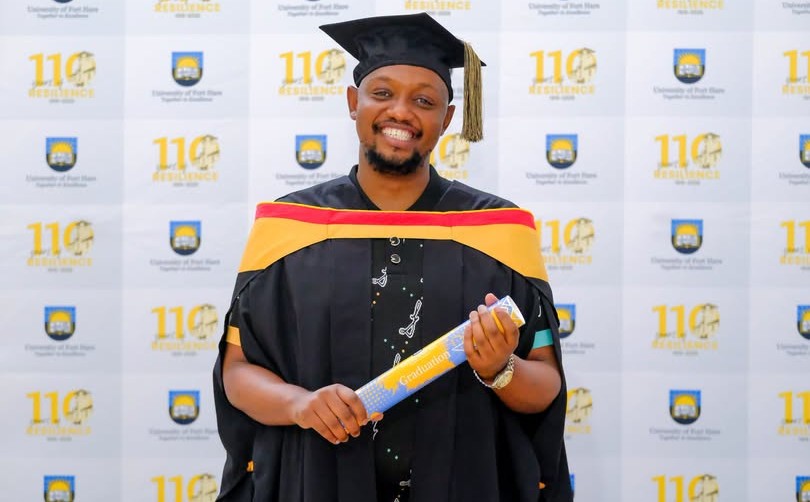
- Bathandwa Hlanjwa is working in Uganda as a Legal Advisor through a 14-month regional legal exchange program.
- His work focuses on criminal justice, alternative dispute resolution, and support for vulnerable and incarcerated people.
- Hlanjwa says his journey from the Cape Flats to East Africa shows that a person’s background does not determine their future.
Growing up on the Cape Flats, Bathandwa Hlanjwa faced poverty, gang violence, drug abuse, and crime. Today, the University of Fort Hare law graduate is in Uganda, helping vulnerable people access justice and supporting efforts to improve the criminal justice system.
Hlanjwa is a Legal Advisor with the Foundation for Human Rights Initiative under a 14-month exchange program coordinated by the Africa Judges and Jurists Forum and Norec, Norway’s government agency for global work exchanges. The program places young legal professionals in organisations across East and Southern Africa to strengthen legal capacity, human rights work, and access to justice.
Based in Kampala and Bushenyi, Hlanjwa’s work focuses on criminal justice processes, alternative dispute resolution, and legal support for vulnerable and incarcerated individuals.
A journey shaped by resilience
Raised by his mother and grandmother in Zone 8 of Kwa Langa, Hlanjwa learned discipline, respect, and perseverance despite facing tough circumstances.
Life on the Cape Flats exposed him to gangsterism, addiction, and crime from an early age. Some of his friends lost their lives to violence, while others ended up in prison. Hlanjwa says he could have easily taken the same path but chose a different one.
His interest in justice began with community activism, where he addressed issues affecting residents, such as housing, sanitation, food security, and gender-based violence. Through this work, he saw how justice affects people’s daily lives.
His academic journey had its challenges. After enrolling in a degree in Politics and Ethics in 2016, he struggled with addiction and went into rehabilitation between 2018 and 2019. This experience became a turning point that helped him rebuild his life and focus on his future.
In 2021, he moved to East London and enrolled at the University of Fort Hare to study law.
Building a legal career
While studying at Fort Hare, Hlanjwa participated in moot court competitions and advocacy programs. In 2024, he ranked among the top six students in the law faculty.
He says the university’s focus on trial advocacy and human rights training prepared him for practical legal work and expanded his understanding of justice beyond South Africa’s borders.
That foundation is now being applied in Uganda, where he works closely with inmates, prosecutors, judicial officers, police officials, and prison authorities.
His responsibilities include supporting mediation, negotiation, and plea bargaining processes, helping reduce delays in the justice system. He also assists with legal drafting, case support, and community outreach programs aimed at improving public understanding of legal rights.
Hlanjwa says one of the most significant lessons from his time in Uganda is seeing how prolonged delays in the justice system affect people waiting for their cases to be resolved.
He has also noticed how language barriers and limited legal awareness can prevent many individuals from fully accessing justice.
Looking ahead, Hlanjwa hopes to contribute to justice systems across Africa and possibly work within African Union structures.
For him, the journey from the Cape Flats to Uganda proves that tough beginnings do not have to define a person’s future. “I come from the Cape Flats, from struggle and recovery, and now I am working across borders in human rights law.”
Get your news on the go. Click here to follow the Conviction WhatsApp channel.