


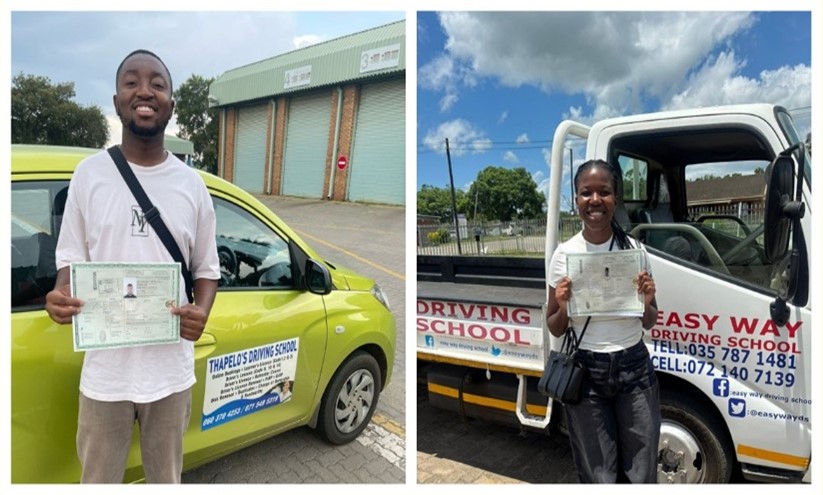
- South Africa’s youth unemployment crisis is being worsened by an often-overlooked requirement: a valid driver’s licence.
- CRET has made driver training part of its holistic bursary support model to improve graduates’ employability.
- The Drive to Thrive Campaign aims to help remove one of the most practical barriers between a qualification and a first job.
Tumelo Malebana did everything a young South African is told to do to escape unemployment. He matriculated, secured a bursary, and completed a scarce-skills qualification: a BSc in Civil Engineering, the kind of degree employers say the country urgently needs.
And still, not once but twice, he watched a job opportunity disappear at the final hurdle, not because of his marks, his references, or his interview, but because he did not have a driver’s licence. Before obtaining his driver’s licence, he lost two job opportunities because he did not meet this requirement.
Malebana, a Cyril Ramaphosa Education Trust (CRET) alumnus, is now a Site Engineer at WBHO. But the months he spent qualified, willing, and still unemployed raise a question South Africa’s job market rarely asks aloud: How many graduates are losing roles not because they cannot do the work, but because they cannot legally drive to it?
It is a peculiar kind of barrier, small enough to be missed in policy debates about skills mismatches and graduate unemployment, yet large enough to decide who gets hired. Scan job advertisements in engineering, sales, logistics, community development, or almost any field-based role, and a valid driver’s licence sits quietly among the requirements, as fixed as the qualification itself.
For young people who are often the first in their families to finish a degree, that single line can undo years of sacrifice. It raises an uncomfortable question for a country that prizes qualifications above almost everything else: What is a degree actually worth if the job adverts ask for something university never taught?
The hidden cost of employability
The barrier exists within a much larger crisis. Statistics South Africa’s first-quarter 2026 Quarterly Labour Force Survey places unemployment among young people aged 15 to 24 at 60.9%, and among those aged 15 to 34 at 45.8%. Behind those numbers are graduates who have done everything expected of them, only to discover that employability often depends on practical requirements never taught in a lecture hall.
This is also why the CRET, an innovative bursary support provider that has supported South African youth skills development for more than 25 years, has recognised that the transition from qualification to employment requires practical support beyond tuition alone.
Even when young people understand the gap, closing it is not simple. Getting a legitimate full driver’s licence in South Africa in 2026, including the learner’s test, an instructor’s lessons, the practical exam, and the licence card itself, typically starts at around R3,750 for a beginner’s package and often runs to R5,000 or more once enough lessons are bought to pass with confidence.
For a new graduate, that is rarely loose change. Many are still paying off NSFAS shortfalls or family loans taken out to get them through university in the first place. Others are stretching a first salary, or a stipend, to support siblings and parents at home. Asking that same household to find several thousand rand for driving lessons, on top of everything else, is often where the plan quietly falls apart, not for lack of will, but for lack of room in the budget.
Closing the gap
This is the gap CRET set out to close. For CRET, stories like Tumelo’s were becoming impossible to ignore. Time and again, graduates left the programme with qualifications, confidence, and ambition, yet met the same unexpected hurdle.
For more than 25 years, CRET’s holistic model has funded tuition, accommodation, books, and stipends for academically promising young South Africans from under-resourced backgrounds. But the Trust kept seeing the same pattern among its own graduates: strong qualifications were still being undercut by the same missing requirement that tripped up Malebana.
In response, CRET made a decision that few bursary schemes have taken: since 2020, obtaining a driver’s licence has become part of what it means to complete the CRET programme, on the same footing as finishing the academic qualification itself.
Nearly 100 young people have been supported through the initiative so far, starting with simulator training to build basic confidence and competence before moving on to practical lessons behind the wheel with registered driving instructors. By the time they graduate, CRET’s beneficiaries leave with one fewer reason for an employer to say no.
None of this happens on goodwill alone. Driver training is now part of the actual cost of employability for many young people, and it competes for the same limited funding that supports tuition, accommodation, books, stipends, psychosocial care, and work-readiness development.
Few employability interventions offer such a direct return. A relatively modest investment in driver training can remove a barrier that may stand between a qualified young graduate and a first job.
For the cost of supporting one learner’s driver training, a partner can help turn a qualification into employment, mobility into opportunity, and potential into income for an entire household.
Drive to thrive
This is why CRET is now working to scale its driver-training support within its broader employability model. To mark its quarter-century milestone, the Trust has launched the Drive to Thrive Campaign, a focused employability campaign to help address this practical barrier for youth entering the labour market.
The campaign is simple in intent and measurable in impact: every contribution helps move a young person closer to a legal driver’s licence, greater workplace readiness, and a fairer chance at employment. For a few thousand rand, partners can help remove a barrier that may otherwise keep a qualified graduate out of the labour market for months, or even years.
A bridge worth building
There is no shortage of qualified young South Africans. What is in short supply are the small, practical bridges between a qualification and a job offer. A driver’s licence, on the evidence of CRET’s own graduates, may be one of the more affordable bridges the country could choose to build at scale. It costs a few thousand rand per young person. The alternative, a graduate stuck on the sidelines for want of a licence, costs the economy a great deal more.
South Africa does not have a shortage of talented young people. It has a shortage of pathways that connect talent to opportunity. Sometimes that pathway is not another qualification, internship, or training programme. Sometimes it is a driver’s licence.
One licence will not solve youth unemployment. But for the graduate waiting for a first opportunity, it can be the difference between being qualified and being employed. And that is a bridge worth building.
Get your news on the go. Click here to follow the Conviction WhatsApp channel.
