Skip to content
Close Menu
ConvictionConviction
  • Home
  • Law & Justice
  • Special Reports
  • Opinion
  • Ask The Expert
  • Get In Touch

Subscribe to Updates

Get the latest creative news from FooBar about art, design and business.

What's Hot

AI will not save broken supply chains – but it will expose deeper flaws

July 28, 2026

Deputy Minister Nel wants indigenous languages to become languages of jurisprudence

July 28, 2026

Correctional Services was right to dismiss officer for depositing money into inmate’s account

July 28, 2026
Facebook X (Twitter) Instagram
Trending
  • AI will not save broken supply chains – but it will expose deeper flaws
  • Deputy Minister Nel wants indigenous languages to become languages of jurisprudence
  • Correctional Services was right to dismiss officer for depositing money into inmate’s account
  • ARB says Castle Lager influencer Jana Swart should have disclosed sponsored post
  • Legal Practice Council ordered to disclose records behind English-only admission exams
  • Labour Court halts UCT consultation process that could defeat pending whistleblower trial
  • Constitutional Court overturns 22-year murder sentence, orders prisoner’s release
  • UP scholar makes the case for specialised environmental courts to curb pollution
Facebook X (Twitter) Instagram
ConvictionConviction
Sonneblom
  • Home
  • Law & Justice
  • Special Reports
  • Opinion
  • Ask The Expert
  • Get In Touch
ConvictionConviction
Home » Deputy Minister Nel wants indigenous languages to become languages of jurisprudence
Special Reports

Deputy Minister Nel wants indigenous languages to become languages of jurisprudence

Deputy Justice Minister Andries Nel says South Africa must move beyond courtroom interpretation and develop indigenous languages into full languages of legal scholarship, legislation, and judicial reasoning.
Conviction Staff ReporterBy Conviction Staff ReporterJuly 28, 2026Updated:July 28, 2026No Comments
Facebook Twitter Pinterest LinkedIn WhatsApp Reddit Tumblr Email
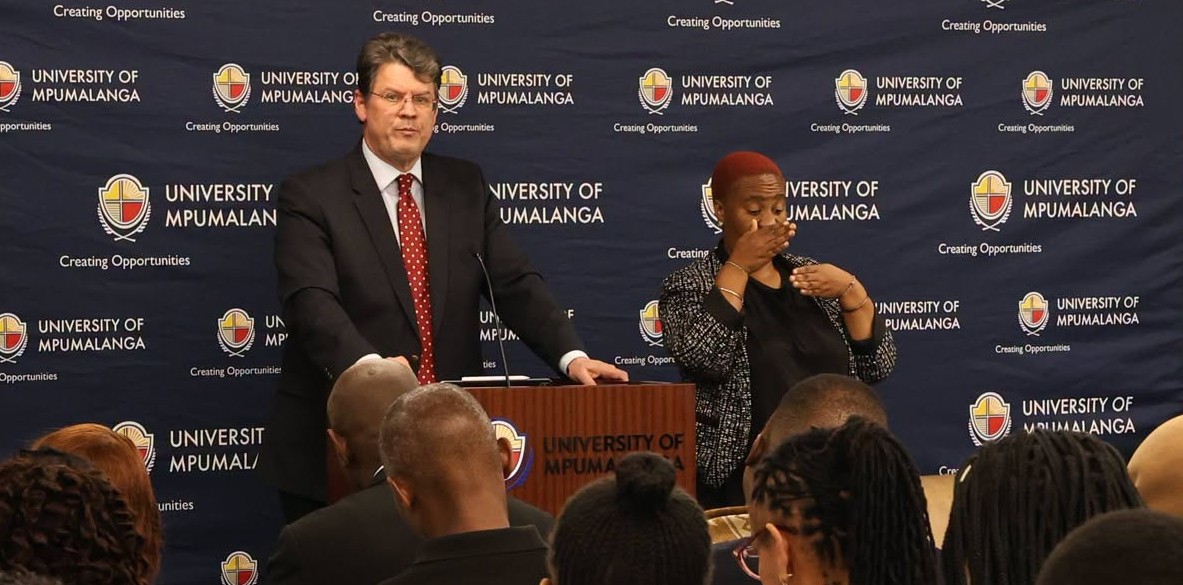
Deputy Justice Minister Andries Nel delivers a public lecture at the University of Mpumalanga on multilingualism and access to justice.
Share
Facebook Twitter LinkedIn Pinterest Email
  • South Africa should develop indigenous languages into languages used to write judgments, draft legislation and teach law, Deputy Justice Minister Andries Nel says.
  • He argues that constitutional transformation requires linguistic transformation to improve meaningful access to justice.
  • He proposes a national partnership to expand multilingual legal education, research, and judicial practice.

South Africa's indigenous languages must become languages in which the law is written, taught, debated, and developed, if the country is to achieve meaningful access to justice, Deputy Minister of Justice and Constitutional Development Andries Nel said.

Speaking during a public lecture at the University of Mpumalanga in Mbombela, Nel said the country's constitutional promise of equality would remain incomplete if most citizens continued to encounter the justice system through languages they could not confidently use.

Constitutional promise requires practical action

Nel said language occupies a central place in South Africa's constitutional order, and that Section 6 of the Constitution goes beyond recognising linguistic diversity. "It recognises 'the historically diminished use and status of the indigenous languages of our people,' and imposes a positive duty upon the state to take 'practical and positive measures' to elevate their status and advance their use,'" he said.

He said language is fundamental to the exercise of constitutional rights. "If the law speaks in words that most citizens cannot use confidently, the constitutional promise of equal protection is weakened at the very point at which it must become real," Nel said.

According to Nel, recognising indigenous languages without expanding their role in the legal system would not fulfil the Constitution's transformative vision.

Interpretation alone is not enough

Nel said there is an important distinction between languages used during court proceedings, legal languages, and languages of jurisprudence. While interpreters enable people to participate in court, he argued that indigenous languages should ultimately become languages in which judgments are written, legislation is drafted, legal scholarship is produced, and constitutional ideas are developed.

He said interpretation remains essential, but cannot be the end goal. "Interpretation remains indispensable. However, we must progress from interpreting participation towards multilingual production."

Court interpreters remain essential

Nel acknowledged the significant contribution made by court interpreters to the administration of justice. He said the Department of Justice and Constitutional Development currently employs about 1,900 court interpreters across South Africa, and maintains a database of more than 500 ad hoc interpreters, including South African Sign Language and foreign-language interpreters.

"Our interpreters make justice understandable and accessible. Their ongoing training and professional development is vital," he said. The Deputy Minister added that South Africa became the first country in the world to introduce the Court Interpreters' Robing Programme in October 2025, recognising interpreters as professionals who play a direct role in protecting constitutional rights.

Universities must help build multilingual justice

Nel said universities have a crucial role because they educate future judges, magistrates, prosecutors, advocates, attorneys, and academics. "The University of Mpumalanga now faces a comparable historical question of whether it will merely teach the legal languages that history has handed to it, or help create the multilingual jurisprudence that constitutional democracy requires," he said.

He proposed that the Department of Justice and Constitutional Development, through the Brigitte Mabandla Justice College, enter into a memorandum of understanding with the University of Mpumalanga.

The proposed partnership would focus on education and training, research and innovation, indigenous languages and access to justice, digital justice, and community engagement. It would also promote interpreter training, multilingual court resources, legal terminology development, judicial education, and student internships.

Language is central to justice

Nel said transformative constitutionalism requires not only legal reform, but also linguistic transformation. He argued that indigenous languages already carry rich legal traditions, and should become active contributors to modern constitutional jurisprudence, rather than remaining confined to interpretation.

"Language is the lifeblood of the law. Without words, rights cannot be claimed, enforced, or protected. For justice to be real, it must be spoken in the languages of the people," he said.

He concluded by urging government, universities, the judiciary, and the legal profession to work together to fulfil the Constitution's multilingual vision.

"Thirty years after the adoption of the Constitution, our task is not merely to praise its multilingual promise. It is to build the institutions through which that promise can speak."

He added, "Let us ensure that every language of our people can become a language not only in which justice is heard, but through which justice is imagined, reasoned, and made."

Conviction.co.za

Get your news on the go. Click here to follow the Conviction WhatsApp channel.

access to justice Andries Nel Department of Justice Indigenous Languages University of Mpumalanga
Share. Facebook Twitter Pinterest LinkedIn Tumblr Telegram Email
Conviction Staff Reporter

Conviction.co.za — Towards a Positive Impact on People

Related Posts

AI will not save broken supply chains – but it will expose deeper flaws

July 28, 2026

Unisa Law Clinic launches drive for professional attire donations to support LLB students

July 26, 2026

From rock samples to rocking the stage: Gavaza Mongwe advances to Mrs SA Top 30

July 24, 2026
Leave A Reply Cancel Reply

Prove your humanity: 4   +   1   =  

Subscribe to our newsletter:
Top Posts

Making sectional title rules that work: A practical guide

January 17, 2025

Protection order among the consequences of trespassing in an ‘Exclusive Use Area’

December 31, 2024

Between a rock and a foul-smelling place

November 27, 2024

Irregular levy increases, mismanagement, and legal threats in a sectional title scheme

June 2, 2025
Don't Miss
Special Reports
6 Mins Read

AI will not save broken supply chains – but it will expose deeper flaws

By Wesley NiemannJuly 28, 20266 Mins Read

Artificial intelligence is transforming supply chains, but it cannot overcome weak infrastructure, fragmented logistics or poor-quality data. Wesley Niemann argues that South Africa must pair digital transformation with investment in resilient infrastructure to unlock AI’s full potential.

Deputy Minister Nel wants indigenous languages to become languages of jurisprudence

July 28, 2026

Correctional Services was right to dismiss officer for depositing money into inmate’s account

July 28, 2026

ARB says Castle Lager influencer Jana Swart should have disclosed sponsored post

July 28, 2026
Stay In Touch
  • Facebook
  • Twitter
  • WhatsApp
Demo
About Us
About Us

Helping South Africans to navigate the legal landscape; providing accessible legal information; and giving a voice to those seeking justice.

Facebook X (Twitter) YouTube WhatsApp Twitch RSS
Latest posts

Making sectional title rules that work: A practical guide

January 17, 2025

Protection order among the consequences of trespassing in an ‘Exclusive Use Area’

December 31, 2024

Between a rock and a foul-smelling place

November 27, 2024
OUR PICKS

Judge dismisses bid to suspend attorneys over R23 million dispute, citing unfair investigation

July 22, 2026

Labour Court stops municipal disciplinary hearing over AI citation concerns

July 22, 2026

Court approves surrogacy where second wife carries child for first wife under customary law

July 22, 2026
© 2026 Conviction.
  • Home
  • Law & Justice
  • Special Reports
  • Opinion
  • Ask The Expert
  • Get In Touch

Type above and press Enter to search. Press Esc to cancel.

Powered by
►
Necessary cookies enable essential site features like secure log-ins and consent preference adjustments. They do not store personal data.
None
►
Functional cookies support features like content sharing on social media, collecting feedback, and enabling third-party tools.
None
►
Analytical cookies track visitor interactions, providing insights on metrics like visitor count, bounce rate, and traffic sources.
None
►
Advertisement cookies deliver personalized ads based on your previous visits and analyze the effectiveness of ad campaigns.
None
►
Unclassified cookies are cookies that we are in the process of classifying, together with the providers of individual cookies.
None
Powered by