


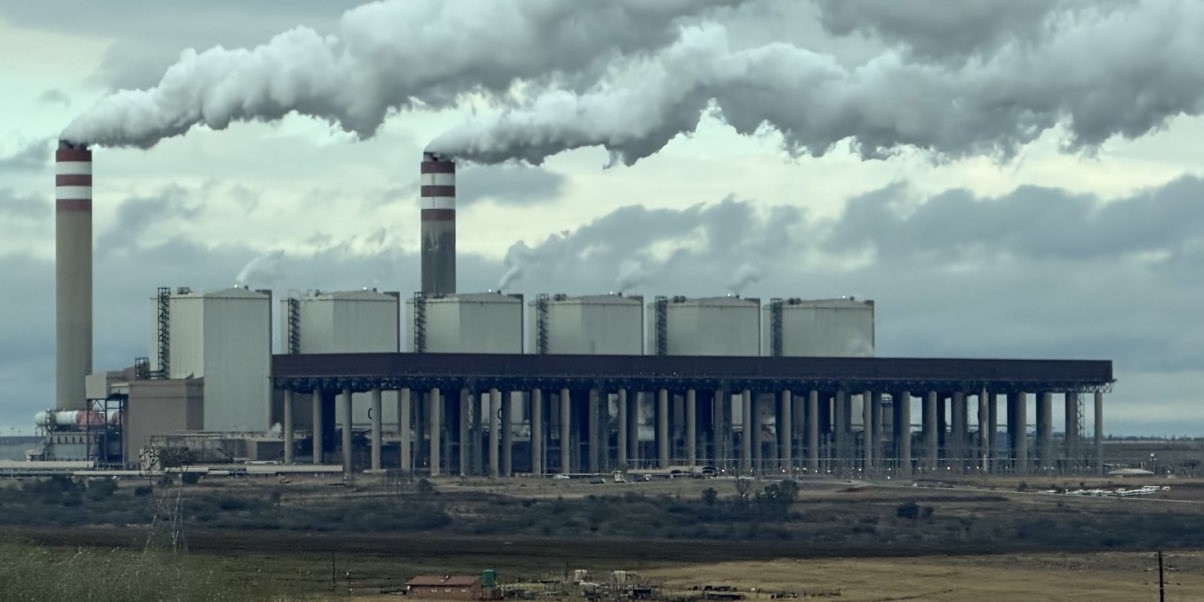
- Eskom must ensure Kusile follows environmental authorisations, NEMA and its water-use licences.
- The Supreme Court of Appeal found that Eskom and the responsible environmental regulators did not meet their legal and constitutional duties.
- Eskom has 30 days to submit a detailed action plan. The environmental regulators have 75 days to report on what enforcement action they will take.
Eskom has been ordered to take action to address pollution from the Kusile Power Station after the Supreme Court of Appeal found it had repeatedly failed to comply with environmental authorisations and water-use licences for the plant.
The appeal court also found that the Directors-General of the Department of Water and Sanitation and the Department of Forestry, Fisheries and the Environment failed for a long time to take reasonable and effective steps to enforce environmental and water laws.
The case was brought by Topigs Norsvin SA (Pty) Ltd, a swine genetics company with a farm next to Kusile. Topigs went to the High Court in Pretoria, asking the court to order Eskom and state regulators to deal with pollution affecting water resources downstream of the power station.
Eskom's compliance failures exposed
Topigs argued that Eskom had not complied with the conditions in its environmental authorisations and water-use licences for years, despite the risks to downstream water resources.
The Supreme Court of Appeal found that the environmental authorisations placed strict obligations on Eskom. These included recycling polluted water until pollutants were safely removed, banning the discharge of effluent or wastewater into stormwater drains or furrows, and requiring Eskom to stop contaminants from escaping into the environment.
The court also said that under the National Water Act, Eskom had to take reasonable steps to prevent pollution from happening, continuing or happening again. Eskom admitted that its operations at Kusile had harmed downstream water resources.
The judgment noted that contaminant exceedances increased between October 2022 and January 2024, even though Eskom's water-use licence limits were relaxed in 2022.
The judgment was delivered on 14 August 2026 by President MB Molemela, with Justice PA Meyer, Judge AM Kgoele, and Acting Justice EF Dippenaar and Acting Justice A Govindjee agreeing. Justice Molemela said Eskom was not allowed to “pollute the environment at will”.
Topigs succeeds on appeal
The High Court in Pretoria dismissed Topigs' application in June 2024. It said the company had not proved it had no other option, and that Topigs had not properly relied on section 28(12) of the National Environmental Management Act, so had gone against the subsidiarity principle.
The Supreme Court of Appeal disagreed. Justice Molemela found that Topigs' case was firmly based on the National Environmental Management Act (NEMA), the National Water Act, and the environmental authorisations and water-use licences for Kusile. Topigs relied on these laws while also claiming its constitutional right to a healthy environment under section 24.
“Topigs’ reliance on both NEMA and the Constitution does not break the subsidiarity rule,” Molemela said. The court found Topigs had not ignored the law, and Section 28(12) was not the only way to get help.
The appeal court found the High Court was wrong to deny relief because of subsidiarity, and went on to consider what orders were appropriate given Eskom’s non-compliance.
Regulators also failed to enforce the law
The court said that Eskom’s failures were made worse by the state regulators, who did not ensure compliance.
The court found that the Department of Forestry, Fisheries and the Environment and the Department of Water and Sanitation did not intervene properly after pollution exceedances and did not use their powers to make sure Eskom followed environmental rules.
“There were no proper interventions by Department of Forestry, Fisheries and the Environment and Department of Water and Sanitation officials before or after Topigs’ court application,” the judgment said, calling their failure to act quickly and diligently “inexcusable”.
The appeal court found that Eskom’s ongoing non-compliance, and the regulators’ failure to step in, violated the constitutional right to an environment that is not harmful to health or wellbeing, and to have the environment protected for current and future generations.
Molemela said that refusing the court order because of subsidiarity was just “putting form over substance”.
Eskom told to produce action plan in 30 days
The Supreme Court of Appeal ordered Eskom and its board members to take all necessary steps to make sure they comply with environmental authorisations, their environmental management programme, NEMA, the National Water Act, and relevant water-use licences.
They must submit a detailed action plan under oath within 30 days. This plan must list the steps to be taken, who is responsible for each, and when they will happen.
Eskom must then file a detailed report under oath within 60 days, explaining what has been done to carry out the order, any remaining non-compliance, and what will be done to fix these issues. The court also said Topigs can respond to these reports and go back to court if Eskom does not comply.
Regulators given 75 days to act
The appeal court also declared that the Directors-General acted unlawfully by failing to properly enforce the environmental and water-use laws for Kusile.
They were ordered to take all necessary steps to ensure compliance and, within 75 days, file affidavits confirming that they have properly considered whether to issue enforcement directives, compliance notices or other remedial steps against Eskom.
The court held that once non-compliance is proven, the enforcement powers under NEMA cannot just be treated as optional.
Court declines ongoing supervision
Topigs wanted a structural interdict that would have placed Eskom and the state under ongoing court supervision, including regular reports to the court.
The appeal court declined to grant this order. It found that because the environmental measures at Kusile are technical, the judiciary should not be responsible for repeatedly managing technical issues or the implementation of these measures.
Instead, the court found that declaratory and mandatory orders were enough to enforce the law, without requiring the judiciary to manage things on an ongoing basis.
The court also upheld the dismissal of the case against three senior Eskom employees. It found that their jobs did not make them personally responsible for Eskom’s compliance, and including them in the case was a mistake.
Topigs’ claims against the Minister of Mineral Resources and Energy and NERSA also failed, as there were no legal duties established against them.
Eskom told to pay costs
Eskom was ordered to pay Topigs’ legal costs, including the costs of two counsel, reasonable investigation and preparation costs, and the qualifying fees for Topigs’ expert witness.
Topigs was ordered to pay the costs of the three senior Eskom employees, since its appeal against them failed.
Get your news on the go. Click here to follow the Conviction WhatsApp channel.
