


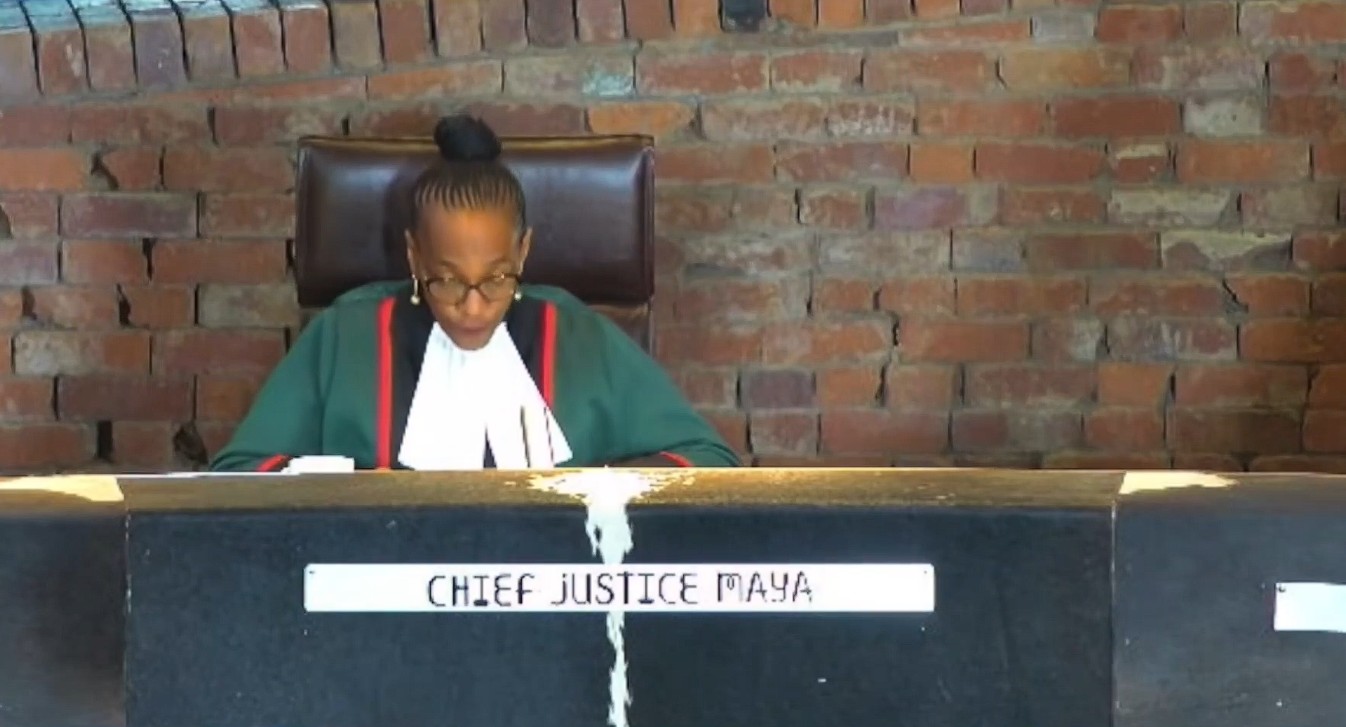
- Chief Justice Mandisa Maya said Parliament has a constitutional duty to hold the President accountable when serious allegations arise.
- She ruled that impeachment rules must be effective in practice and not allow accountability to be blocked by the political process.
- Maya made clear that constitutional accountability is a duty owed to the public and cannot be avoided through majority power.
Chief Justice Mandisa Maya has delivered a sweeping Constitutional Court judgment that reshapes how Parliament must handle impeachment proceedings against a sitting President.
In striking down a key National Assembly rule and setting aside the 2022 vote that halted the Phala Phala process, Chief Justice Maya made clear that Parliament cannot block a full constitutional inquiry once sufficient evidence exists to warrant further investigation.
What Chief Justice Maya said
- I must take full responsibility for the delay in producing this judgment concerning an extremely difficult matter of great national importance.
- I tender my sincere apologies to the parties, my colleagues and fellow South Africans for the inconvenience it has caused.
- The matter concerned complaints that the National Assembly had failed to hold the President accountable.
- The EFF challenged both the National Assembly’s 13 December 2022 vote and the constitutional validity of Rule 129I of the National Assembly Rules.
- Section 167(4)(e) of the Constitution permits only the Constitutional Court to determine whether Parliament or the President has failed to fulfil a constitutional obligation.
- The Constitutional Court’s exclusive jurisdiction must be construed narrowly so as not to trench on the powers of the High Court and the Supreme Court of Appeal.
- A mere allegation that Parliament has failed to fulfil a constitutional obligation is insufficient to trigger exclusive jurisdiction.
- Accountability is entrenched as a foundational value of South Africa’s constitutional order in Section 1(d) of the Constitution.
- Section 42(3) imports that constitutional value into the National Assembly’s role of scrutinising and overseeing executive action.
- Section 55(2) enjoins the National Assembly to put in place mechanisms to ensure executive accountability.
- Section 89 is one of the constitutional tools through which the National Assembly fulfils its obligation of holding the President to account.
- Section 89 implicitly imposes an obligation on the National Assembly to make rules specially tailored for an impeachment process.
- The question is not simply whether a mechanism exists, but whether that mechanism is effective.
- The National Assembly bears an obligation to put in place an effective mechanism to hold Members of the Executive accountable.
- The National Assembly also bears an obligation to take appropriate action against the President where allegations of conduct falling within Section 89 arise.
- Although Section 89 uses the word may, that does not mean the National Assembly is free of obligations under that section.
- What is discretionary is the decision whether to remove the President, but what is not permissive is the obligation to determine whether one of Section 89(1)’s grounds exists.
- Rule 129I is inconsistent with the Constitution, invalid and must be set aside.
- The National Assembly’s vote on 13 December 2022 declining to refer the Independent Panel report to an Impeachment Committee is inconsistent with the Constitution, invalid and set aside.
- The Independent Panel report be referred to the Impeachment Committee established in terms of the National Assembly Rules.
Get your news on the go. Click here to follow the Conviction WhatsApp channel.
