


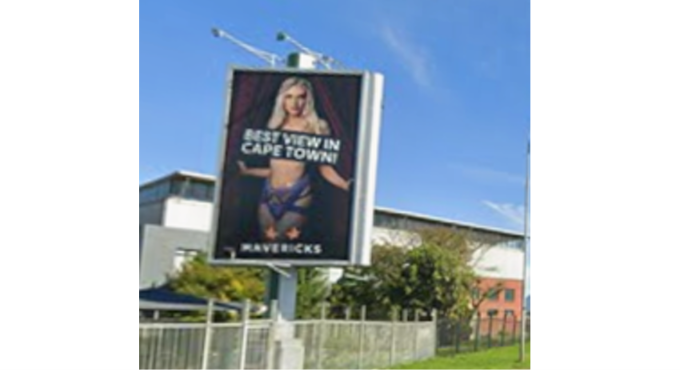
- The complainant said the billboard uses a woman’s body to attract attention and promote the business.
- He raised concerns about normalising the idea of women as objects of sexual consumption, especially in a country struggling with gender-based violence.
- The Advertising Regulatory Board dismissed the complaint and found that the advertisement did not break its Code of Advertising Practice.
A consumer challenged a Mavericks Review Bar billboard on the road out of Cape Town International Airport, arguing that its sexualised portrayal of a woman objectified women and exposed travellers, families and children to imagery they could not avoid.
He said his concerns went beyond personal offence. He argued that using a woman’s body to promote a commercial business reduces women to objects of sexual consumption and helps normalise that portrayal, particularly in a country that struggles with gender-based violence.
He also objected to the public being involuntarily exposed to sexualised advertising in a public transport environment, including people who might object for personal, cultural, religious or ethical reasons. The Advertising Regulatory Board (ARB) dismissed the complaint, saying the billboard did not break its Code of Advertising Practice.
Mavericks defends its billboard
Mavericks said it is not a member of the ARB and does not submit to its authority. The club further pointed out that the Code does not ban billboard advertising for legal adult entertainment businesses, and referred to earlier rulings about Mavericks and Teazers.
The club said the advert contains no explicit or gratuitous nudity and does not show the model in an overly sexualised way. It compared her outfit to what is seen in lingerie and swimwear ads. Mavericks also said the headline ‘Best view in Cape Town’ is just suggestive wordplay about its services, and does not reduce the model to a sexual object.
Mavericks admitted that travellers, including families and children, could see the billboard without choosing to. However, it argued that involuntary exposure does not automatically make an advert offensive. The club also said the billboard has been up at that spot for more than five years and this is the first complaint it has received.
ARB considers objectification concerns
In a decision, the ARB Directorate considered whether the billboard breached the code’s provisions on offensive advertising, gender stereotyping and harm to children. The Directorate explained that while the ARB cannot force non-members to take part in its process or follow its orders, it can consider adverts and issue rulings to guide its members on whether to accept or remove them.
On the complaint itself, the Directorate acknowledged the concerns about the sexualised depiction of a woman and the billboard’s placement in a public space. It noted that the advert shows a woman wearing underwear, with the words ‘Best view in Cape Town’ placed on a banner across her chest. The Directorate wrote, “The Directorate is uncomfortable with the fact that a woman is being compared to a view, which in the most literal sense is an act of objectification.”
It said this case is different from an earlier ruling involving We Buy Brands, where the woman’s portrayal suggested she could be owned. The Directorate said, “In the first place, the woman is not compared to something that can be owned, or eaten, or other similarly problematic objects. She is compared to a view. Views are generally regarded as being beautiful, and have no inference of possession.”
It also said, “In the second place, the advertisement draws attention to the model’s physical appearance as a whole, as the model is depicted as a whole person, including her head, and not reduced to only her sexual characteristics.”
The Directorate compared this case to an earlier Teazers ruling about a chief executive surrounded by women. In that case, it found the advert suggested women were “a benefit or prop of wealth and power”. The Directorate said the Mavericks billboard does not send a similar message. “The model is depicted alone, and there is nothing to suggest that she is subordinate to another person, or that she occupies a particular role in society.”
It concluded, “Given this, the Directorate does not believe that the advertisement, considered as a whole, constitutes the kind of objectification or demeaning portrayal as prohibited by the Code.” It also noted that the image is no more revealing than a swimwear advert and found no gender stereotyping or negative gender portrayal.
Directorate finds no harm to children
The Directorate acknowledged that children could see the billboard but said it was “not convinced that the content of the Advertisement will cause moral harm”.
Referring to an earlier Mavericks ruling, it said a young child seeing this kind of advert would likely not understand what services are being promoted. An older child might ask questions about the billboard or business, but “this does not on its own establish moral harm”.
The Directorate said it looked at whether seeing the advert was likely to expose a child to “new and inappropriate information” and concluded it was not. It found no breach of the Code’s rules on children.
The complaint was dismissed.
Get your news on the go. Click here to follow the Conviction WhatsApp channel.
