


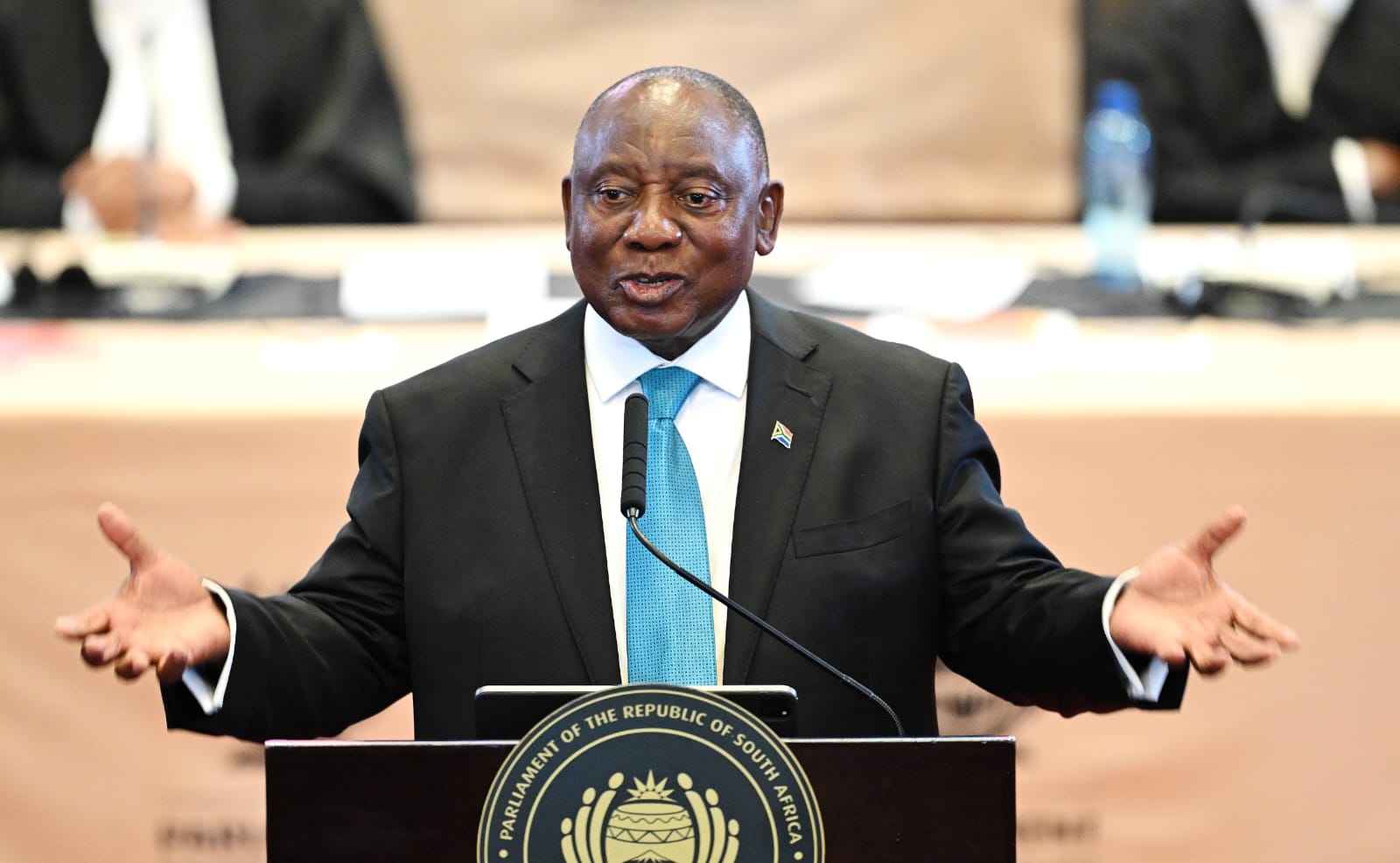
- The Constitutional Court found that President Cyril Ramaphosa and former presidents Thabo Mbeki, Kgalema Motlanthe and Jacob Zuma failed to meet their constitutional obligations by allowing a joint pardon application to go unresolved for 24 years.
- Fusi Simon Mofokeng and Tshokolo Joseph Mokoena always insisted on their innocence after being convicted of murder and other charges related to a 1992 shootout, even though former SDU members testified that they were not involved.
- The two men are entitled to constitutional damages, with the exact amount to be decided after written submissions are made in November 2026.
President Cyril Ramaphosa and three former presidents failed in their constitutional duties by not ensuring that a joint presidential pardon application was decided for 24 years, according to the Constitutional Court.
In a unanimous judgment on Wednesday 21 October 2026, Justice J Kollapen found that Ramaphosa and former presidents Thabo Mbeki, Kgalema Motlanthe and Jacob Zuma did not ensure the application by Fusi Simon Mofokeng and Tshokolo Joseph Mokoena was considered quickly and with care.
The Minister of Justice and Constitutional Development, Mmamoloko Kubayi, and the Department of Justice and Constitutional Development also opposed the application. The three former presidents did not oppose or take part in the case.
Mokoena’s widow, Xoliswa Percival Mokoena, joined the case as his estate’s representative. Both men were eventually pardoned in December 2025, but the Constitutional Court said the late decision did not undo the constitutional breach or take away the need for a real remedy.
The judgment in Mofokeng and Another v President of the Republic of South Africa and Others [2026] ZACC 43 makes clear that while the President can grant or refuse a pardon at his discretion, he must still decide on applications logically, in good faith, lawfully, diligently and without delay.
Convictions followed a disputed shoot-out
The case came from a shoot-out on 2 April 1992 between an ANC self-defence unit and members of the South African Police Service in Bethlehem, Free State. One police officer died, and another was badly injured.
Mofokeng and Mokoena were found guilty of conspiracy to commit robbery, attempted murder and murder after what the Constitutional Court called a flawed trial. The only evidence against them came from one State witness whose reliability was in doubt.
Neither man was at the scene of the shootout or involved with the Self-Defence Unit (SDU). Even so, they were convicted of murder and attempted murder under the doctrine of common purpose. Both men received life sentences plus another 18 years.
Both men insisted they were innocent throughout the trial and tried every legal avenue available, including appeals against their convictions. They also sought amnesty through the Truth and Reconciliation Commission (TRC), but withdrew their application because they refused to admit guilt, which was necessary to get amnesty.
Four SDU members who were involved in the shootout received amnesty for the murder and attempted murder convictions. During their TRC hearings, three of them admitted that Mofokeng and Mokoena had nothing to do with the unit and were strangers to them. Despite the evidence that supported their innocence, both men had to keep searching for ways to clear their names.
Pardon application remained unresolved for decades
Mofokeng and Mokoena applied together for a presidential pardon in November 2001 under Section 84(2)(j) of the Constitution. Their application was based on the SDU members’ admissions before the TRC, the amnesties that had been granted, the State witness’s unreliability, and the witness’s own admission that he had been bribed to give false evidence.
They asked to be released from prison immediately or, if not, for a reprieve under Section 325 of the Criminal Procedure Act. Their original application did not include the trial transcript or their applications for leave to appeal because those documents were hard to get. But they were never told that missing these documents made their application incomplete. Instead, officials kept telling them that the application was still under consideration.
Around 2008, both men also applied for pardons under Mbeki’s Special Dispensation, even though they knew that insisting on their innocence would likely disqualify them from the process. The department then told the National Council of Provinces Petitions and Executive Undertakings Committee in April 2010 that it could not decide on the Special Dispensation applications.
In July 2017, Mofokeng and Mokoena also applied under Section 327 of the Criminal Procedure Act, which lets courts consider new evidence that could change a conviction. The Director of Public Prosecutions turned down that application in June 2018, but the men only found out about the decision in March 2019. They were also never told that the minister had officially rejected their application, as the law requires.
In April 2021, they went back to the Office of the Presidency and asked for a decision by May that year. The Department of Justice and Constitutional Development said the matter had been sent back for a new recommendation because so much time had passed. The department asked for new forms, which meant the process started over from scratch.
After being assured that providing extra information would not count as a new application, the men sent in more documents in July 2023. They also asked that the Section 327 process be put on hold until a decision was made on their pardon application.
Despite following up many times, they still received no decision. They eventually went to the Constitutional Court in August 2025. It was only after the legal case started that the President promised to decide on the application by 31 January 2026. On 19 December 2025, both men were pardoned on all charges for which they had been convicted. Mokoena’s pardon was granted after his death.
Presidents remained responsible for the delay
The President admitted that the delay since 2021 was deeply regrettable and apologised. He said he could not find any proof that the original application was ever put before the former presidents, even though the department had processed it.
The respondents argued that the delay should be counted from November 2021, when they said the application was resubmitted, not from November 2001. They claimed the original application had been replaced by the Special Dispensation process, the men’s parole and the Section 327 application.
They also blamed the delay on not having enough staff in the Department’s Legal Process Directorate, which deals with pardon applications and requests to clear criminal records.
Justice Kollapen rejected the argument that the other processes cancelled out the original application. There was never any communication saying the 2001 application had been refused, and neither its supposed incompleteness nor the men’s pursuit of other remedies cancelled it out. The judge found that the delay should be counted from November 2001, which means it lasted 24 years.
The judgment stressed that the President’s power to grant a pardon is discretionary only when deciding whether to grant it. But the duty to consider and decide on an application in good faith, rationally, lawfully, diligently and without delay is mandatory.
The President could not avoid responsibility just because the application hadn’t reached his office. The power to grant pardons belongs only to the President, who is ultimately responsible for the whole process, even the steps carried out by the minister or department.
The judgment found that not having enough resources in the administration was not a valid excuse for the delay. Even if the delay was counted from 2021 instead of 2001, the four-year wait would still have been unacceptable and impossible to explain.
The court also pointed out the many letters sent by the applicants and their lawyers. The department had been told that Mokoena was seriously ill and wanted a decision before he died. Two weeks later, a follow-up letter told the department that he had died, but there was still no response.
Justice Kollapen criticised the respondents’ claim that there was nothing left to be done for the harm Mokoena suffered because his pardon came too late. The government’s own delay could not be used to avoid responsibility for what happened.
Constitutional damages ordered
The respondents argued that the pardons made the case irrelevant and that nothing else would have any real effect. The Constitutional Court disagreed, finding that the pardons did not wipe away the earlier constitutional failures or settle the question of a proper remedy.
The applicants asked for declaratory relief, constitutional damages and, if not that, delictual damages. They also wanted a structural interdict requiring the President to fix the systemic problems in the way pardon applications are handled.
Justice Kollapen said constitutional damages were the right remedy, considering the 24-year delay, the seriousness of the harm, the Presidency’s response and the need for a real solution without dragging out more litigation.
The judgment made it clear that constitutional damages are not meant to punish the State. They are meant to recognise constitutional violations and deal with the harm suffered. Having another possible remedy does not automatically rule out constitutional damages; the test is whether the other remedy would be just as suitable and effective.
The court also rejected the idea that Mokoena’s estate could not receive constitutional damages just because he died before the claim was finished. Using the Constitution’s broad powers to provide relief, the judge said it would not be fair or right to let the respondents’ own delay block a remedy for what Mokoena went through.
However, the court decided not to grant the structural interdict. It said these kinds of orders should only be made when they are really needed to make sure court orders are followed. Even so, the Court said it expects the Presidency to review the pardon process and take steps to prevent similar failures in the future.
Damages amount still to be determined
The Constitutional Court ruled that Ramaphosa and the three former presidents failed to meet their constitutional obligations under Section 84(2)(j), together with Sections 83(b) and 237 of the Constitution. The court found that these failures related to their official roles, not their personal capacities.
Both sides must submit written arguments about how much constitutional damages should be awarded. The applicants’ arguments are due by 11 November 2026 and the respondents’ by 25 November 2026. Each submission can be up to 30 pages long.
The order also allows the applicants to bring a separate delictual damages claim in the High Court if they want. The judgment does not decide if such a claim is possible or what defences might be raised. If delictual damages are awarded, constitutional damages must be considered when deciding the amount.
Ramaphosa, in his official role, was ordered to pay the applicants’ legal costs. This includes the costs of two counsel, where they were used.
Get your news on the go. Click here to follow the Conviction WhatsApp channel.
