


- The government has enacted strong GBV laws but failed to adequately fund their implementation.
- Reliance on corporate donations has effectively outsourced a constitutional responsibility.
- Both the state and the private sector must be held accountable for protecting women.
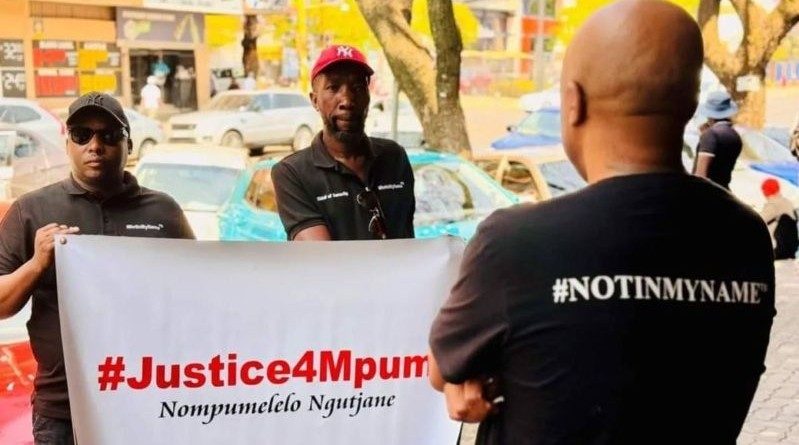
Every August, South Africa engages in a well-rehearsed ritual of hypocrisy. At Not In My Name International, we refuse to applaud paper laws, unfunded plans and corporate performative allyship. We do not need another televised summit or corporate sponsorship banner. We demand direct, structural accountability from both the state and the private sector.
As the country marks 70 years since the historic 1956 Women's March and 30 years of official Women's Day commemorations, government ministers in tailored suits and corporate executives in high-rise boardrooms gather for Women's Month breakfasts, deliver solemn speeches and pledge their commitment to ending gender-based violence.
We are offered glossy policy pamphlets, corporate press releases and grand promises. Yet outside these polished venues, South African women are being hunted, beaten, raped and murdered in their homes and workplaces.
Progressive laws have failed in practice
When Parliament passed three landmark GBV Amendment Acts between 2021 and 2022 — (1) the Domestic Violence Amendment Act; (2) the Criminal and Related Matters Amendment Act; and (3) the Criminal Law (Sexual Offences and Related Matters) Amendment Act — the state declared victory and promised a new era of protection.
On paper, these statutory frameworks represent significant progress. The Domestic Violence Amendment Act expanded definitions of abuse to include coercive control and elder abuse, introduced an online portal for protection order applications and mandated an Integrated Electronic Repository.
Meanwhile, the Criminal and Related Matters Amendment Act eliminated police station and prosecutor bail for GBV suspects, shifting the burden to the accused in court, while the Criminal Law (Sexual Offences and Related Matters) Amendment Act expanded the National Register for Sex Offenders and broadened reporting duties.
Yet years after their enactment, these laws exist almost entirely on paper, severely crippled by operational realities. The Department of Justice's online protection order portal is a digital mirage, regularly rendered unusable because of server downtime and staffing shortages, while completely excluding women in townships and rural areas who lack internet access, data or smartphones.
Furthermore, the Integrated Electronic Repository remains fragmented, preventing police from verifying the status of active protection orders across jurisdictions. On the ground, frontline police officers frequently lack training, routinely turning survivors away under the pretence that domestic abuse is a private family matter or illegally granting station bail and releasing perpetrators back into communities.
An unfunded national strategy
This legislative breakdown and decay are directly linked to the government's failure to fund its own strategy.
The National Strategic Plan on Gender-Based Violence and Femicide (NSP) was trumpeted as a multi-sectoral roadmap organised around six strategic pillars. Yet years later, the NSP remains an unfunded wish list because the Department of Women, Youth and Persons with Disabilities failed to comprehensively cost the plan.
Without a costed framework, budget allocations across government departments are spent haphazardly and remain fragmented, leading to chronic underspending, unallocated funds, poor local coordination and an inability to deliver frontline services, leaving local shelters and advice centres in marginalised communities starved of resources.
Corporate funding cannot replace constitutional obligations
To plug this fiscal gap, instead of funding the NSP directly through the national budget, the state launched the GBVF Response Fund 1 in 2021, securing initial pledges of more than R128 million from corporate heavyweights, including Anglo American, ABSA and the Ford Foundation.
While paraded as a triumph of social compacting, it exposes a shameful truth: the government has privatised the basic safety of women. Protecting citizens from violent crime is a core constitutional obligation of the state, not an opt-in charity project or an outsourced responsibility for big business.
For corporate South Africa, contributing to the GBVF Response Fund has become a convenient Environmental, Social and Governance (ESG) tax write-off and a photo opportunity. Corporate leaders eagerly hand over ceremonial cheques while presiding over organisations that enforce pay inequality, ignore workplace sexual harassment, maintain precarious labour conditions and trap female employees in financial dependency.
You cannot claim to fight gender-based violence in public while maintaining the structural wage gap in private that forces women to remain with abusive partners for financial survival.
Time for accountability
The government must immediately cost and fully fund the National Strategic Plan directly from the national Treasury, ensuring that resources reach frontline community organisations rather than languishing in administrative delays.
The Department of Justice must repair and stabilise its digital infrastructure so that protection orders are processed 24/7 while establishing functional, staffed help desks at every magistrate's court.
The South African Police Service must enforce the law without exception, and station commanders who unlawfully grant bail or ignore breaches of protection orders must face immediate disciplinary action.
Simultaneously, corporate South Africa must look inward, audit its wage structures, enforce zero-tolerance workplace harassment policies and move beyond tax-deductible public relations.
Until the government funds its commitments and corporations align their workplace practices with their public declarations, Women's Month remains an insult to every survivor in this country. Stop handing women paper shields and corporate promises while letting the systems built to protect them crumble. Act with the required urgency, or admit that the lives of South African women are treated as nothing more than an acceptable loss.
Get your news on the go. Click here to follow the Conviction WhatsApp channel.
The opinions expressed in this article are solely those of the author and do not necessarily reflect the views of Conviction.co.za.
