


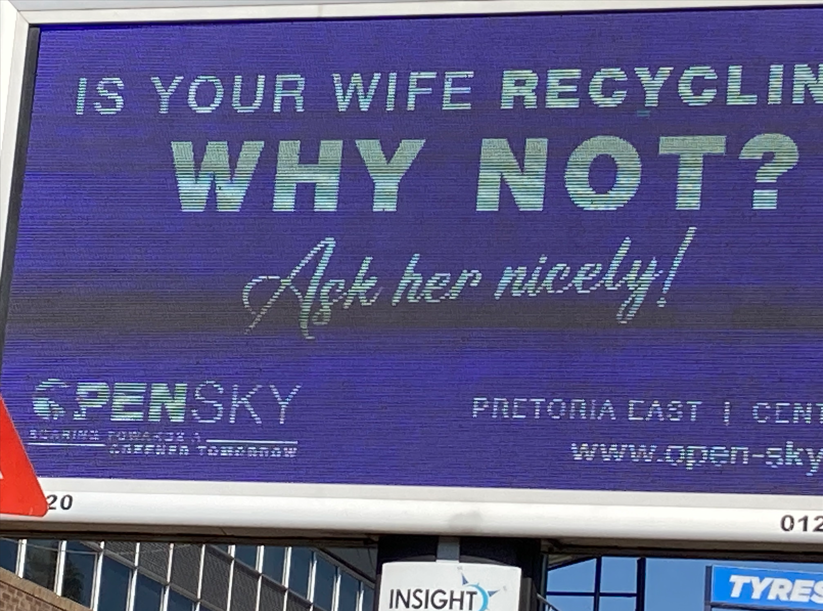
- A billboard by Open Sky Recycling Services asked, “Is your wife recycling? If not, ask her nicely,” drawing public backlash.
- The ARB ruled that the advert perpetuates negative gender stereotypes and casual sexism.
- ARB members instructed to remove and not accept any future use of this message.
What started as a supposed attempt at humour on a digital billboard has ended in a firm reprimand from South Africa’s Advertising Regulatory Board. Open Sky Recycling Services has been found in breach of advertising codes after public outrage over its ad that read, “Is your wife recycling? If not, ask her nicely.”
For many, the line was more than a harmless prompt, it was a stark reminder of the everyday sexism embedded in media messaging. A consumer complaint to the ARB captured the growing discomfort: “Why is it assumed that only women should do the recycling? Why cannot men also step up?”
The complaint did not just address the wording, it exposed a broader societal issue. It questioned why, in 2025, women are still primarily portrayed as the ones responsible for household chores. This kind of messaging, the complainant argued, reinforces the outdated and harmful stereotype that “women belong in the kitchen.”
Advertiser defends the message as ‘humorous’
In response, Open Sky Recycling Services acknowledged it is not bound by ARB decisions but agreed to participate in the process in good faith. The company argued that the line was intended to be light-hearted, not offensive. It explained that the messaging was based on what it claimed were real community dynamics, where women, or in many cases domestic workers, typically take the lead in recycling.
The advertiser insisted it never meant to exclude men, and that the phrase was designed to provoke a chuckle and encourage participation in their recycling initiatives.
ARB says the joke is not funny, it it sexist
But the ARB did not share the joke. After a thorough review, the watchdog found the ad in violation of two key clauses in its Code of Advertising Practice, one dealing with gender stereotyping, and another on offensive advertising. The Directorate ruled that the ad entrenched the outdated notion that women are homemakers, and that men must instruct or influence women to act responsibly.
In its decision, the ARB stated: “The stereotype that housework is the domain of women is problematic in that it entrenches outdated gender roles that place women in the kitchen, and men in the professional space.”
The Directorate noted that the billboard completely overlooks working women, single women, or women in equal partnerships, many of whom make independent decisions about household matters. Instead, it reinforces the image of the man as head of the household, issuing directives.
The ARB further criticised the phrase “Ask her nicely”, which it found especially troubling. This, they said, plays into casual sexism, the idea that women are emotional or volatile and must be treated delicately, lest they react negatively. Far from humour, the Directorate found the tone and implication harmful.
Members ordered to remove the ad
Ultimately, the ARB instructed all its members to remove the advertisement and refuse any future ads from Open Sky that include the same wording.
In the end, what was intended to be a humorous campaign turned into a case study of how even small phrases can uphold large systems of inequality. As South Africa continues its journey toward equality in all spheres, including domestic responsibilities, this case serves as a reminder: language matters, and so does accountability.
Conviction.co.za
