


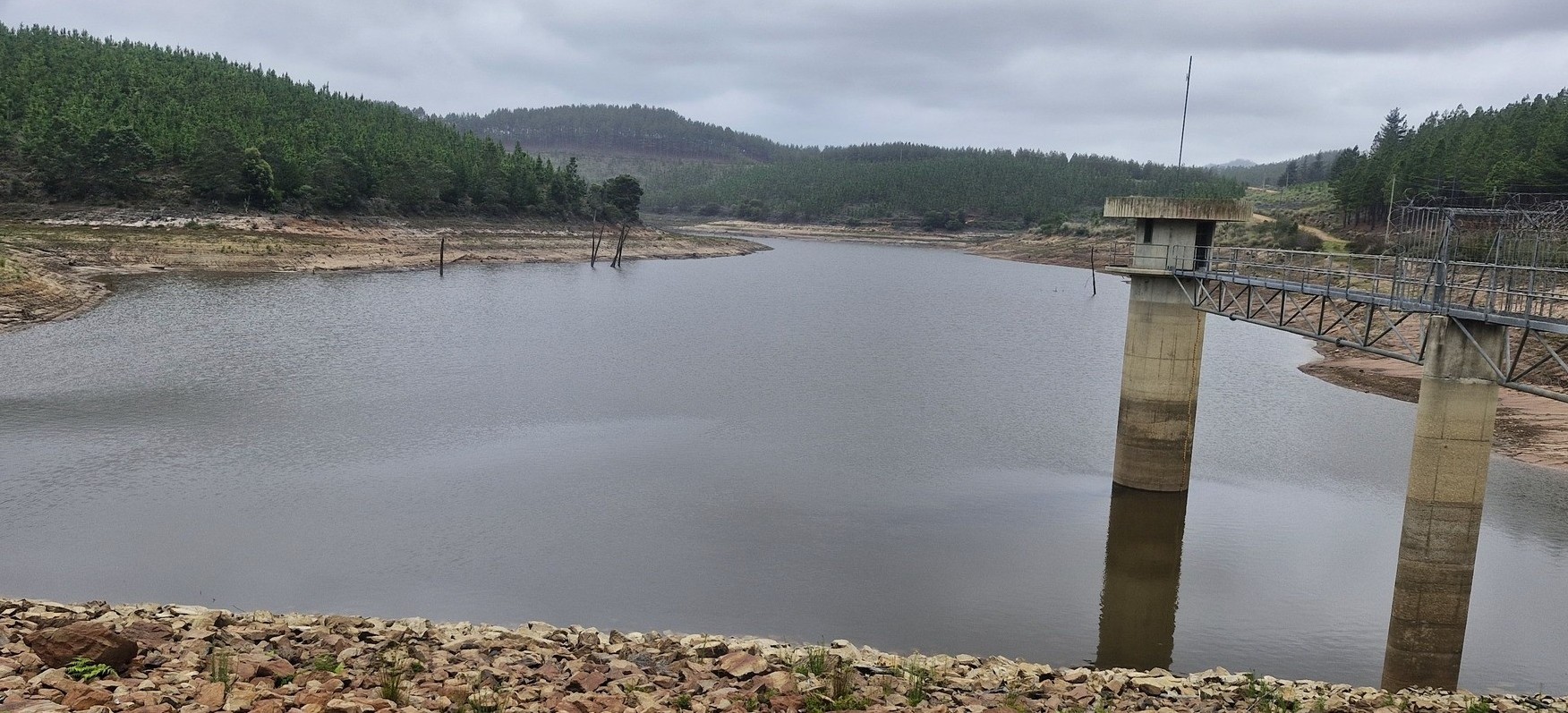
- Knysna’s water shortages stem from governance failures and neglected infrastructure rather than a lack of rainfall.
- Lessons from the 2009 drought and Cape Town’s Day Zero crisis were ignored, entrenching vulnerability.
- Clean audit outcomes have masked deep weaknesses in maintenance, equity, and water governance.
Knysna is not running out of water because it has not rained. It is running out of water because the municipality failed to learn from its own history, from national warning signs, and from the slow decay of its infrastructure.
The town’s primary water storage facility, the Akkerkloof Dam, has dropped below 20% capacity, leaving roughly two weeks of supply at current consumption levels. Water restrictions are tightening, emergency measures are again being discussed, and residents are being asked to conserve as though this crisis arrived suddenly. It did not.
South Africa is a water-scarce country. Droughts are neither rare nor unpredictable. The legislation, technical expertise, and institutional memory required to manage them already exist. What is unfolding in Knysna is therefore not a climatic anomaly or an act of nature. It is an institutional failure, repeated over more than a decade, marked by the inability to convert past crises into durable governance reform.
As a sociologist who researches hydropolitics, inequality, and water governance, I argue that Knysna’s current emergency reflects three interlinked failures: the failure to learn from its own 2009 drought, the failure to internalise lessons from Cape Town’s Day Zero crisis, and the false reassurance taken from clean audit outcomes despite chronic infrastructure neglect. Together, these failures have normalised vulnerability and turned preventable stress into recurring crisis.
Knysna has been here before. In 2009, the town experienced its worst drought in more than a century, pushing water security to the brink. In response, significant public resources were mobilised. Emergency water was trucked in, and new infrastructure was constructed, including a desalination plant intended to provide a drought-resilient supply buffer. More than R50 million in national emergency funding was allocated across Mossel Bay, George, and Knysna for these interventions.
At the time, this was presented as a forward-looking investment, evidence that Knysna was preparing for a water-scarce future. Yet today, that desalination plant has not been operational for at least a decade. It has not been maintained, upgraded, or meaningfully integrated into a long-term water strategy. It has simply been allowed to decay.
This is not a technical oversight. It reveals a deeper institutional pattern in South African local government: the ability to build infrastructure in moments of crisis, coupled with a persistent failure to maintain it once political urgency fades. Capital expenditure is rewarded, while operations and maintenance are neglected. Knysna’s desalination plant stands as a material symbol of this governance failure.
Cape Town’s Day Zero: a warning ignored
If Knysna’s own history was insufficient warning, Cape Town’s Day Zero crisis should have been impossible to ignore. Between 2017 and 2018, South Africa’s second-largest city came within weeks of shutting off its municipal water supply. The episode demonstrated how close urban systems are to collapse when climate stress intersects with weak demand management and delayed political action.
Day Zero offered painful but valuable lessons: the importance of early demand reduction, diversified supply, pressure management, transparent communication, and decisive leadership. Above all, it showed that water crises do not emerge overnight. They are produced through years of incremental failure.
Yet Knysna did not meaningfully internalise these lessons. Demand management was slow and uneven. Water losses through leaks and system inefficiencies were tolerated. Alternative supply options were not progressively developed. Public communication intensified only once the situation became acute, often focusing on household behaviour rather than systemic losses.
In effect, Knysna treated Day Zero as Cape Town’s problem rather than a national warning. This reflects a broader pathology in South Africa’s water governance: crises are framed as local exceptions even when their causes are systemic. Each municipality imagines itself immune until it is not.
Clean audits, broken systems
Perhaps the most troubling aspect of Knysna’s crisis is the contradiction between formal governance assessments and lived reality. The municipality has received audit outcomes indicating “no material irregularities.” On paper, financial processes appear compliant. Oversight institutions find little cause for alarm.
And yet water infrastructure has not been adequately maintained. Non-revenue water, that is, potable water produced and pumped but lost through leaks, theft, or faulty meters, remains unacceptably high. Critical assets have deteriorated without timely intervention. Technical capacity has been stretched thin.
This exposes a dangerous misconception: that clean audits are synonymous with good governance. They are not. Audit outcomes assess financial compliance, not service resilience. A municipality can tick the boxes, follow procurement rules, and still fail to deliver water. Knysna starkly illustrates this paradox.
Not scarcity alone, but governance failure
Climate change is real. Rainfall patterns are shifting, and droughts are becoming more frequent and intense. But scarcity alone does not produce a crisis. A crisis emerges when scarcity meets weak institutions.
Knysna’s situation illustrates what I have elsewhere described as “invented scarcity,” not because water is plentiful, but because governance failures manufacture acute shortages for some while insulating others. Households and businesses with financial means secure storage, boreholes, and private supply. Poorer residents, disproportionately in black communities, bear the brunt of restrictions, outages, and uncertainty.
This outcome is not accidental. It is the predictable result of governance systems that fail to prioritise maintenance, equity, and accountability.
What must change
If Knysna’s crisis is to mean anything beyond another emergency declaration, it must force a shift in how water governance is practised.
First, operations and maintenance must be ring-fenced. Maintenance cannot be treated as discretionary spending sacrificed under budget pressure. Without protected funding for upkeep, every new infrastructure investment becomes a future liability.
Second, non-revenue water must be reduced aggressively and transparently. Losses must be measured credibly and reported publicly. Water lost through leaks is not an act of nature; it is a governance failure.
Third, technology must support institutions, not replace them. Sensors, AI-driven leak detection, and pressure management systems can improve efficiency, but only if municipalities have the capacity, skills, and accountability structures to act on the data. Technology cannot compensate for institutional weakness.
Underlying all of this is an ethical imperative. Water governance must be rebuilt around dignity, fairness, and accountability. Access to water is not merely a technical service; it is a constitutional right and a condition of human dignity. When crises recur, trust erodes not only in municipalities but in the democratic promise itself.
Three decades into democracy, the constitutional right to water is only as secure as the institutions entrusted to uphold it — and in Knysna, that security is eroding.
Get your news on the go. Click here to follow the Conviction WhatsApp channel.
