


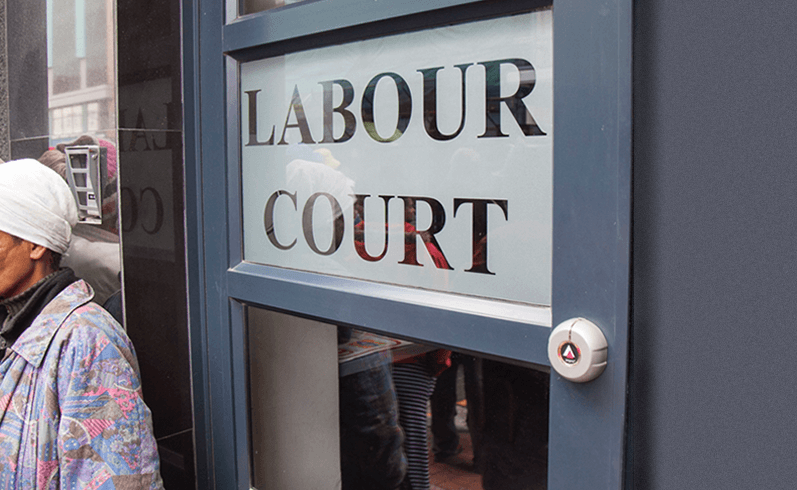
- The Labour Court ruled that a representative’s lack of authority cannot invalidate an employee’s labour dispute or remove the worker’s right to have their case heard.
- Acting Judge C de Kock explained that jurisdiction and representation are separate legal issues, and a tribunal’s power to hear a dispute remains unaffected.
- The judgment emphasises the importance of accurate representation in labour disputes, while confirming that workers cannot lose their claims because of a representative’s misconduct.
Employees who challenge dismissals or disciplinary action often rely on representatives to speak on their behalf during arbitration or court proceedings.
These representatives may be lawyers, trade union officials, or other individuals authorised to appear in labour dispute forums. When a representative lacks proper authority, it can disrupt proceedings and delay the resolution of a dispute.
A recent Labour Court judgment involving Nomfundo Dlakana, the Education Labour Relations Bargaining Council, Commissioner R Olivier, and the Western Cape Department of Education illustrates why correct representation in labour disputes matters. The dispute arose after arbitration proceedings concerning Dlakana’s alleged unfair dismissal were declared invalid when the commissioner concluded that the person representing her did not have the required legal standing.
The commissioner ruled that the conduct of the representative had compromised the arbitration proceedings, stating that “the material and fraudulent misrepresentation in this matter, where Mr Kwayiso, as the applicant’s representative, acted as her representative without having locus standi, vitiated the whole of the arbitration proceedings, and the matter is therefore null and void.”
The commissioner further indicated that the dispute had effectively reached its conclusion, noting, “I have already noted that this matter is null and void, and from that point of view, the matter is concluded.”
Dlakana approached the Labour Court to review and set aside that ruling, arguing that the dispute itself had never been properly determined.
Court clarifies distinction between jurisdiction and representation
Acting Judge C de Kock examined whether the commissioner’s decision lawfully brought the dispute to an end. The court found that the ruling never expressly dismissed the unfair dismissal dispute, and that the commissioner had incorrectly treated the representative’s lack of authority as grounds to terminate the proceedings.
The judgment emphasised that jurisdiction and representation are distinct legal concepts. Jurisdiction concerns whether the tribunal has the authority to hear the dispute at all, while representation concerns the authority of a person acting on behalf of a party.
Judge de Kock explained the difference clearly, writing, “Jurisdiction concerns the competence of the tribunal to hear the dispute at all.”
The court then clarified that the authority of a representative is a separate legal inquiry, noting, “The authority of a representative is an altogether different inquiry.”
Because of this distinction, the court held that problems with representation cannot invalidate the underlying dispute. The appropriate response is to deal with the representative’s lack of authority as a procedural matter, rather than terminating the case.
As Judge de Kock stated, “Where a representative is found to lack authority, the proper legal consequence is that the unauthorised representation falls away and not that such representation should lead to a premature dismissal of a referral.”
Workers retain the right to have disputes heard
The Labour Court also stressed that employees cannot lose their right to dispute resolution because of irregularities involving a representative. Labour dispute resolution in South Africa is grounded in constitutional protections guaranteeing access to fair labour practices and access to courts.
Judge de Kock made this principle clear, stating, “Even on the most adverse view of the Applicant’s conduct, her right to have her dispute determined has not been forfeited.”
The court relied on guidance from the Constitutional Court confirming that defects in representation do not eliminate the rights of the parties themselves. In previous litigation involving invalid union representation, the Constitutional Court confirmed that workers may still pursue their claims personally, stating, “The dismissed employees themselves are entitled to continue with the Labour Court proceedings in their own names.”
Dispute must return for fresh arbitration
Because the commissioner had incorrectly terminated the proceedings, the Labour Court set aside the jurisdictional ruling in its entirety. The court also set aside a cost order of R18,000 that had been made against Dlakana.
The dispute has now been referred back to the Education Labour Relations Bargaining Council so that arbitration can begin anew before a different commissioner. This means the merits of the alleged unfair dismissal will finally be determined.
The judgment reinforces an important lesson for workers and representatives alike: correct representation in labour disputes is essential for the smooth functioning of arbitration proceedings, but even when representation goes wrong, employees remain entitled to have their disputes heard and decided.
Get your news on the go. Click here to follow the Conviction WhatsApp channel.
