


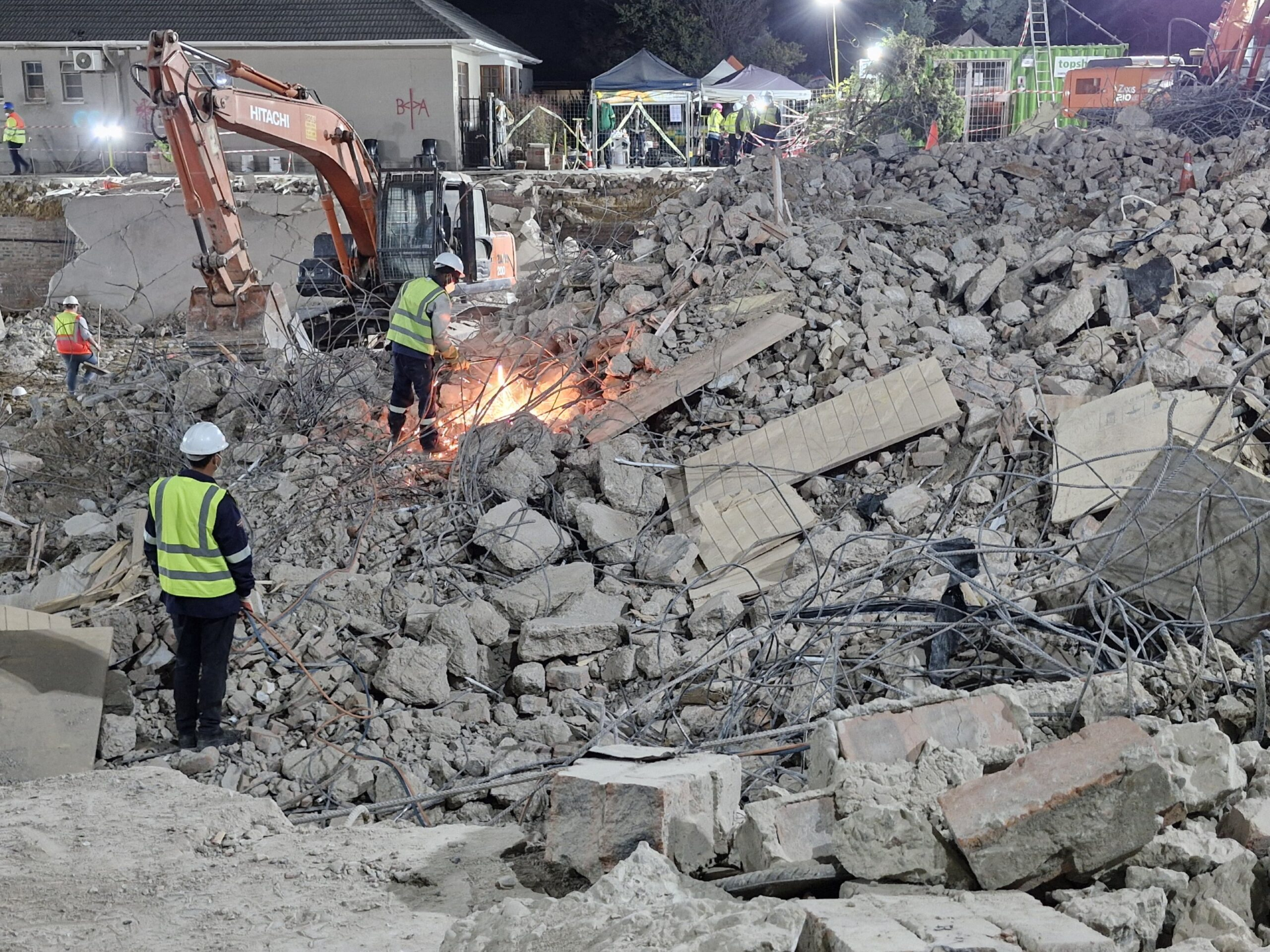
- Saving lives and securing the site become the immediate priority after a collapse, while legal reporting duties begin almost immediately.
- Multiple investigations may follow, including occupational safety probes, professional disciplinary processes and possible civil claims.
- Preserving evidence early is critical because site records, drawings and material samples may determine liability and shape future litigation.
The recent and deeply tragic building collapses in George, Verulam, and, most recently, Ormonde have brought renewed attention to a difficult question: what actually happens after a structure collapses on a construction site?
Beyond the immediate human tragedy and the urgent search-and-rescue efforts, a complex legal and regulatory process is set in motion. Multiple authorities become involved, investigations begin almost immediately, and the owner, developer, contractor and professional team must navigate overlapping obligations while responding to public scrutiny and potential litigation.
There is often confusion about who has authority over the site, which investigations take priority, and what legal responsibilities arise in the critical hours and days following a collapse.
Drawing on experience advising on construction collapse investigations, this article outlines the key procedures typically followed in South Africa when a structural failure results in injury, loss of life, or property damage.
Construction sites are inherently dangerous places. As a result, the Occupational Health and Safety Act, 1993, together with the National Building Regulations and Building Standards Act, 1977, were promulgated in an attempt by the government to safeguard contractors and third parties on site, as well as the general public.
These statutes, read together with the Housing Consumer Protection Measures Act, 1998, largely dictate the regulatory framework in terms of which construction takes place in South Africa.
Accordingly, immediately before the collapse, the owner of the property and the developer (if they are separate entities), together with the building contractor on site, bear primary legal responsibility and liability under these Acts. It follows that immediately upon the structure collapsing, responsibility attaches to them to respond in accordance with the site-specific health and safety plans they have in place.
The immediate response must therefore come from the property owner, the developer, and the main contractor on site. Shortly thereafter, the first responders will arrive on site in response to various emergency calls. More often than not, this will be the South African Police Services.
The South African Police Services will establish a chain of command on-site and dictate how the site is managed. In terms of Regulation 8 of the General Administrative Regulations, 2003, promulgated under the Occupational Health and Safety Act, 1993, the relevant parties must, within seven days of the incident, notify the Provincial Director of the Department of Employment and Labour using the prescribed forms.
At this stage, the site is effectively under the control of the South African Police Services as search and rescue teams attempt to locate individuals trapped beneath the rubble and save their lives.
Those involved must work with the South African Police Services and the Department of Labour in the best interests of the individuals who have sadly been injured or trapped beneath the debris.
Sadly, after some time, rescue efforts may transition into search-and-recovery operations. At this point, the South African Police Services will generally hand control of the investigation to the Department of Labour so that it may commence a Section 31 investigation in terms of the Occupational Health and Safety Act, 1993.
Regulatory investigations and professional scrutiny
The purpose of a Section 31 investigation is to determine the cause of the incident and to investigate whether the owner of the property, the developer and the contractor complied with their regulatory obligations. The Department of Labour will appoint a senior inspector to investigate what occurred on site.
Importantly, the Section 31 investigation can commence while search and rescue efforts are still ongoing. The inspector appointed by the Department of Labour will contact the property owner, the developer, and the main contractor and arrange urgent meetings with them. This is a critical stage in the investigation process.
It is a particularly difficult time for the parties involved, as they are often simultaneously assisting emergency responders while responding to regulatory investigations. The Section 31 investigation can be invasive and is usually conducted at short notice.
The inspector may request documents and take statements from various witnesses on site. At this stage, the inspector’s focus will be on occupational health and safety compliance and broader regulatory compliance in relation to the construction project.
The outcome of the Section 31 investigation will be a written report, together with witness statements, documents and other evidence gathered by the inspector. These will be delivered to the Department of Labour for a decision on whether to hold a formal Section 32 inquiry or refer the matter to an inquest under the Inquests Act, 1959.
While the Section 31 investigation is underway, various professional bodies may also become involved, particularly where registered professionals such as engineers, quantity surveyors, architects or project managers participated in the project.
Each professional body, such as the Engineering Council of South Africa, has professional conduct rules and may initiate its own investigation or disciplinary inquiry into the conduct of its members.
More recently, the Council for the Built Environment has also become involved in investigations relating to construction collapses. The Council is a public entity established under the Council for the Built Environment Act, 2000, and reports to the National Department of Public Works and Infrastructure.
Its mandate includes promoting professional conduct within the built environment professions, advancing transformation in the sector, protecting the public interest, and advising government on built environment matters. There remains some debate about the Council's precise jurisdiction over collapse investigations and whether parties on site are legally obliged to respond to its requests for information.
Preserving evidence and managing legal risk
From the outset, the priority must be the health and safety of all individuals on site and assisting with emergency services, working to recover those who have sadly died or been injured.
At the same time, it is essential to preserve evidence. This includes collating documentation, contracts and construction drawings and, where possible, preserving material samples from the collapsed structure. Striking this balance can be extremely difficult.
It is therefore critically important to appoint a senior assessor and a team of experts as soon as possible. Preserving evidence is key in a construction collapse investigation. Experts should attend the site as soon as possible to photograph, video and record what is taking place. If possible, a full scan of the site should also be conducted.
The updated drawing register and all construction drawings issued for the project should be preserved, together with the various statutory appointments made under the Occupational Health and Safety Act and the Construction Regulations.
All occupational health and safety files, risk assessments, toolbox talks and site induction records should also be gathered and preserved. This information will become highly relevant during the Department of Labour's Section 31 investigation.
At the same time, media interest in the incident will inevitably grow, and it is advisable for an experienced individual to manage communications with the press.
To gain access to the site for investigative purposes, it is usually necessary to engage with the Department of Labour and develop a protocol, risk assessment, and safety plan governing how the collapsed structure will be accessed, how evidence will be preserved, and how the structure will ultimately be cleared.
Engineers will play an important role at this stage, assisting in determining the proximate cause of the collapse. In incidents where lives are lost, or individuals are injured, the owner of the property, the developer and the main contractor will often find themselves participating in a Section 32 inquiry, a public inquiry aimed at determining the proximate cause of the collapse.
They may also face civil claims arising from property damage, personal injury, and loss of support, brought by affected parties. It is therefore advisable to brief legal representatives at an early stage to address potential third-party claims and to maintain a proper register of those claims as they arise.
It is equally important to notify the relevant insurance broker and insurers as soon as possible. Professionals involved in the project may also be required to respond to investigations conducted by their professional regulatory bodies, which may involve presenting evidence and compiling a detailed documentary record.
In these circumstances, such professionals must receive appropriate legal advice regarding the various regulatory and legal risks they may face. In summary, the most important steps following a construction collapse are preserving evidence and protecting legal privilege in communications and investigations.
Expert appointments should be made through legal representatives wherever possible. Construction collapse investigations are multi-layered, complex and highly technical. They require a coordinated team of legal advisers, engineers and specialist assessors to work quickly to assist the parties involved while ensuring that the relevant evidence is properly preserved and analysed.
Get your news on the go. Click here to follow the Conviction WhatsApp channel.
