


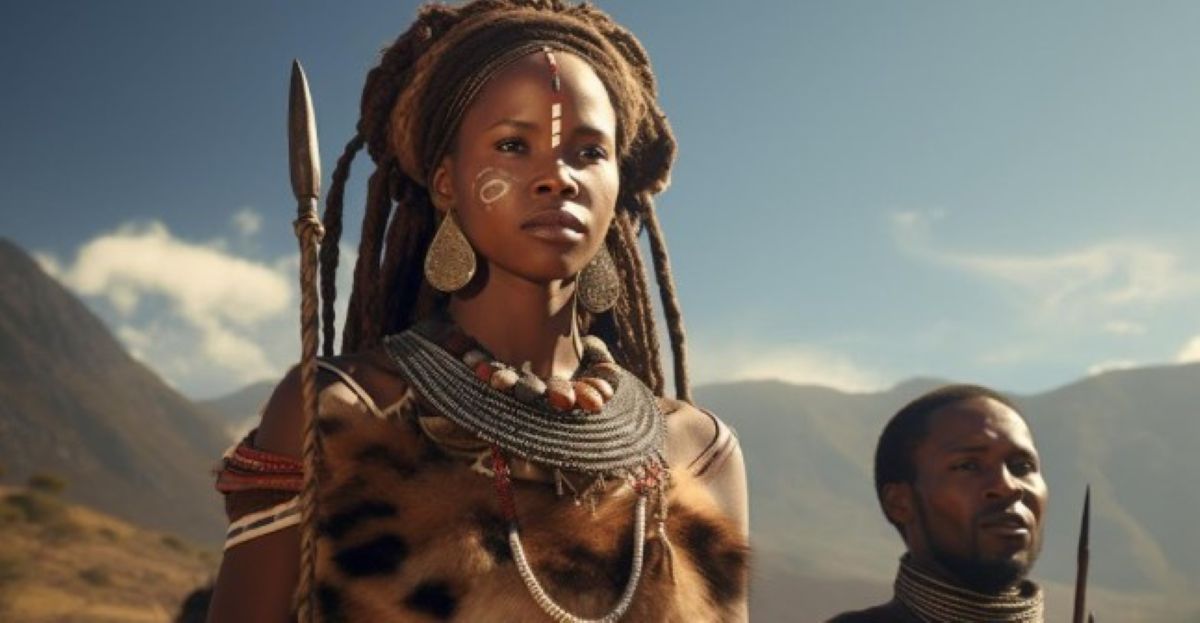
- Queen Manthatisi of the Batlokwa led her people through one of southern Africa’s most turbulent eras, commanding armies and shaping alliances.
- Her story highlights a longstanding tradition of female leadership in Africa, predating modern governments and corporations.
- Recognising her legacy is essential for a fuller understanding of Africa’s history and the enduring power of women in society.
As we round off Women’s Month celebrations, let us not forget that female leadership is not a recent phenomenon or an innovation of the modern democratic era. We should not limit our celebrations to only current and recent female leaders.
African herstory tells the story of a continent that has been led by matriarchs, sometimes from behind the scenes, with a few others at the forefront. This is not because men rule the world through their strength, money, and power, nor because women rule men through some weakness common to all men.
Long before corporate boardrooms, national and provincial parliaments, and ministerial portfolios existed, African societies were led, defended, and transformed by women. These include figures such as the Queen of Sheba in the Biblical era, Queen Nandi (c. 1760–1827), Queen Nonesi (mid-1800s), and, of course, the Amazon, Queen Manthatisi, Queen of the Wild Cat people.
The rise of Queen Manthatisi
Queen Manthatisi (c. 1784–1847) of the Batlokwa governed as regent between 1813 and 1824, during one of the most turbulent periods in southern African history. She is described by oral historians and herstorians as a beautiful, light-skinned woman from the Basia tribe, and the daughter of Chief Mothaba.
Her name was Monyalue, and she was a maternal cousin to Mokotjo, her husband. She became known as Queen Manthatisi to celebrate the birth of her daughter, Nthatisi, and to honour her status as a mother.
The leadership of Queen Manthatisi is best reflected in the Northern Sotho paremiology that says, “Mmago ngwana o tshwara thipa ka bogaleng,” which loosely translates to “a mother holds the knife by the sharp blade.” The proverb means that a mother will endure great pain, extreme hardship, and make ultimate sacrifices to protect and provide for her children.
Leadership amid turmoil
Queen Manthatisi held the “knife by the sharp blade” during the difficult times of the scattering in the history and herstory of southern Africa. Following the death of her husband, Chief Mokotjo (1785–1813), she assumed leadership as regent for her eldest son, Sekonyela, the crown prince who was not yet of age to succeed his father, Mokotjo.
In a political environment where public affairs were largely regarded as the domain of men, Queen Manthatisi consolidated power through extraordinary political acumen, military leadership, and force of character amid much opposition.
She first protected her son by taking him to the circumcision rites among her own people, the Basia. In 1824, when she felt that Sekonyela had reached maturity, Queen Manthatisi retired, and her son took over as the sole ruler of the Batlokwa social structures and the military.
Challenging patriarchy and shaping history
A beauty with brains, this larger-than-life woman was known to be a strategist and skilled with a battle-axe. She commanded over 14,000 troops and fought various battles, achieving significant victories and suffering occasional losses. Historians and herstorians describe Queen Manthatisi as a courageous and capable leader who successfully protected and guided her people during the upheavals of the Lifaqane period. During council meetings, she would sit on the largest stone circle to face those who opposed her decisions. As a strategist, she led her people to many victories, which her commanders were able to implement.
Yet her story and those of other Valkyries are often relegated to footnotes in our national consciousness and commemorations. Only stories of contemporary women leaders are celebrated as exceptional anomalies breaking through historically and herstorically male spaces.
This framing may inadvertently reproduce the colonial misconception that African societies were exclusively patriarchal and that women occupied only marginal political roles. Historical and herstorical evidence suggests otherwise.
Queen Manthatisi was not merely a symbolic figurehead; she commanded armies, negotiated alliances, and exercised sovereign authority over her people. Her leadership challenged social conventions and demonstrated that women could occupy positions of power and command respect in precolonial Africa.
The enduring legacy of Queen Manthatisi
Her legacy is an epitome of what scholar and historian Tlhabaki Modise defines as “queenly power.” According to Modise, women from the royal councils were often in the inner circle, privy to the world of men. Since she was of royal blood, it could possibly mean that Queen Manthatisi enjoyed the privileges that shaped her political beginning, mental aptitude, and military prowess.
If there were recordings of her own life delivered through her personhood, she would claim to have sat in on her father’s councils when she was a child. The queendom was the shrine of the people’s soul. To remove and separate queenly power and authority from kingship is to rupture the people’s soul, to break the link between the not-yet-born and the living in the memory of the ancestors, and to cut off the kingdom’s instrument of life support.
This herstory matters because representation without herstorical memory can become superficial. Celebrating contemporary women leaders is necessary, but it should not come at the expense of forgetting the women who laid the foundations upon which present achievements stand. Queen Manthatisi reminds us that women have long occupied positions of political authority in Africa.
She should therefore not be remembered simply as a warrior queen of the Batlokwa. Along with other women leaders, she should be recognised as part of a much longer African tradition of female leadership, a tradition that predates modern governments and corporations.
When we celebrate women leaders today, we do not celebrate the beginning of a story; we celebrate the continuation of one.
Get your news on the go. Click here to follow the Conviction WhatsApp channel.
The opinions expressed in this article are solely those of the author and do not necessarily reflect the views of Conviction.co.za
