



- Consumers can cancel eligible fixed-term contracts with 20 business days’ notice, even if arrears remain unpaid.
- Stopping a debit order does not cancel the service agreement or erase the outstanding debt.
- Consumers generally have 60 calendar days to dispute unauthorised or incorrect debit order payments through their bank.
The reader had agreed to pay R300 a month towards the arrears on his vehicle tracking subscription. Without an income, he could not sustain that either. He says the provider kept submitting debit orders against an account with no money in it, and that each failed attempt added another charge. When he asked to cancel the service itself, he says he was told to settle the arrears and pay three months in advance first.
He was trying to stop a cost he could no longer carry, and was told he could only leave once he paid money he did not have. I usually see accounts like this from the other side. At Vezi de Beer Inc., we act for creditors in debt recovery, and from there the picture is clear: a collection that fails every month recovers nothing for the creditor and costs the consumer more each time.
I would want to see the contract, the debit order authority, and the statement before assessing these demands. The starting point, however, is that owing money, continuing a service, and allowing access to your bank account are three separate questions. A debit order that fails every month collects nothing. It only makes the debt bigger.
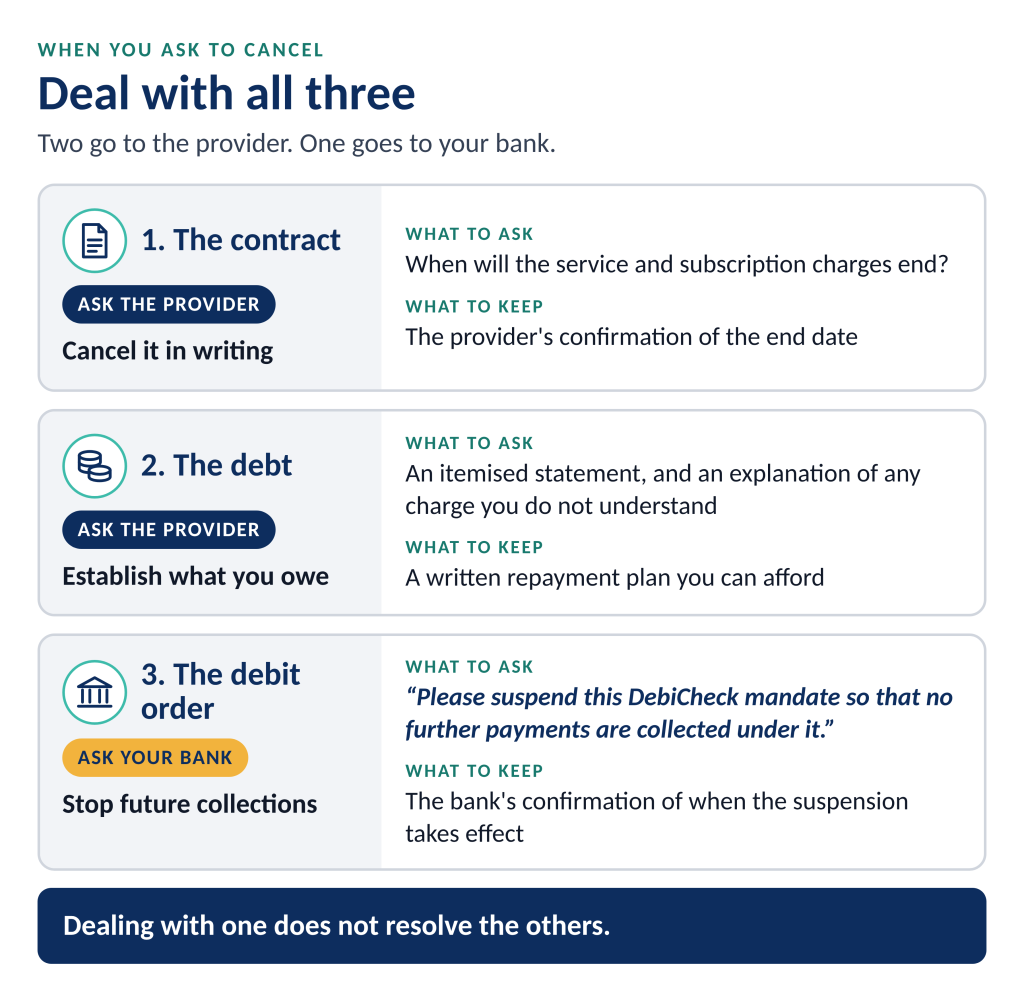
1. One account, three separate decisions
When you ask to “cancel,” be clear about what you want to stop.
The contract is your agreement for the service.
In this reader’s case, it is the vehicle tracking subscription. It sets out what the company provides, what he must pay, and how the agreement can end.
If you can no longer afford the service, ask to cancel the contract. Simply leaving your bank account empty does not end it. Monthly subscription charges may continue while the agreement remains in force.
The debt is the money you already owe.
Ending the subscription does not wipe out amounts you lawfully owe. Those still need to be paid, whether in full or through an agreed repayment arrangement. Paying the arrears does not, by itself, end the subscription.
For this reader, the R300 arrangement concerns repayment. I would need to see its terms to establish what it covers and what happens if he misses a payment.
The debit order is permission to collect from your bank account.
It is the payment method. It is not the subscription or the debt. If you approved the debit order electronically through your bank, it may be a DebiCheck debit order. Contact your bank’s help centre or visit a branch and ask what steps are available to stop or suspend future collections under the mandate.
Thereafter, you can ask the bank, “Please suspend this DebiCheck mandate so that no further payments are collected under it.” A mandate is the permission you gave to collect payment.
Stopping or suspending a debit order does not, by itself, cancel the service agreement or extinguish the debt. You must deal separately with cancellation of the agreement with the provider. Identify the provider and the debit order reference on your statement. Ask the bank to confirm, in writing, when the suspension takes effect, and keep that confirmation. This stops future collections under that mandate, and nothing more.
2. Must you settle the arrears before you can cancel?
Being behind on payments does not, by itself, mean you must keep a subscription running. For a fixed-term service contract covered by Section 14 of the Consumer Protection Act, you can cancel early by giving the provider 20 business days’ notice (roughly four weeks, excluding weekends and public holidays) in writing or another recorded form. You do not have to wait until you can afford to settle the arrears before giving that notice.
These rules apply to fixed-term agreements covered by Section 14. They do not apply to agreements between two companies or other juristic persons, and some contracts fall outside the Act. You will still owe amounts lawfully due up to the cancellation date. The provider may also charge a reasonable cancellation penalty. The outstanding debt, however, can be dealt with after the contract ends.
Bear in mind that the supplier may not impose a charge that effectively removes the consumer’s right to cancel. Ask for an itemised breakdown and an explanation of how the penalty has been calculated. For this reader, that distinction matters. If he waits until he can pay everything before cancelling, further subscription charges may accumulate while he tries to catch up.
What about the demand for three months’ payment?
Ask the provider to explain what that amount covers. Is it unpaid subscription fees, a cancellation penalty, or payment for another three months of service? Those are different charges. The provider should identify each one and explain how it calculated the amount.
A cancellation penalty is not automatically reasonable because it appears in the contract. The regulations require consideration of factors such as the length of the agreement, the notice given, and goods supplied or returned. The charge cannot be so high that it effectively takes away your right to cancel.
Your next stop
Send written cancellation notice and keep proof of delivery. Ask for the cancellation date, an itemised closing balance, and the calculation of any cancellation penalty. If the provider says you must settle everything first, ask it to explain the legal basis for refusing your notice.
3. When failed payments make the problem bigger
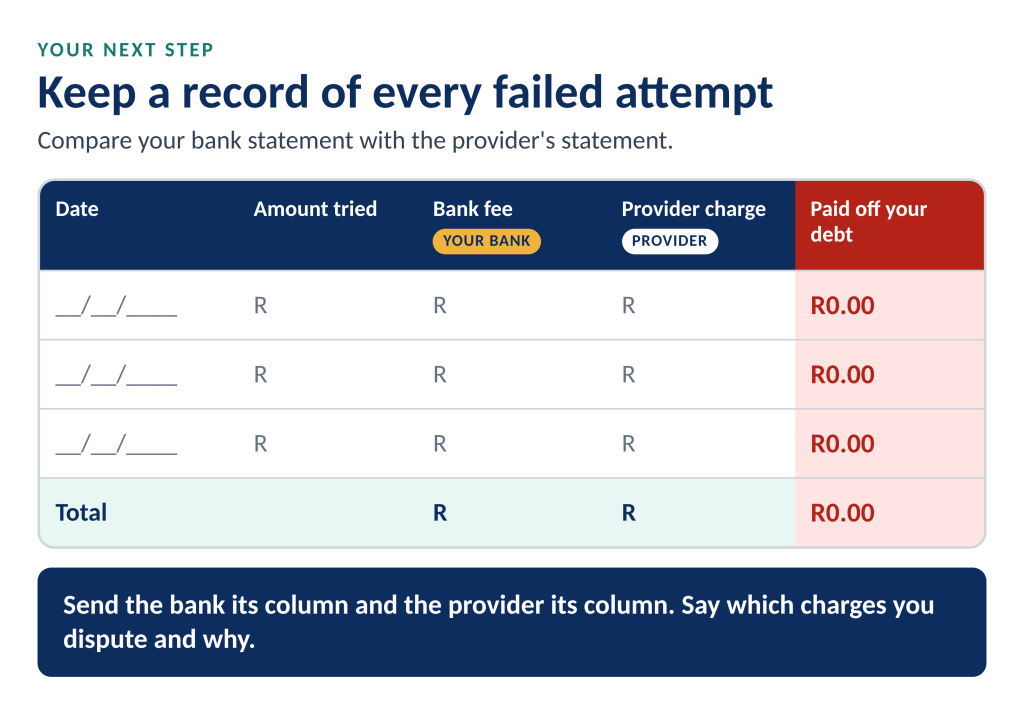
An unsuccessful debit collects nothing towards your debt. It may still leave you with a fee from your bank and another charge from the provider. Before challenging those charges, establish who charged what.
The bank’s fee
A fee for an unsuccessful debit usually arises under your agreement with the bank. It is separate from the subscription debt. Check your bank statement against the bank’s fee schedule. If a debit was attempted after the bank confirmed that it had stopped or suspended future collections, ask the bank to investigate and review the resulting fee.
Keep the confirmation and identify each affected transaction. You can also ask the bank to consider waiving failed-payment fees because of your financial circumstances. That is a request for relief, rather than an automatic entitlement.
The provider’s charge
Ask the provider to identify the contract term that allows each failed-payment charge, explain how it calculated the amount, and list every occasion on which it charged you. A charge does not become unquestionable simply because it appears on a statement or in a contract. Where the Consumer Protection Act applies, unfair or unreasonable terms can be challenged.
A court can also reduce a contractual penalty that is out of proportion to the harm the creditor suffered. Neither means that every failed-payment charge is unlawful. It means the provider must have a defensible basis for claiming it.
If your contract charges interest or a fee when you pay late, some of the National Credit Act’s rules on “incidental credit” may also apply, including limits on the interest that may be charged. Only certain protections apply, so take advice rather than assuming the whole subscription has become a credit agreement.
What if the provider knows there is no money?
Telling the provider that you cannot pay does not, by itself, withdraw its authority to debit your account. That is what the instruction to your bank in section 1 is for. It does, however, give you a reason to request a different collection arrangement.
Write to the provider. Explain that repeated attempts are generating charges without reducing the debt. Ask it to stop those attempts, review the charges already added, and agree on a payment method and date you can realistically manage.
From where I sit, on the creditor’s side, the practical question is whether the arrangement will produce payment. Adding charges to an amount someone already cannot afford makes repayment less likely, not more.
Your next step
Compare your bank statement with the provider’s statement. List the failed attempts and the charges each generated. Use that record to request a review from each party. Be specific about which charges you dispute and why.
4. Make sure the payment arrangement solves the problem
The reader agreed to pay R300 a month but could not keep up. Before proposing another arrangement, he needs to establish what the first one actually changed.
What does the monthly amount cover?
Is the R300 a payment towards arrears, with the normal subscription still payable separately? Or is it the total monthly payment the provider agreed to accept?
That difference matters. You may believe you have negotiated a smaller payment while the provider expects both amounts.
Get this in writing
- The outstanding balance covered by the arrangement.
- The amount and date of each payment.
- Whether subscription fees, interest, or other charges will continue.
- How payments will be collected.
- What happens if you miss a payment.
Does the debit order match the arrangement?
Do not assume that agreeing to a smaller payment automatically changes an existing debit order. Ask the provider to confirm whether it will amend the collection amount, replace the debit order, or accept payment another way. If you receive a new DebiCheck approval request, check the amount, collection date, and other terms before approving it. They should reflect what you agreed.
Can you sustain the payment?
Work out what you can afford after essential living expenses. Tell the provider if your income is uncertain. Ask what happens if you cannot pay on the agreed date, including whether the provider can demand the full outstanding balance.
An amount you agree to under pressure may secure a reprieve but leave you facing the same problem next month. From the creditor’s side, a smaller arrangement that holds is worth more than a larger one that fails. If several debts are under pressure at the same time, a registered debt counsellor can assess your overall position and explain the options available to you.
Your next stop
Get the full proposal in writing before accepting it. Check that you understand what you must pay, what will still be added, and what happens if the arrangement fails.
5. If money has already left your account, act promptly
Stopping future debit orders and disputing a payment already collected are two different requests.
If you believe a debit was unauthorised or incorrect, identify the transaction and explain why you dispute it. Common reasons include:
- You never gave permission.
- The amount differs from what you agreed.
- Collection continued after a confirmed suspension.
You now have 60 calendar days to lodge a dispute through your bank. Since 13 April 2026, the standard debit order dispute window has shortened from 365 days to 60 calendar days. Count from the day after the payment was successfully collected. This concerns money actually taken from your account, rather than an unsuccessful attempt.
The period runs from the day after the successful collection, up to and including day 60. If you believe a debit was unauthorised or incorrect, contact your bank promptly and follow its dispute process. If the dispute remains unresolved, you can approach the Banking Ombudsman for consideration and determination of your dispute.
Example
A debit collected on 1 November must be disputed by 31 December. The clock starts when the money leaves your account, not when you notice it.
Query the payment with the provider promptly. If it remains unresolved, lodge the dispute with your bank before the deadline. Keep the transaction details, correspondence, and reference number. Do not let a prolonged exchange with the provider use up your dispute window.
DebiCheck does not guarantee a reversal. With DebiCheck, your bank checks collections against the payment details you approved. You can query a collection you believe is incorrect, but a refund is not automatic. Being unable to afford a payment does not, by itself, make it unauthorised.
If more than 60 days have passed, still contact your bank and ask what process is available. Missing the standard window does not mean you should abandon the query.
Your next step
Check your bank statement every month. For each disputed payment, record the provider, date, amount, and reason for the dispute. Ask the bank to address the payment already taken and future collections separately.
You can owe money and still question how it is collected
Being in arrears does not mean you must accept every charge without explanation. You can acknowledge what you lawfully owe while questioning a fee, giving notice to end a service, or asking your bank to stop future collections.
Start with the three written requests set out in the illustration above: cancellation notice to the provider, a request for an itemised balance and affordable repayment terms, and an instruction to your bank about future debits.
Keep the replies. Check that the cancellation took effect, that collections stopped, and that the balance reflects what was agreed. If something remains unresolved, use that record to make a formal complaint:
Where to take a complaint
- Banking complaints: once the bank’s own process is exhausted, the National Financial Ombud Scheme.
- Service disputes: the Consumer Goods and Services Ombud, where it has jurisdiction.
- Credit law concerns: the National Credit Regulator.
Effective debt recovery should reduce the outstanding balance, not unnecessarily increase the cost of repayment. Your debit order is not your debt. Understanding this distinction helps you address the payment method, the agreement, and the outstanding balance separately.
About Vezi de Beer Inc.
Vezi de Beer Inc. is a vanguard South African law firm with deep experience in debt recovery. It acts for major banks, corporates, and state-owned entities, managing high volumes of recovery matters from first contact through its dedicated Contact Centre to resolution in court. Its practice also spans dispute resolution, insolvency and business rescue, conveyancing, and deceased estates, and its practitioners serve on the Master’s panels as liquidators, trustees, and curators.
Get your news on the go. Click here to follow the Conviction WhatsApp channel.
This article provides general legal information and does not constitute financial or legal advice. Readers should obtain advice specific to their circumstances. If you need to consult or have a question on these matters, email expert@conviction.co.za
