


- Court finds that moving a stuttering employee away from public interaction amounted to unfair discrimination.
- CCMA commissioner’s award is reviewed and replaced after failing to properly assess the evidence.
- Employee awarded four months’ salary as compensation under the Employment Equity Act.
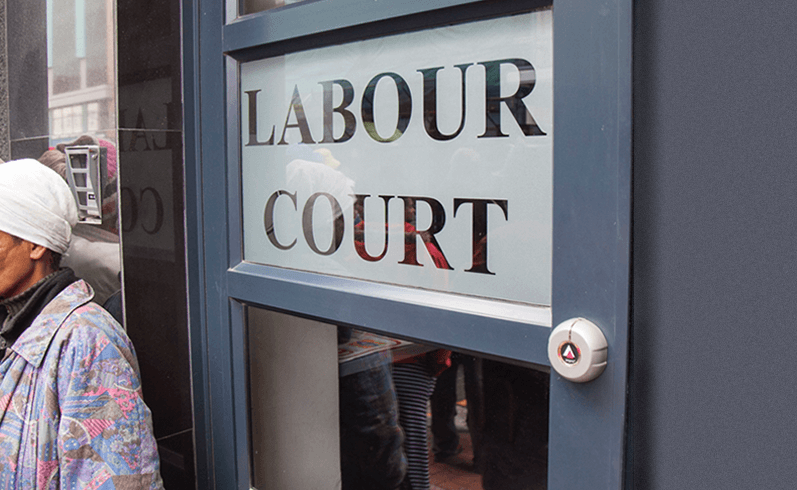
The Labour Court in Johannesburg has set aside a CCMA arbitration award after finding that a security company unfairly discriminated against one of its employees because of his speech disability.
Acting Judge HA van der Merwe ruled that Justice Mmakau, a security guard who stutters, had been unlawfully moved from a public facing position because of his condition, and was entitled to compensation for the infringement of his constitutional and statutory rights.
The case arose from an unfair discrimination dispute referred to the Commission for Conciliation, Mediation and Arbitration in terms of the Employment Equity Act. Mmakau alleged that his employer, Mantis Security, removed him from a post where he interacted with members of the public after becoming aware that he stutters. The employer denied that the move was linked to disability and claimed it was based on operational reasons.
The central question before the court was not whether disability discrimination would be unlawful, which the employer conceded, but whether the relocation was in fact motivated by Mmakau’s speech impairment.
Commissioner’s approach found wanting
In reviewing the arbitration award, Judge Van der Merwe found that the commissioner failed to properly evaluate the evidence and reached an unreasonable conclusion.
The court noted that the employer had accepted a crucial legal principle. “The employer conceded that if it could be shown that the decision to move the employee from where he interacted with the public to another location was motivated by the employee’s disability, a case for unfair discrimination would be made out,” the judge recorded.
Despite this concession, the commissioner dismissed the claim on the basis that the employee had not proved the link between the move and his disability. Judge van der Merwe found this conclusion unsustainable on the record.
“A proper case is made out for the review of the award rendered by the commissioner,” the court held, before setting aside the CCMA outcome in its entirety.
In doing so, the court substituted the award with a finding in favour of the employee, confirming that the employer’s conduct amounted to unfair discrimination under the Employment Equity Act.
Compensation and dignity in the workplace
The judgment then turned to the appropriate remedy. At the time of the dispute, Mmakau earned a monthly salary of R6 160. The court emphasised that compensation under Section 50 of the Employment Equity Act must be “just and equitable” and must reflect the seriousness of the infringement.
Judge van der Merwe reminded the court that “the employee is entitled to just and equitable compensation for the infringement of his right not be unfairly discriminated against.”
Relying on precedent, including Smith v Kit Kat Group (Pty) Ltd, where a disabled employee was awarded substantial damages after being excluded from work, the court considered the impact of discrimination on dignity and workplace inclusion. Unlike in that case, Mmakau had retained his job, and accordingly sought only compensation rather than damages.
“In all the circumstances, compensation equal to four months’ remuneration is appropriate,” the judge ruled.
The final order substituted the CCMA award with a directive that the employee be paid R24 640, representing four months of his salary, with no order as to costs.
Get your news on the go. Click here to follow the Conviction WhatsApp channel.
